
Continuity and Differentiability
Get insights from 335 questions on Continuity and Differentiability, answered by students, alumni, and experts. You may also ask and answer any question you like about Continuity and Differentiability
- 335
Questions
- 0
Discussions
- 0
Active Users
- 0
Followers
Have a question about Continuity and Differentiability? Ask our experts
Keep it short & simple. Type complete word. Avoid abusive language.
Let f(x) be a differentiable function defined on [0, 2] such that f’(x) = f’(2 – x) for all <!-- [if gte mso 9]><xml>
Let f(x) be a differentiable function defined on [0, 2] such that f’(x) = f’(2 – x) for all <!-- [if gte mso 9]><xml>
.(A)
Put .(i)
Using properties
.(ii)
Adding (i) and (ii) we get
f(2) – f(0) = e2 – 1
From (A) l = 2e2 – e2 + 1 = e2 + 1
 Upvote

The number of points, at which the function f(x) = <!-- [if gte mso 9]><xml>
The number of points, at which the function f(x) = <!-- [if gte mso 9]><xml>
Critical point of function are x =
Upvote Let be a twice differentiable function such that , for all . If , then the value of is
Let be a twice differentiable function such that , for all . If , then the value of is
Let A be a matrix of order and . If then is equal to
<!-- [if !supportLineBreakNewLine]-->
<!--[endif]-->
Let A be a matrix of order and . If then is equal to
<!-- [if !supportLineBreakNewLine]-->
<!--[endif]-->
: adj adj(2A))|
adj(2A)|
intersect the line at the point
Upvote We can convert 50! In terms of prime factor: & using the greatest integer function.
n
The maximum value of n is 22.
Upvote Let f : R -> be a function defined as f(x) = <!-- [if gte mso 9]><xml>
Let g : R -> R be given by g(x) = f(x + 2) – f(x - 2). If n and m denote the number of points in R where g is the continuous and not differentiable, respectively, then n + m is equal to…………….
Let f : R -> be a function defined as f(x) = <!-- [if gte mso 9]><xml>
Let g : R -> R be given by g(x) = f(x + 2) – f(x - 2). If n and m denote the number of points in R where g is the continuous and not differentiable, respectively, then n + m is equal to…………….
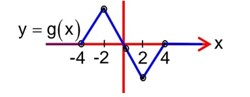
g(x) is continuous every where but not differentiable
at x = -4, -2, 2 and 4
Upvote Let a function g: <!-- [if gte mso 9]><xml>
Let a function g: <!-- [if gte mso 9]><xml>
f (t) = t3 – 6t2 + 9t + 3
Hence g (x) is not differentiable at only x = 3.
Upvote If the real part of the complex number (1 - cosθ + 2i sinθ)-1 is <!-- [if gte mso 9]><xml>
If the real part of the complex number (1 - cosθ + 2i sinθ)-1 is <!-- [if gte mso 9]><xml>
Kindly consider the following figure
Upvote If the function f(x) =
is continuous at x = 0, then <!-- [if gte mso 9]><xml>
If the function f(x) =
is continuous at x = 0, then <!-- [if gte mso 9]><xml>
The function f(x) = <!-- [if gte mso 9]><xml>
The function f(x) = <!-- [if gte mso 9]><xml>
Number of non differential points is 2 at x = -1, 3.
Upvote