Continuity and Differentiability

Get insights from 335 questions on Continuity and Differentiability, answered by students, alumni, and experts. You may also ask and answer any question you like about Continuity and Differentiability

  • 335

    Questions

  • 0

    Discussions

  • 0

    Active Users

  • 0

    Followers

Have a question about Continuity and Differentiability? Ask our experts

Ask Your Question

Keep it short & simple. Type complete word. Avoid abusive language.

New answer posted•a year ago
A
a year ago

This is an Objective Answer Type Questions as classified in NCERT Exemplar

Sol:

G i v e n     t h a t     f ( x ) = | s i n x | L e t     g ( x ) = | s i n x |         a n d         t ( x ) = | x | ∴     f ( x ) = t o g ( x ) = t [ g ( x ) ] = t ( s i n x ) = | s i n x | w h e r e     g ( x )     a n d     t ( x )     b o t h     a r e     c o n t i n u o u s . ∴     f ( x ) = g o t ( x )     i s     c o n t i n u o u s     b u t     t ( x )     i s     n o t     d i f f e r e n t i a b l e     a t     x = 0 . S o ,     f ( x )     i s     n o t     c o n t i n u o u s     a t     s i n x = 0 ⇒ x = n π , n ∈ Z . H e n c e ,     t h e     c o r r e c t     o p t i o n     i s     ( b )

Thumbs Up IconUpvote Thumbs Down Icon
New answer posted•a year ago
A
a year ago

This is an Objective Answer Type Questions as classified in NCERT Exemplar

Sol:
G i v e n     t h a t     f ( x ) = { m x + 1 , x ≤ π 2 s i n x + n , x > π 2     i s     c o n t i n u o u s     a t     x = π 2 R . H . L . = l i m x → π 2 + ( s i n x + n ) = l i m h → 0 [ s i n ( π 2 + h ) + n ]                                 = l i m h → 0 c o s h + n = 1 + n A l s o , L . H . L . = l i m x → π 2 − ( m x + 1 ) = l i m h → 0 [ m ( π 2 − h ) + 1 ]                                                         = m π 2 + 1 W h e n     f ( x )     i s     c o n t i n u o u s     a t     x = π 2 . ∴                                         L . H . L . = R . H . L .                                               m π 2 + 1 = 1 + n ⇒ n = m π 2 H e n c e ,     t h e     c o r r e c t     o p t i o n     i s     ( c )

...Read more

Thumbs Up IconUpvote Thumbs Down Icon
New answer posted•a year ago
A
a year ago

This is an Objective Answer Type Questions as classified in NCERT Exemplar

Sol:

G i v e n     t h a t     f ( x ) = x 2 s i n 1 x     w h e r e     x ≠ 0 . S o ,     t h e     V a l u e     o f     t h e     f u n c t i o n     f     a t     x = 0 , s o     t h a t     f ( x ) i s     c o n t i n u o u s     i s     0 . H e n c e ,     t h e     c o r r e c t     o p t i o n     i s     ( a )

Thumbs Up IconUpvote Thumbs Down Icon
New answer posted•a year ago
A
a year ago

This is an Objective Answer Type Questions as classified in NCERT Exemplar

Sol:

G i v e n     t h a t     f ( x ) = e | x | We  know  that  modulus  function  is  continuous  but  not  differentiable  in  its  domain. L e t                                       g ( x ) = | x |         a n d         t ( x ) = e | x | ∴                                                 f ( x ) = g o t ( x ) = g [ t ( x ) ] = e | x | Since  g(x)  and  t(x)  both  are  continuous  at  x=0  but  f(x)  is  not  differentiable  at  x=0. H e n c e ,     t h e     c o r r e c t     o p t i o n     i s     ( a )

Thumbs Up IconUpvote Thumbs Down Icon
New answer posted•a year ago
A
a year ago

This is an Objective Answer Type Questions as classified in NCERT Exemplar

Sol:

G i v e n     t h a t     f ( x ) = c o t x ⇒                                           f ( x ) = c o s x s i n x W e     k n o w     t h a t     s i n x = 0     i f     f ( x )     i s     d i s c o n t i n u o u s . ∴ I f     s i n x = 0 ∴                               x = n π ,     n ∈ n π . S o ,     t h e     g i v e n     f u n c t i o n     f ( x )     i s     d i s c o n t i n u o u s     o n     t h e     s e t     { x = n π ;     n ∈ Z } . H e n c e ,     t h e     c o r r e c t     o p t i o n     i s     ( a )

Thumbs Up IconUpvote Thumbs Down Icon
New answer posted•a year ago
A
a year ago

This is an Objective Answer Type Questions as classified in NCERT Exemplar

Sol:

G i v e n     t h a t     f ( x ) = | 2 x − 1 | s i n x C l e a r l y ,     f ( x )     i s     n o t     d i f f e r e n t i a b l e     a t     x = 1 2 R . H . L . = f ' ( 1 2 ) = l i m h → 0 f ( 1 2 + h ) − f ( 1 2 ) h                                                                           = l i m h → 0 | 2 ( 1 2 + h ) − 1 | s i n ( 1 2 + h ) − 0 h                                                                           = l i m h → 0 | 2 h | s i n ( 1 + 2 h 2 ) h = 2 s i n ( 1 2 ) A l s o , L . H . L . = f ' ( 1 2 ) = l i m h → 0 f ( 1 2 − h ) − f ( 1 2 ) − h                                                                           = l i m h → 0 | 2 ( 1 2 − h ) − 1 | [ − s i n ( 1 2 − h ) ] − 0 − h                                                                           = l i m h → 0 | − 2 h | [ − s i n ( 1 2 − h ) ] − h = − 2 s i n ( 1 2 ) ∴                                         L . H . L . ≠ R . H . L . S o ,     t h e     g i v e n     f u n c t i o n     f ( x )     i s     n o t     d i f f e r e n t i a b l e     a t     x = 1 2 . ∴ f ( x )     i s     d i f f e r e n t i a b l e     i n     R − { 1 2 } H e n c e ,     t h e     c o r r e c t     o p t i o n     i s     ( b )

Thumbs Up IconUpvote Thumbs Down Icon
New answer posted•a year ago
A
a year ago

This is an Objective Answer Type Questions as classified in NCERT Exemplar

Sol:

G i v e n     t h a t     f ( x ) = 4 − x 2 4 x − x 3 F o r     d i s c o n t i n u o u s     f u n c t i o n ⇒                                     4 x − x 3 = 0 ⇒                             4 ( x − x 2 ) = 0 ⇒     x ( 2 − x ) ( 2 + x ) = 0 ⇒       x = 0 , x = 2 , x = − 2 Hence,  the  given  fuction  is  discontinuous  exactly  at  three  points. H e n c e ,     t h e     c o r r e c t     o p t i o n     i s     ( c )

Thumbs Up IconUpvote Thumbs Down Icon
New answer posted•a year ago
A
a year ago

This is an Objective Answer Type Questions as classified in NCERT Exemplar

Sol:

We  know  that  the  algebraic  polynomials  are  continuous  functions  everywhere. ∴ f ( x ) + g ( x )     i s     c o n t i n u o u s                                 [ ? S u m , d i f f e r e n c e     a n d     p r o d u c t     o f     t w o     c o n t i n u o u s f u n c t i o n s     i s     a l s o     c o n t i n u o u s ]         f ( x ) − g ( x )     i s     c o n t i n u o u s               f ( x ) . g ( x )     i s     c o n t i n u o u s           g ( x ) f ( x )     i s     o n l y     c o n t i n u o u s     i f     g ( x ) ≠ 0 ∴     f ( x ) g ( x ) = 2 x x 2 2 + 1 = 4 x x 2 + 2 H e r e ,     g ( x ) f ( x ) = x 2 2 + 1 2 x = x 2 + 2 4 x     w h i c h     i s     d i s c o n t i n u o u s     a t     x = 0 . H e n c e ,     t h e     c o r r e c t     o p t i o n     i s     ( d )

Thumbs Up IconUpvote Thumbs Down Icon
New answer posted•a year ago
A
a year ago

This is a Short Answer Type Questions as classified in NCERT Exemplar

Sol:

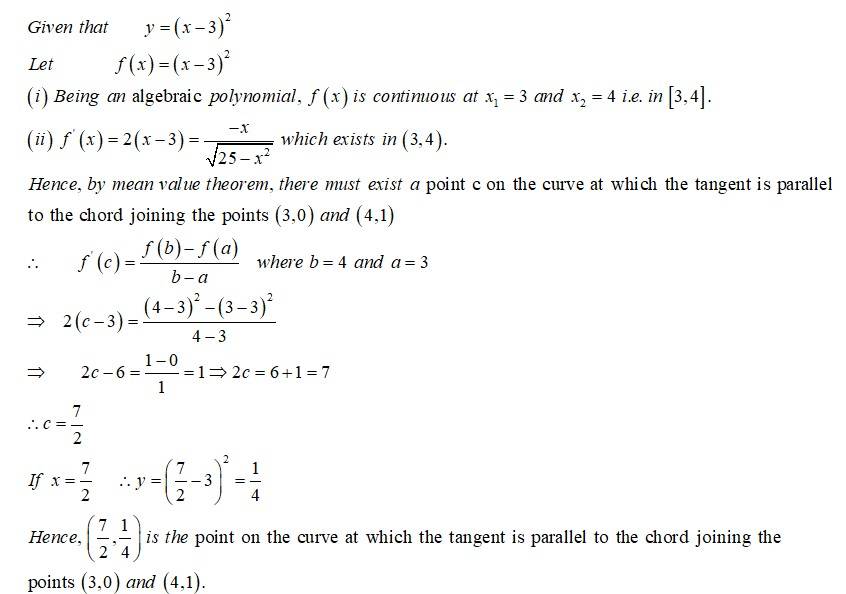
Given  that          y=2x2−5x+3Let                 f(x)=2x2−5x+3(i)  Being  an    polynomial,  f(x)  is  continuous  in  [1,2].(ii)  f'(x)=4x−5  which  exists  in  (1,2).Hence,  by  mean  value  theorem,  there  must  exist  a    ∈(1,2)                              A(1,0)  and  B(2,1)∴           f'(c)=f(b)−f(a)b−a⇒         4c−5=(8−10+3)−(2−5+3)2−1⇒          4c−5=1−01=1⇒4c=5+1=6∴                       c=64=32∴                       y=2(32)2−5(32)+3⇒                          =2×94−152+3=92−152+3⇒                          =9−15+62=0Hence,  (32,0)  is  the                                A(1,0)  and  B(2,1).

Thumbs Up IconUpvote Thumbs Down Icon
New answer posted•a year ago