
Differentiability
Get insights from 5 questions on Differentiability, answered by students, alumni, and experts. You may also ask and answer any question you like about Differentiability
- 5
Questions
- 0
Discussions
- 0
Active Users
- 0
Followers
Have a question about Differentiability? Ask our experts
Keep it short & simple. Type complete word. Avoid abusive language.
Let f, g : R ® R be two real valued function defined as f(x) = and , where k1 and k2 are real constants. If (gof) is differentiable at x = 0, then (gof)(-4) is equal to:
Let f, g : R ® R be two real valued function defined as f(x) = and , where k1 and k2 are real constants. If (gof) is differentiable at x = 0, then (gof)(-4) is equal to:
gof is differentiable at x = 0
So R.H.D = L.H.D.
⇒ 4 = 6 – k1 Þ k1 = 2
Now g (f (-4) + g (f (4)
=2 (2e4 – 1)
 Upvote

If f(x) = is differentiable everywhere and K = a + b, then value of k is
If f(x) = is differentiable everywhere and K = a + b, then value of k is
cont at x = 1, a + b = 1
diff at x = 1, 2a = 1
Upvote If the function f(x) = { ax+b, -∞<x≤2; x²-5x+6, 2<x<3; px²+qx+1, 3≤x<∞ } is differentiable is (-∞, ∞), then:
<!-- [if !supportLineBreakNewLine]-->
<!--[endif]-->
If the function f(x) = { ax+b, -∞<x≤2; x²-5x+6, 2<x<3; px²+qx+1, 3≤x<∞ } is differentiable is (-∞, ∞), then:
<!-- [if !supportLineBreakNewLine]-->
<!--[endif]-->
Differentiable ⇒ continuous
Continuous at x = 2 ⇒ 2a + b = 0
Continuous at x = 3
0 = 9p + 3q + 1
Differentiable at x=2
a = 2×2 - 5 ⇒ a = -1
Differentiable at x=3
2×3 - 5 = 2p×3 + q ⇒ 6p + q = 1
a = -1, b = 2, p = 4/9, q = -5/3
Upvote Let f: (-1, 1) → R be a differentiable function with f(0) = 1 and f'(0) = -1. If g(x) = (f(nf(x) – n))^n, where n is a natural number and g'(0) = 4, then n equals
Let f: (-1, 1) → R be a differentiable function with f(0) = 1 and f'(0) = -1. If g(x) = (f(nf(x) – n))^n, where n is a natural number and g'(0) = 4, then n equals
g (x) = (f (nf (x) – n)?
g' (x) = n (f (nf (x) – n)? ¹ . f' (nf (x) – n) . n . f' (x)
∴ g' (0) = 0
⇒ 4 = n (f (nf (0) – n)? ¹ . f' (nf (0) – n) . nf' (0)
⇒ 4 = n (f (0)? ¹ . f' (0) . nf' (0)
⇒ 4 = n . 1 . (-1) . n (-1)
n² = 4
⇒ n = 2
Upvote Related Tags
0 Followers
0 Followers
0 Followers
0 Followers
0 Followers
0 Followers
Let the functions f: R → R and g: R → R be defined as :
f(x) = {x+2, x<0; x², x≥0} and g(x) = {x³, x<1; 3x-2, x≥1}
Then, the number of points in R where (fog)(x) is NOT differentiable is equal to :
<!-- [if !supportLineBreakNewLine]-->
<!--[endif]-->
Let the functions f: R → R and g: R → R be defined as :
f(x) = {x+2, x<0; x², x≥0} and g(x) = {x³, x<1; 3x-2, x≥1}
Then, the number of points in R where (fog)(x) is NOT differentiable is equal to :
<!-- [if !supportLineBreakNewLine]-->
<!--[endif]-->
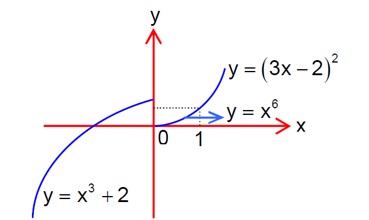
Given f (g (x) is defined piecewise:
f (g (x) =
x³ + 2 ; x < 0
x? ; 0? x < 1
(3x - 2)² ; x? 1
fog (x) is discontinuous at x = 0.? non differentiable.
fog (x) is not differentiable at x = 0.
Upvote