

DILR Prep Tips for MBA
Get insights from 473 questions on DILR Prep Tips for MBA, answered by students, alumni, and experts. You may also ask and answer any question you like about DILR Prep Tips for MBA
Follow Ask QuestionQuestions
Discussions
Active Users
Followers
New answer posted
8 months agoContributor-Level 10
In the 1st round in one group number of matches is (7 * 8/2) = 28
Let's consider bottom 3 they will have 3 matches between them, so remaining 28-3 = 25 matches have involvement of top 5 team, if they won equal number of matches, i.e. 5 each then decision will be taken based on tie breaker rule, hence a team may be eliminated even after winning 5 matches.
New answer posted
8 months agoContributor-Level 10
Number of matches in stage 1 is 2 (8C2) = 2 (7 * 8/2) = 56
Stage 2 will be a knock out tournament with 8 teams so in this stage number of matches will be 7
Total 56 + 7 = 63
New answer posted
8 months ago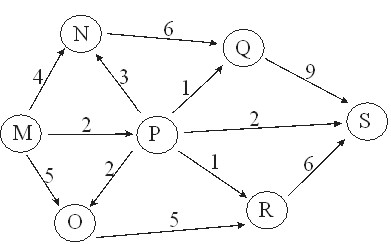
Contributor-Level 10
The maximum quantity of natural gas that can be transported that can be transported from M to Q is 6
New answer posted
8 months agoContributor-Level 10
From the figure and the conditions R can receive only 6 units (5 + 1) of natural gas if utilization is 100 Percent
New answer posted
8 months agoContributor-Level 10
From the figure the maximum quantity of natural gas that S can receive = 6 + 2 + 9 = 17 units.
New answer posted
8 months agoContributor-Level 10
| Mohit | Manohar | Prashant | Dinesh |
Round – 4 | 3200 | 3200 | 3200 | 3200 |
Round – 3 | 1600 | 1600 | 1600 | 1600 |
Round – 2 | 800 | 800 | 7200 | 4000 |
Round – 1 | 400 | 6800 | 3600 | 2000 |
Initially | 6600 | 3400 | 1800 | 1000 |
New answer posted
8 months agoContributor-Level 10
| Mohit | Manohar | Prashant | Dinesh |
Round – 4 | 3200 | 3200 | 3200 | 3200 |
Round – 3 | 1600 | 1600 | 1600 | 1600 |
Round – 2 | 800 | 800 | 7200 | 4000 |
Round – 1 | 400 | 6800 | 3600 | 2000 |
Initially | 6600 | 3400 | 1800 | 1000 |
New answer posted
8 months agoContributor-Level 10
| Mohit | Manohar | Prashant | Dinesh |
Round – 4 | 3200 | 3200 | 3200 | 3200 |
Round – 3 | 1600 | 1600 | 1600 | 1600 |
Round – 2 | 800 | 800 | 7200 | 4000 |
Round – 1 | 400 | 6800 | 3600 | 2000 |
Initially | 6600 | 3400 | 1800 | 1000 |
New answer posted
8 months agoContributor-Level 10
| Mohit | Manohar | Prashant | Dinesh |
Round – 4 | 3200 | 3200 | 3200 | 3200 |
Round – 3 | 1600 | 1600 | 1600 | 1600 |
Round – 2 | 800 | 800 | 7200 | 4000 |
Round – 1 | 400 | 6800 | 3600 | 2000 |
Initially | 6600 | 3400 | 1800 | 1000 |
New answer posted
8 months agoContributor-Level 10
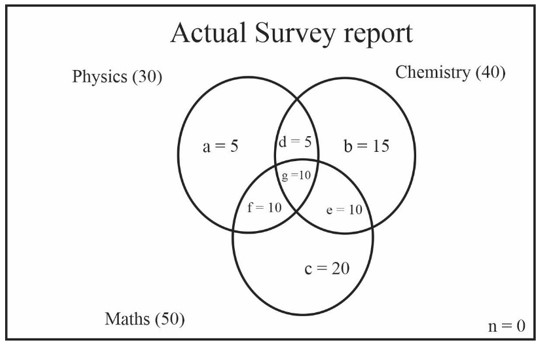
From the given condition g = 10,
Number of students who like both Physics and Maths = 10 + f
Number of students who like both chemistry and Maths = 10 + e
From given condition 10 + f = 10 + e or e = f
Similarly from 3rd condition ¾ (10 + e) = 10 + d
Or 30 + 3e = 40 + 4d
Or
d = 3e - 10/4
Since 15 students like only chemistry hence b = 15
Number of students who like only chemistry is 40
Hence e + g + d + b = 40
or e + 10 + (3e – 10)/4 + 15 = 40
or (7e – 10)/4 = 15 or 7e = 70 or e = 10
Hence a = 5, c = 20, f = e = 10, d = 5
Hence the distribution is as follows
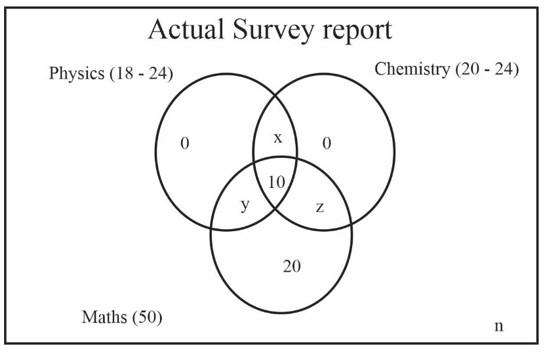
As per the observation of class teacher actual numbers of students who lik
Taking an Exam? Selecting a College?
Get authentic answers from experts, students and alumni that you won't find anywhere else
Sign Up on ShikshaOn Shiksha, get access to
- 66k Colleges
- 1.2k Exams
- 687k Reviews
- 1800k Answers