

Electric Charges and Fields
Get insights from 100 questions on Electric Charges and Fields, answered by students, alumni, and experts. You may also ask and answer any question you like about Electric Charges and Fields
Follow Ask QuestionQuestions
Discussions
Active Users
Followers

New answer posted
a year ago
Contributor-Level 10
This is a Multiple Choice Questions as classified in NCERT Exemplar
Answer- a, b, c
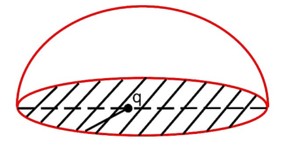
Explanation- the positive charge Q is uniformly distributed at the outer surface of the enclosed sphere thus electric field inside the sphere is zero. So the effect of electric field on charge q due to positive charge Q is zero.
Now the only attractive and repulsive force between Q and q
Case 1 q>0 this creates repulsive force
Case 2 q<0 this creates attractive force
If q is shifted from the centre then the positive charges nearer to this charge will attract it towards itself and charge q will never return to its centre.
New answer posted
a year ago
Contributor-Level 10
This is a Multiple Choice Questions as classified in NCERT Exemplar
Answer. (a), (b), (c), (d)
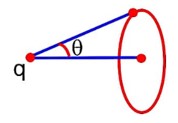
Explanation- The positive charge Q is uniformly distributed along the circular ring then electric field at the centre of ring will be zero, hence no force is experienced by the charge if it is placed at the centre of the ring.
Now the charge is displaced away from the centre in the plane of the ring. There will be net electric field opposite to displacement will push back the charge towards the centre of the ring if the charge is positive. If charge is negative, it will experience net force in the direction of displacement and the charge w
New answer posted
a year ago
Contributor-Level 10
This is a Multiple Choice Questions as classified in NCERT Exemplar
Answer – (a, c)
Explanation- Gauss's law states that the total electric flux of an enclosed surface is given by q/? 0, where q is the charge enclosed by the surface.
So total charge inside the surface is = Q-2Q = -Q
Therefore total flux through the surface of the sphere = -Q/? 0
Now, charge 5Q is lies outside the surface, thus it makes no contribution to electric flux through the given surface. So both option a and c are true.
Taking an Exam? Selecting a College?
Get authentic answers from experts, students and alumni that you won't find anywhere else
Sign Up on ShikshaOn Shiksha, get access to
- 66k Colleges
- 1.2k Exams
- 714k Reviews
- 1850k Answers