
Electric Charges and Fields
Get insights from 100 questions on Electric Charges and Fields, answered by students, alumni, and experts. You may also ask and answer any question you like about Electric Charges and Fields
- 100
Questions
- 0
Discussions
- 0
Active Users
- 0
Followers
Have a question about Electric Charges and Fields? Ask our experts
Keep it short & simple. Type complete word. Avoid abusive language.
Consider a region inside which there are various types of charges but the total charge is zero. At points outside the region,
(a) The electric field is necessarily zero
(b) The electric field is due to the dipole moment of the charge distribution only
(c) The dominant electric field is ∝ 1/r3, for large r, where r is the distance from an origin in this regions r
(d) The work done to move a charged particle along a closed path, away from the region, will be zero
This is a Multiple Choice Questions as classified in NCERT Exemplar
Answer. (c), (d)
Explanation- electric field is not necessarily zero may it become zero by their algeabric sum. For dipole the electric field is always ∝ 1/r3 and it is also conservative.
 Upvote

The electric field at a point is
(a) Always continuous
(b) Continuous if there is no charge at that point
(c) Discontinuous only if there is a negative charge at that point (d) discontinuous if there is a charge at that point
The electric field at a point is
(a) Always continuous
(b) Continuous if there is no charge at that point
(c) Discontinuous only if there is a negative charge at that point (d) discontinuous if there is a charge at that point
This is a Multiple Choice Questions as classified in NCERT Exemplar
Answer. (b), (d)
Explanation- if we place a charge then we must experience some forces but if there would be no charge so field is continuous
Upvote Multiple Choice Questions
(One or More than One Correct Answer Type)
If Фs E . dS = 0 over a surface, then
(a) The electric field inside the surface and on it is zero
(b) The electric field inside the surface is necessarily uniform
(c) The number of flux lines entering the surface must be equal tothe number of flux lines leaving it
(d) All charges must necessarily be outside the surface
Multiple Choice Questions
(One or More than One Correct Answer Type)
If Фs E . dS = 0 over a surface, then
(a) The electric field inside the surface and on it is zero
(b) The electric field inside the surface is necessarily uniform
(c) The number of flux lines entering the surface must be equal tothe number of flux lines leaving it
(d) All charges must necessarily be outside the surface
This is a Multiple Choice Questions as classified in NCERT Exemplar
Answer. (c), (d)
Explanation- It is only possible when charges must be outside the surface or field line entering or leaving the surface are equal.
Upvote A hemisphere is uniformly charged positively. The electric field at a point on a diameter away from the centre is directed .
(a) Perpendicular to the diameter
(b) Parallel to the diameter
(c) At an angle tilted towards the diameter
(d) At an angle tilted away from the diameter
A hemisphere is uniformly charged positively. The electric field at a point on a diameter away from the centre is directed .
(a) Perpendicular to the diameter
(b) Parallel to the diameter
(c) At an angle tilted towards the diameter
(d) At an angle tilted away from the diameter
This is a Multiple Choice Questions as classified in NCERT Exemplar
Answer. (a)
Explanation- field lines are always perpendicular to the surface.
Upvote A point charge +q is placed at a distance d from an isolated conducting plane. The field at a point P on the other side of the plane is
(a) Directed perpendicular to the plane and away from the plane
(b) Directed perpendicular to the plane but towards the plane
(c) Directed radially away from the point charge
(d) Directed radially towards the point charge
A point charge +q is placed at a distance d from an isolated conducting plane. The field at a point P on the other side of the plane is
(a) Directed perpendicular to the plane and away from the plane
(b) Directed perpendicular to the plane but towards the plane
(c) Directed radially away from the point charge
(d) Directed radially towards the point charge
This is a Multiple Choice Questions as classified in NCERT Exemplar
Answer. (a)
Explanation- when a point positive charge brought near an isolated conducting plane, some negative charge develops on the surface of the plane towards the charge and an equal positive charge develops on opposite side of th
Upvote Figure shows electric field lines in which an electric dipole P is placed as shown. Which of the following statements is correct?
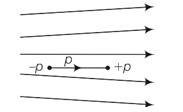
(a) The dipole will not experience any force
(b) The dipole will experience a force towards right
(c) The dipole will experience a force towards left
(d) The dipole will experience a force upwards
Figure shows electric field lines in which an electric dipole P is placed as shown. Which of the following statements is correct?

(a) The dipole will not experience any force
(b) The dipole will experience a force towards right
(c) The dipole will experience a force towards left
(d) The dipole will experience a force upwards
This is a Multiple Choice Questions as classified in NCERT Exemplar
Answer. (c)
Explanation- As the space is increasing towards right means electric field is decreasing so as force is also decreasing . so force on -p is more than the force on +p
Upvote Five charges q1, q2, q3, q4 and q5 are fixed at their positions as shown in figure, S is a Gaussian surface. The Gauss’ law is given by
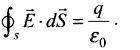
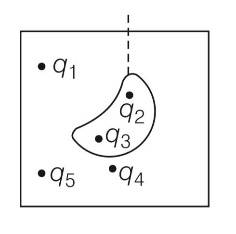
Which of the following statements is correct?
(a) E on the LHS of the above equation will have a contribution from q1 ,q5 and q1, q5 and q3 while q on the RHS will have a contribution from q1 and q4 only
(b) E on the LHS of the above equation will have a contribution from all charges while q on the RHS will have a contribution from q2 and q4 only
(c) E on the LHS of the above equation will have a contribution from all ch arges while q on the RHS will have a contribution from q1, q3 and q5 only
(d) Both E on the LHS and q on the RHS will have contributions from q2 and q4 only
Five charges q1, q2, q3, q4 and q5 are fixed at their positions as shown in figure, S is a Gaussian surface. The Gauss’ law is given by

Which of the following statements is correct?
(a) E on the LHS of the above equation will have a contribution from q1 ,q5 and q1, q5 and q3 while q on the RHS will have a contribution from q1 and q4 only
(b) E on the LHS of the above equation will have a contribution from all charges while q on the RHS will have a contribution from q2 and q4 only
(c) E on the LHS of the above equation will have a contribution from all ch arges while q on the RHS will have a contribution from q1, q3 and q5 only
(d) Both E on the LHS and q on the RHS will have contributions from q2 and q4 only
This is a Multiple Choice Questions as classified in NCERT Exemplar
Answer. (b)
Explanation-The charges may be located anywhere inside the surface, if the surface is so chosen that there are some charges inside and some outside, the electric field on the left side of equa
Upvote The electric flux through the surface
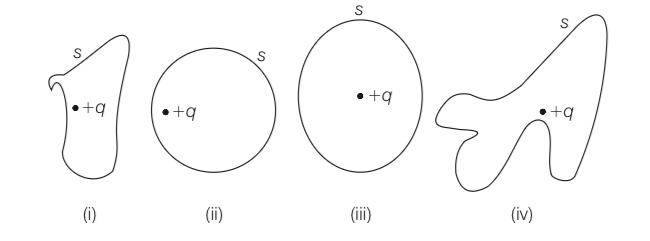
(a) In Fig. (iv) is the largest
(b) In Fig. (iii) is the least
(c) In Fig. (ii) is same as Fig. (iii) but is smaller than Fig. (iv)
(d) Is the same for all the figures
The electric flux through the surface

(a) In Fig. (iv) is the largest
(b) In Fig. (iii) is the least
(c) In Fig. (ii) is same as Fig. (iii) but is smaller than Fig. (iv)
(d) Is the same for all the figures
This is a Multiple Choice Questions as classified in NCERT Exemplar
Answer. (d)
Explanation- Total flux inside a conducting sphere is depend upon the algeabric sum of total charge inside that surface, which is same for all fig. As it does not depend upon shape of a body
Upvote A point positive charge is brought near an isolated conducting sphere. The electric field is best given by.
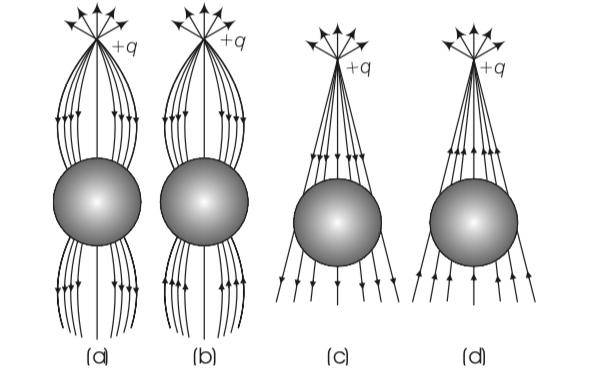
A point positive charge is brought near an isolated conducting sphere. The electric field is best given by.

This is a Multiple Choice Questions as classified in NCERT Exemplar
Answer- (a)

Explanation- when a positive point charge is brought near an isolated conducting sphere without touching the sphere, then the free electron in the sphere are attracted towards the positive charge. This leaves an excess pos
Upvote In figure two positive charges q2 and q3 fixed along the y-axis, exert a net electric force in the +x-direction on a charge q1, fixed along the x-axis. If a positive charge Q is added at (x, 0), the force on q1
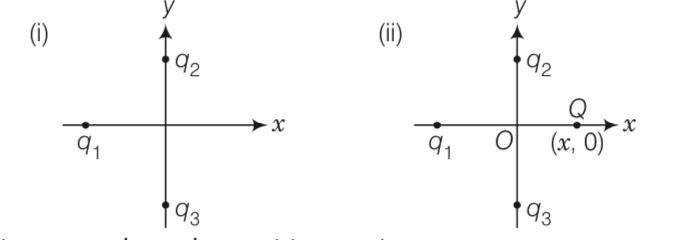
(b) Shall decrease along the positive x-axis
(c) Shall point along the negative x-axis
(d) Shall increase but the direction changes because of the intersection of Q with q2 and q3
In figure two positive charges q2 and q3 fixed along the y-axis, exert a net electric force in the +x-direction on a charge q1, fixed along the x-axis. If a positive charge Q is added at (x, 0), the force on q1

(b) Shall decrease along the positive x-axis
(c) Shall point along the negative x-axis
(d) Shall increase but the direction changes because of the intersection of Q with q2 and q3
This is a Multiple Choice Questions as classified in NCERT Exemplar
Answer. (a)
Explanation-The force between (q1, q2) and (q1, q3) is must be attractive to net forces act in positive direction of x . so q1 must be negative. But if we place a positive charge Q in positive direction of x then it
Upvote