
Electromagnetic Induction
Get insights from 123 questions on Electromagnetic Induction, answered by students, alumni, and experts. You may also ask and answer any question you like about Electromagnetic Induction
- 123
Questions
- 0
Discussions
- 0
Active Users
- 5
Followers
Have a question about Electromagnetic Induction? Ask our experts
Keep it short & simple. Type complete word. Avoid abusive language.
An inductor of inductance 0.1H and a resistor of resistance 8Ω are connected in series to a battery of emf 1.5 V through a switch. Find the initial rate of growth of current when the switch is closed (in A/s).
An inductor of inductance 0.1H and a resistor of resistance 8Ω are connected in series to a battery of emf 1.5 V through a switch. Find the initial rate of growth of current when the switch is closed (in A/s).
at t = 0, I = 0; E = L (dI/dt) ⇒ dI/dt = E/L = 1.5/0.1 = 15 A/s
 Upvote

A copper ring of radius and circular cross-sectional is in a homogeneous magnetic field whose induction is perpendicular to its plane and changes uniformly. At the induction is and in it increases to . The angular velocity at which the ring should be rotated uniformly in order not to have tensile stress in it at time instant is approximately: (mass of the ring gram, Resistance , self-induction and gravity can be neglected)
A copper ring of radius and circular cross-sectional is in a homogeneous magnetic field whose induction is perpendicular to its plane and changes uniformly. At the induction is and in it increases to . The angular velocity at which the ring should be rotated uniformly in order not to have tensile stress in it at time instant is approximately: (mass of the ring gram, Resistance , self-induction and gravity can be neglected)
at
Tat
volts
ampere
ampere
magnetic force
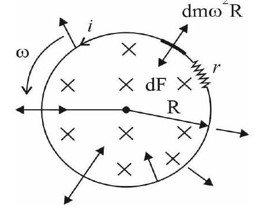
centrifugal force
Upvote Two fixed long parallel horizontal rails, a distance 1 m apart are joined at one end by a resistance 1Ω . A rod AB of negligible resistance slides towards the resistance. A magnetic field of magnitude 4T perpendicular to the plane of rails exists. Find the current flowing (in Ampere) in the resistance, at an instant when the velocity of the rod is 2 m/s.
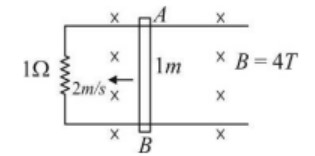
Two fixed long parallel horizontal rails, a distance 1 m apart are joined at one end by a resistance 1Ω . A rod AB of negligible resistance slides towards the resistance. A magnetic field of magnitude 4T perpendicular to the plane of rails exists. Find the current flowing (in Ampere) in the resistance, at an instant when the velocity of the rod is 2 m/s.
EMF induced = BLV = 4 * 2 * 1 = 8V
Current produced = BLV/R = 8/1 = 8A
Upvote Match List – I with List – II.
(A) AC generator(I) Detects the presence of current in the circuit
(B) Galvanometer(II) Converts mechanical energy into electrical energy
(C) Transformer (III) Works on the principle of resonance in AC circuit
(D) Metal detector(IV) Changes an alternating voltage for smaller or greater value
Choose the correct answer from the options given below:
Match List – I with List – II.
(A) AC generator(I) Detects the presence of current in the circuit
(B) Galvanometer(II) Converts mechanical energy into electrical energy
(C) Transformer (III) Works on the principle of resonance in AC circuit
(D) Metal detector(IV) Changes an alternating voltage for smaller or greater value
Choose the correct answer from the options given below:
What is the direction of the force between two parallel current-carrying conductors?
What is the direction of the force between two parallel current-carrying conductors?
The direction of the net magnetic force is always perpendicular to the plane of current-carrying conductors. The direction of the magnetic force is determined through the right-hand rule.
The right-hand thumb rule states that if you wrap a wire in a way that the thumb points towards the flow of
Upvote How does the force between parallel conductors used in defining the ampere (current SI unit)?
How does the force between parallel conductors used in defining the ampere (current SI unit)?
The "ampere" was defined based on the magnetic interaction. The scientific community used the magnetic force between two parallel current-carrying conductors placed at a distance. Below is the definition of 1 ampere, based on this concept.
1 Ampere is the constant current that produces a magnetic force of exactly when two infinitely long, straight, parallel conductors are placed one meter apart in vacuum. |
Upvote What is the formula for the force per unit length between two parallel current-carrying conductors?
What is the formula for the force per unit length between two parallel current-carrying conductors?
The exact formula for the magnetic force per unit length between two parallel current-carrying conductors:
For more information, check: Force between parallel conductors
Upvote A rod of length l slides against the perpendicular wall, such that the lowest point (A) of the rod slides with a speed v on horizontal surface as shown in figure. There exist a uniform magnetic field throughout the region. Now, what is the distance of point 'P' on the rod from end 'A' such that, the induced emf across 'P' and 'A' is maximum?
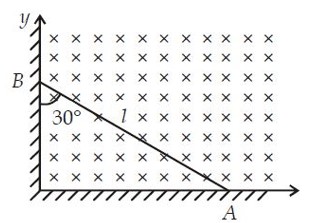
A rod of length l slides against the perpendicular wall, such that the lowest point (A) of the rod slides with a speed v on horizontal surface as shown in figure. There exist a uniform magnetic field throughout the region. Now, what is the distance of point 'P' on the rod from end 'A' such that, the induced emf across 'P' and 'A' is maximum?
A simple LR circuit is connected to a battery at t = 0. The time instant at which rate of energy storage in inductor is half of power delivered by battery
A simple LR circuit is connected to a battery at t = 0. The time instant at which rate of energy storage in inductor is half of power delivered by battery
i = (V? /R) (1 - e? /? )
U = ½Li²
dU/dt = Li (di/dt)
(R/2L) × (V? ²/R²) (1 - e? /? )²e? /? = (V? ²/R) (1 - e? /? )
t = (L/R)ln2
Upvote