

English
Get insights from 1.8k questions on English, answered by students, alumni, and experts. You may also ask and answer any question you like about English
Follow Ask QuestionQuestions
Discussions
Active Users
Followers
New answer posted
a year agoContributor-Level 10
Name | Game | Occupation | Floor | Age |
P | Tennis | Industrialist | 3 | the youngest (1) |
Q | Chess | Engineer | 3 | the oldest (5) |
R | Football |
|
| 6 |
S | Tennis |
| 2 | 4 |
T | Crickets |
|
| 2 |
From the above table Q is chess player and she is engineer option (A) is correct.
New answer posted
a year agoContributor-Level 10
Name | Game | Occupation | Floor | Age |
P | Tennis | Industrialist | 3 | the youngest (1) |
Q | Chess | Engineer | 3 | the oldest (5) |
R | Football |
|
| 6 |
S | Tennis |
| 2 | 4 |
T | Crickets |
|
| 2 |
From the above table, Correct answer is option (A)
New answer posted
a year agoContributor-Level 10
From the given condition g = 10,
Number of students who like both Physics and Maths = 10 + f
Number of students who like both chemistry and Maths = 10 + e
From given condition 10 + f = 10 + e or e = f
Similarly from 3rd condition ¾ (10 + e) = 10 + d
Or 30 + 3e = 40 + 4d
Or
Since 15 students like only chemistry hence b = 15
Number of students who like only chemistry is 40
Hence e + g + d + b = 40
or e + 10 + (3e – 10)/4 + 15 = 40
or (7e – 10)/4 = 15 or 7e = 70 or e = 10
Hence a = 5, c = 20, f = e = 10, d = 5
Hence the distribution is as follows
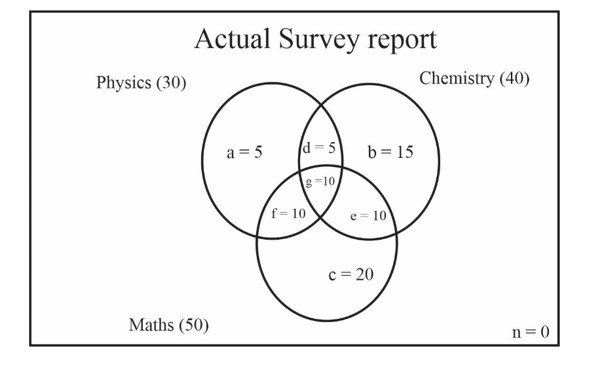
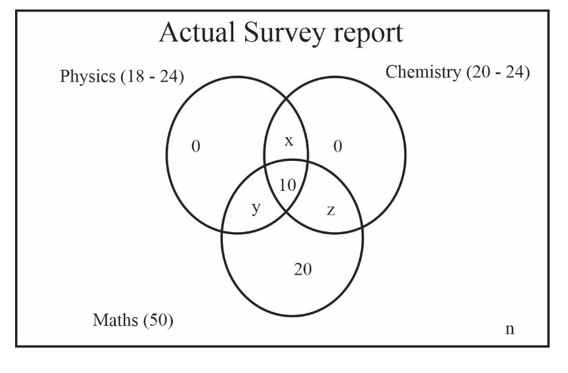
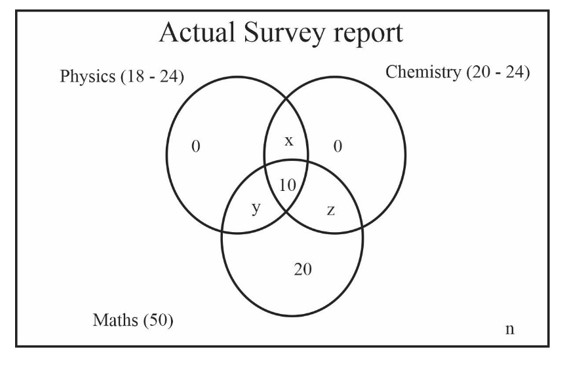
As per the observation of class teacher actual numbers of students who like Physics in
New answer posted
a year agoContributor-Level 10
Following are the possible ways in which Andy, Kandy, Mandy and Sandy can cross the bridge in minimum time.
Case I:
Journey | Men | Time |
1 st trip | Andy, Sandy | 3 min |
Return | Andy, Sandy | 2 min |
2 nd trip | Kandy, Mandy | 9 min |
Return | Sandy | 3 min |
Final trip | Sandy, Andy | 3 min |
Total time |
| 20 min |
Case II:
Journey | Men | Time |
1 st trip | Sandy | 3 min |
Return | Andy, Sandy | 3 min |
2 nd trip | Kandy, Mandy | 9 min |
Return | Andy | 3 min |
Final trip | Sandy, Andy | 2 min |
Total time |
| 20 min |
In total, there are 2 ways to do so.
New answer posted
a year agoContributor-Level 10
Two men cross at a time, and one must come back with the torch.
Journey | Men | Time |
1 st trip | Andy, Sandy | 3 min |
Return | Andy, Sandy | 2 min / 3 |
2 and trip | Kandy, Mandy | 9 min |
Return | Sandy, Andy | 3 min / 2 |
Final trip | Sandy, Andy | 3 min |
Or
Total time taken for the trip = 20 min
New answer posted
a year agoContributor-Level 10
From the given condition g = 10,
Number of students who like both Physics and Maths = 10 + f
Number of students who like both chemistry and Maths = 10 + e
From given condition 10 + f = 10 + e or e = f
Similarly from 3rd condition ¾ (10 + e) = 10 + d
Or 30 + 3e = 40 + 4d
Or
Since 15 students like only chemistry hence b = 15
Number of students who like only chemistry is 40
Hence e + g + d + b = 40
or e + 10 + (3e – 10)/4 + 15 = 40
or (7e – 10)/4 = 15 or 7e = 70 or e = 10
Hence a = 5, c = 20, f = e = 10, d = 5
Hence the distribution is as follows
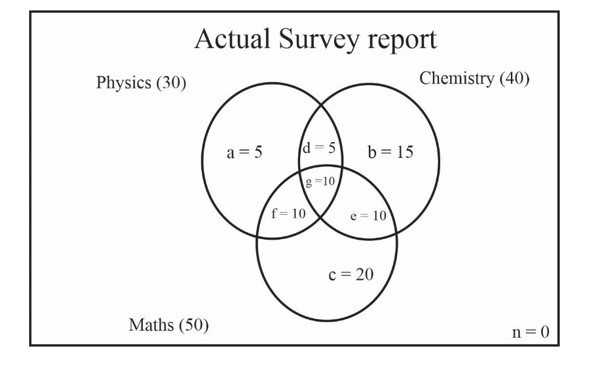
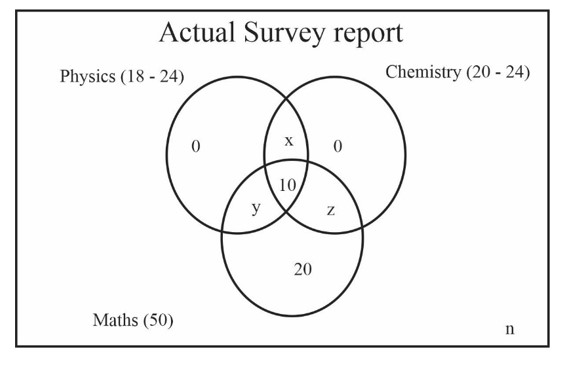
As per the observation of class teacher actual numbers of students who like Physics in
New answer posted
a year agoContributor-Level 10
According to the information provided following arrangement of the schedule will be formed.
Days | Events |
Wednesday | Quiz and Drawing |
Thursday | Dress and Planting |
Friday | Reading and science |
Saturday | Writing |
Sunday | Holiday (*) |
Monday | Cultural fest, festival |
Tuesday | Picnic |
New answer posted
a year agoContributor-Level 10
Solution for question 1 to 4
From the given condition g = 10,
Number of students who like both Physics and Maths = 10 + f
Number of students who like both chemistry and Maths = 10 + e
From given condition 10 + f = 10 + e or e = f
Similarly from 3rd condition ¾ (10 + e) = 10 + d
Or 30 + 3e = 40 + 4d
Or
Since 15 students like only chemistry hence b = 15
Number of students who like only chemistry is 40
Hence e + g + d + b = 40
or e + 10 + (3e – 10)/4 + 15 = 40
or (7e – 10)/4 = 15 or 7e = 70 or e = 10
Hence a = 5, c = 20, f = e = 10, d = 5
Hence the distribution is as follows
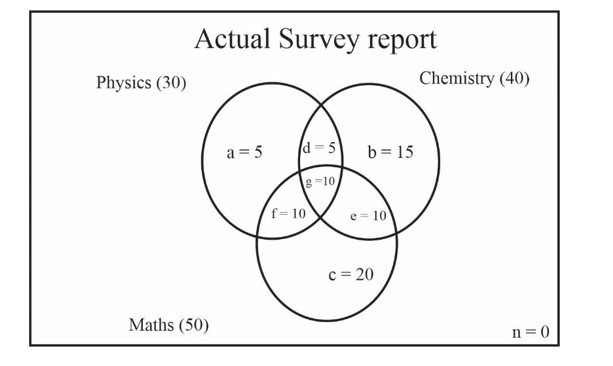
As per the observation of class teacher actual numbers of s
New answer posted
a year agoContributor-Level 10
According to the information provided following arrangement of the schedule will be formed.
Days | Events |
Wednesday | Quiz and Drawing |
Thursday | Dress and Planting |
Friday | Reading and science |
Saturday | Writing |
Sunday | Holiday (*) |
Monday | Cultural fest, festival |
Tuesday | Picnic |
Taking an Exam? Selecting a College?
Get authentic answers from experts, students and alumni that you won't find anywhere else
Sign Up on ShikshaOn Shiksha, get access to
- 67k Colleges
- 1.2k Exams
- 719k Reviews
- 1850k Answers