

English
Get insights from 1.8k questions on English, answered by students, alumni, and experts. You may also ask and answer any question you like about English
Follow Ask QuestionQuestions
Discussions
Active Users
Followers
New answer posted
a year agoContributor-Level 10
According to the information provided following arrangement of the schedule will be formed.
Days | Events |
Wednesday | Quiz and Drawing |
Thursday | Dress and Planting |
Friday | Reading and science |
Saturday | Writing |
Sunday | Holiday (*) |
Monday | Cultural fest, festival |
Tuesday | Picnic |
New answer posted
a year agoContributor-Level 10
According to the information provided following arrangement of the schedule will be formed.
Days | Events |
Wednesday | Quiz and Drawing |
Thursday | Dress and Planting |
Friday | Reading and science |
Saturday | Writing |
Sunday | Holiday (*) |
Monday | Cultural fest, festival |
Tuesday | Picnic |
New answer posted
a year agoContributor-Level 10
According to given condition, we conclude:
I. Amlia – Giana = 8
II. Drew + Raddix = 37
III. Joanna = Drew + 8
IV. Amlia = Drew + 5
V. Amlia + Giana = 40
Using (I) and (IV),
Amlia = 24, Giana = 16
Using (IV),
Drew = 19
Using (III),
Joanna = 27
Using (II),
Raddix = 18
New answer posted
a year agoContributor-Level 10
According to given condition, we conclude:
I. Amlia – Giana = 8
II. Drew + Raddix = 37
III. Joanna = Drew + 8
IV. Amlia = Drew + 5
V. Amlia + Giana = 40
Using (I) and (IV),
Amlia = 24, Giana = 16
Using (IV),
Drew = 19
Using (III),
Joanna = 27
Using (II),
Raddix = 18
New answer posted
a year agoContributor-Level 10
According to given condition, we conclude:
I. Amlia – Giana = 8
II. Drew + Raddix = 37
III. Joanna = Drew + 8
IV. Amlia = Drew + 5
V. Amlia + Giana = 40
Using (I) and (IV),
Amlia = 24, Giana = 16
Using (IV),
Drew = 19
Using (III),
Joanna = 27
Using (II),
Raddix = 18
Drew and Joanna = 19 + 27 = 46
New answer posted
a year agoContributor-Level 10
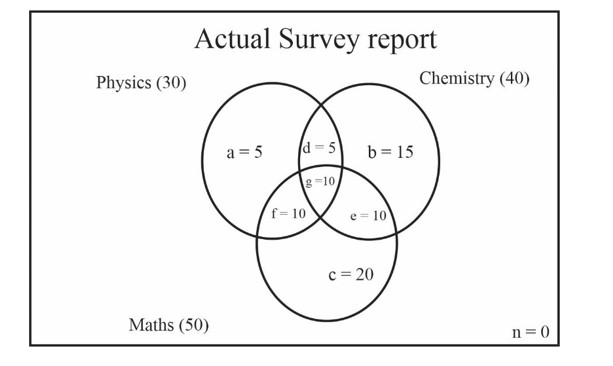
From the given condition g = 10,
Number of students who like both Physics and Maths = 10 + f
Number of students who like both chemistry and Maths = 10 + e
From given condition 10 + f = 10 + e or e = f
Similarly from 3rd condition ¾ (10 + e) = 10 + d
Or 30 + 3e = 40 + 4d
Or
Since 15 students like only chemistry hence b = 15
Number of students who like only chemistry is 40
Hence e + g + d + b = 40
or e + 10 + (3e – 10)/4 + 15 = 40
or (7e – 10)/4 = 15 or 7e = 70 or e = 10
Hence a = 5, c = 20, f = e = 10, d = 5
Hence the distribution is as follows
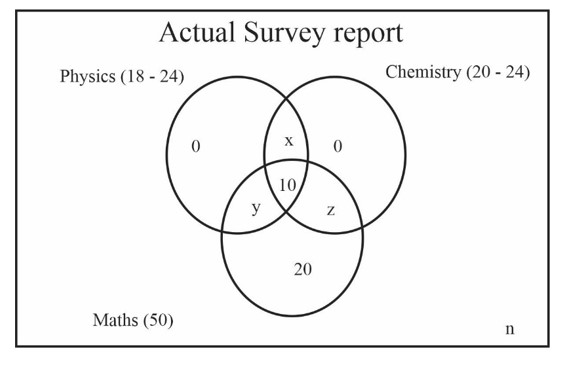
As per the observation of class teacher actual numbers of students who like Physics in
New answer posted
a year agoContributor-Level 10
According to given condition, we conclude:
I. Amlia – Giana = 8
II. Drew + Raddix = 37
III. Joanna = Drew + 8
IV. Amlia = Drew + 5
V. Amlia + Giana = 40
Using (I) and (IV),
Amlia = 24, Giana = 16
Using (IV),
Drew = 19
Using (III),
Joanna = 27
Using (II),
Raddix = 18
Raddix shot 18 baskets and Drew shot 19 baskets.
New answer posted
a year agoContributor-Level 10
As per the given information we have four teams, four couples and 4 different points
I. “Sweet Couple” won 2 points
II. Mukesh's team won 4 points more than Lina's team and Lina's team has not scored the least points. Therefore, only possible options is Lina has 4 points and Mukesh has 8 points. It also means that Mukesh (with point 8) is not with Lina, and both of them does not belongs to “Sweet Couple”
III. “Just Singing” won 6 points. Hence Mukesh and Lina do not belongs to “Just Singing”
IV. Sanjeev's team scored 4 points. While from (II) we have seen that Lina has also 4 points hence Sanjeev and Lina belongs to s
New answer posted
a year agoContributor-Level 10
As per the given information we have four teams, four couples and 4 different points
I. “Sweet Couple” won 2 points
II. Mukesh's team won 4 points more than Lina's team and Lina's team has not scored the least points. Therefore, only possible options is Lina has 4 points and Mukesh has 8 points. It also means that Mukesh (with point 8) is not with Lina, and both of them does not belongs to “Sweet Couple”
III. “Just Singing” won 6 points. Hence Mukesh and Lina do not belongs to “Just Singing”
IV. Sanjeev's team scored 4 points. While from (II) we have seen that Lina has also 4 points hence Sanjeev and Lina belongs to s
New answer posted
a year agoContributor-Level 10
As per the given information we have four teams, four couples and 4 different points
I. “Sweet Couple” won 2 points
II. Mukesh's team won 4 points more than Lina's team and Lina's team has not scored the least points. Therefore, only possible options is Lina has 4 points and Mukesh has 8 points. It also means that Mukesh (with point 8) is not with Lina, and both of them does not belongs to “Sweet Couple”
III. “Just Singing” won 6 points. Hence Mukesh and Lina do not belongs to “Just Singing”
IV. Sanjeev's team scored 4 points. While from (II) we have seen that Lina has also 4 points hence Sanjeev and Lina belongs to s
Taking an Exam? Selecting a College?
Get authentic answers from experts, students and alumni that you won't find anywhere else
Sign Up on ShikshaOn Shiksha, get access to
- 67k Colleges
- 1.2k Exams
- 719k Reviews
- 1850k Answers