
Exemplar Solution
Get insights from 1.3k questions on Exemplar Solution, answered by students, alumni, and experts. You may also ask and answer any question you like about Exemplar Solution
- 1.3k
Questions
- 0
Discussions
- 0
Active Users
- 0
Followers
Have a question about Exemplar Solution? Ask our experts
Keep it short & simple. Type complete word. Avoid abusive language.
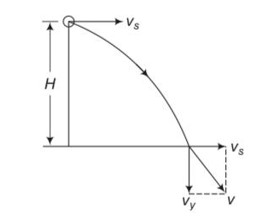
A cricket bowler releases the ball in two different ways
(a) Giving it only horizontal velocity, and
(b) Giving it horizontal velocity and a small downward velocity.
The speed vs at the time of release is the same. Both are released at a height H from the ground. Which one will have greater speed when the ball hits the ground? Neglect air resistance.
A cricket bowler releases the ball in two different ways
(a) Giving it only horizontal velocity, and
(b) Giving it horizontal velocity and a small downward velocity.
The speed vs at the time of release is the same. Both are released at a height H from the ground. Which one will have greater speed when the ball hits the ground? Neglect air resistance.
This is a Long Answer type Questions as classified in NCERT Exemplar
Explanation – horizontal velocity ux= vs
During projectile motion horizontal velocity remains unchanged
Vx=ux=vs
In vertical direction vy2= uy2+2gH
Vy=
Resultant speed of the ball at the bottom
V=
V=
b) when ball is given horizon
 Upvote
In the following questions a statement of Assertion (A) followed by a statement of Reason (R) is given. Choose the correct option out of the choices given below each question.
Assertion (A): Three states of matter are the result of balance between intermolecular forces and thermal energy of the molecules.
Reason (R): Intermolecular forces tend to keep the molecules together but thermal energy of molecules tends to keep them apart.
(i) Both A and R are true and R is the correct explanation of A.
(ii) Both A and R are true but R is not the correct explanation of A.
(iii) A is true but R is false.
(iv) A is false but R is true.
In the following questions a statement of Assertion (A) followed by a statement of Reason (R) is given. Choose the correct option out of the choices given below each question.
Assertion (A): Three states of matter are the result of balance between intermolecular forces and thermal energy of the molecules.
Reason (R): Intermolecular forces tend to keep the molecules together but thermal energy of molecules tends to keep them apart.
(i) Both A and R are true and R is the correct explanation of A.
(ii) Both A and R are true but R is not the correct explanation of A.
(iii) A is true but R is false.
(iv) A is false but R is true.
This is a assertion and reason answer type question as classified in NCERT Exemplar
option (i). Both A and R are true and R is the correct explanation of A.
Upvote Match the following graphs of ideal gas with their co-ordinates:
Graphical representation
x and y co-ordinates
(i)

(a) pV vs. V
(ii)

(b) p vs. V
(iii)

(c) p vs.<!-- [if gte msEquation 12]> 1 V
Match the following graphs of ideal gas with their co-ordinates:
|
Graphical representation |
x and y co-ordinates |
|
(i) |
(a) pV vs. V |
|
(ii) |
(b) p vs. V |
|
(iii) |
(c) p vs.<!-- [if gte msEquation 12]> |
This is a matching answer type question as classified in NCERT Exemplar
(i) - B
(ii) - C
(iii) - A
Upvote The displacement vector of a particle of mass m is given by r(t)=ȋ A cos ĵ B sinwt.
(a) Show that the trajectory is an ellipse.
(b) Show that F= -mw2/r
The displacement vector of a particle of mass m is given by r(t)=ȋ A cos ĵ B sinwt.
(a) Show that the trajectory is an ellipse.
(b) Show that F= -mw2/r
This is a Long Answer type Questions as classified in NCERT Exemplar
Explanation- displacement vector of particle is r (t)=? Acos ? Bsinwt
X=Acoswt
x/A= coswt………1
displacement along y axis is
y=Bsinwt
y/B= sinwt……….2
squaring and then adding eqn1 and 2 we get
x2/A2+y2/B2=cos2wt+sin2wt =1
this is an e
Upvote A racing car travels on a track (without banking) ABCDEFA (Fig). ABC is a circular arc of radius 2 R. CD and FA are straight paths of length R and DEF is a circular arc of radius R = 100 m. The coefficient of friction on the road is µ = 0.1. The maximum speed of the car is 50 m s–1. Find the minimum time for completing one round.
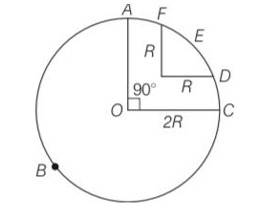
A racing car travels on a track (without banking) ABCDEFA (Fig). ABC is a circular arc of radius 2 R. CD and FA are straight paths of length R and DEF is a circular arc of radius R = 100 m. The coefficient of friction on the road is µ = 0.1. The maximum speed of the car is 50 m s–1. Find the minimum time for completing one round.

This is a Long Answer type Questions as classified in NCERT Exemplar
Explanation – centripetal force, F= mv2/r= f=
V=
For path ABC path length =3/4 (2 )=
V1=
So t= 300
For path DEF path length =
V2=
So t2= 50 = 15.7s
For path CD and FA
Path length =R+R= 200m
T= 200/50= 4s
Total time = 66.6
Upvote Figure shows (vx ,t) and (vy,t) diagrams for a body of unit mass. Find the force as a function of time.
Figure shows (vx ,t) and (vy,t) diagrams for a body of unit mass. Find the force as a function of time.
This is a Long Answer type Questions as classified in NCERT Exemplar
Explanation- vx=2t for 0
= 2 (2-t) for 1
=0 for t>2s
Vy= t for 0
= 1 for t>1s

Fx= max= mdvx/dt= 1 (2)
Fy = may= mdvy/dt
= 1 (1) for 0
F= Fx? +Fy?
= 2? +?
=-2?
=0
Upvote When a body slides down from rest along a smooth inclined plane making an angle of 45° with the horizontal, it takes time T. When the same body slides down from rest along a rough inclined plane making the same angle and through the same distance, it is seen to take time pT, where p is some number greater than 1. Calculate the co-efficient of friction between the body and the rough plane.
When a body slides down from rest along a smooth inclined plane making an angle of 45° with the horizontal, it takes time T. When the same body slides down from rest along a rough inclined plane making the same angle and through the same distance, it is seen to take time pT, where p is some number greater than 1. Calculate the co-efficient of friction between the body and the rough plane.
This is a Long Answer type Questions as classified in NCERT Exemplar
Explanation- as angle is 45
On smooth inclined plane acceleration will be a = gsin

So acceleration will become a= g/
Using equation of motion s =ut +1/2at2
S=
On rough inclined plane a = g (sin )
= g (sin )=
So s=ut +1/2at2
S
Upvote Match the following gas laws with the equation representing them.
(i) Boyle’s law
(a) V ∝ n at constant T and p
(ii) Charle’s law
(b) ptotal = p1 + p2 + p3……… at constant T, V
(iii) Dalton's law
(c) = constant
(iv) Avogadro law
(d) V ∝ T at constant n and p
(e) p ∝ at constant n and T
Match the following gas laws with the equation representing them.
|
(i) Boyle’s law |
(a) V ∝ n at constant T and p |
|
(ii) Charle’s law |
(b) ptotal = p1 + p2 + p3……… at constant T, V |
|
(iii) Dalton's law |
(c) = constant |
|
(iv) Avogadro law |
(d) V ∝ T at constant n and p |
|
(e) p ∝ at constant n and T |
This is a matching answer type question as classified in NCERT Exemplar
(i) Boyle’s law | (e) p ∝ at constant n and T |
(ii) Charle’s law | (d) V ∝ T at constant n and p |
(iii) Dalton's law | (b) ptotal = p1 + p2 + p3……… at constant T, V |
(iv) Avogadro law | (a) V ∝ n at constant T and p |
Upvote Match the graphs between the following variables with their names :
Graphs
Names
(i) Pressure vs temperature (a) graph at constant molar volume.
(a) Isotherms
(ii) Pressure vs volume graph at constant temperature.
(b) Constant temperature curve
(iii) Volume vs temperature graph
at constant pressure.
(c) Isochores
(d) Isobars
Match the graphs between the following variables with their names :
|
Graphs |
Names |
|
(i) Pressure vs temperature (a) graph at constant molar volume. |
(a) Isotherms |
|
(ii) Pressure vs volume graph at constant temperature. |
(b) Constant temperature curve |
|
(iii) Volume vs temperature graph at constant pressure. |
(c) Isochores |
|
|
(d) Isobars |
This is a matching answer type question as classified in NCERT Exemplar
(i) Pressure vs temperature (a) graph at constant molar volume. | (c) Isochores |
(ii) Pressure vs volume graph at constant temperature. | (a) Isotherms |
(iii) Volume vs temperature graph at constant pressure. | (d) Isobars |
Upvote Pressure versus volume graph for a real gas and an ideal gas are shown in Fig. 5.4.

Answer the following questions on the basis of this graph.
1. Interpret the behaviour of real gas with respect to ideal gas at low pressure.
2. Interpret the behaviour of real gas with respect to ideal gas at high pressure.
3. Mark the pressure and volume by drawing a line at the point where real gas behaves as an ideal gas.
Pressure versus volume graph for a real gas and an ideal gas are shown in Fig. 5.4.
Answer the following questions on the basis of this graph.
1. Interpret the behaviour of real gas with respect to ideal gas at low pressure.
2. Interpret the behaviour of real gas with respect to ideal gas at high pressure.
3. Mark the pressure and volume by drawing a line at the point where real gas behaves as an ideal gas.
This is a short answer type question as classified in NCERT Exemplar
1. At low pressure, the curve of real gas coincides with that of ideal gas, this shows that the deviation of behaviour of real gas with respect to ideal gas is small or negligible.
2. At high pressure, the curve of r
Upvote