
Exemplar Solution
Get insights from 1.3k questions on Exemplar Solution, answered by students, alumni, and experts. You may also ask and answer any question you like about Exemplar Solution
- 1.3k
Questions
- 0
Discussions
- 0
Active Users
- 0
Followers
Have a question about Exemplar Solution? Ask our experts
Keep it short & simple. Type complete word. Avoid abusive language.
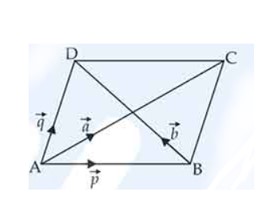
Show that the area of the parallelogram whose diagonals are given by and is Also, find the area of the parallelogram whose diagonals are 2î − ĵ + k̂ and î + 3ĵ − k̂.
Show that the area of the parallelogram whose diagonals are given by and is Also, find the area of the parallelogram whose diagonals are 2î − ĵ + k̂ and î + 3ĵ − k̂.
 Upvote

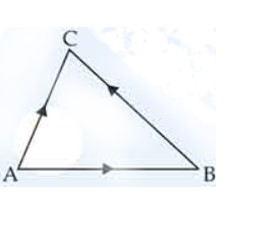
If determine the vertices of a triangle, show that gives the vector area of the triangle. Hence deduce the condition that the three points are collinear. Also, find the unit vector normal to the plane of the triangle.
If determine the vertices of a triangle, show that gives the vector area of the triangle. Hence deduce the condition that the three points are collinear. Also, find the unit vector normal to the plane of the triangle.
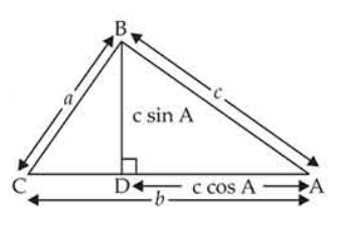
Upvote Prove that in any triangle ABC, <!-- [if gte mso 9]><xml>
Prove that in any triangle ABC, <!-- [if gte mso 9]><xml>
This is a Long Answer type Questions as classified in NCERT Exemplar
Sol:
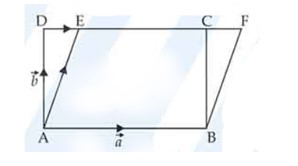
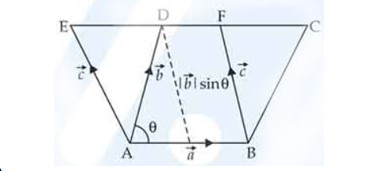
Upvote Using vectors, prove that parallelograms on the same base and between the same parallels are equal in area.
Using vectors, prove that parallelograms on the same base and between the same parallels are equal in area.
This is a Short Answer type Questions as classified in NCERT Exemplar
Upvote Using vectors, find the area of the triangle ABC with vertices A(1, 2, 3), B(2, –1, 4), C(4, 5, –1).
Using vectors, find the area of the triangle ABC with vertices A(1, 2, 3), B(2, –1, 4), C(4, 5, –1).
This is a Short Answer type Questions as classified in NCERT Exemplar
Sol:
Upvote If A, B, C, D are the points with position vectors î + ĵ − k̂, 2î − 3ĵ + k̂, 2î − 3k̂, and 3î + 2ĵ − k̂, respectively, find the projection of along
If A, B, C, D are the points with position vectors î + ĵ − k̂, 2î − 3ĵ + k̂, 2î − 3k̂, and 3î + 2ĵ − k̂, respectively, find the projection of along
This is a Short Answer type Questions as classified in NCERT Exemplar
Upvote Find the sine of the angle between the vectors = 3î + 2ĵ + k̂ and = −î + 2ĵ + 4k̂.
Find the sine of the angle between the vectors = 3î + 2ĵ + k̂ and = −î + 2ĵ + 4k̂.
This is a Short Answer type Questions as classified in NCERT Exemplar
Sol:
Upvote If + + = 0, show that × = × = × <!-- [if gte mso 9]><xml>
If + + = 0, show that × = × = × <!-- [if gte mso 9]><xml>
This is a Short Answer type Questions as classified in NCERT Exemplar
Sol:
Upvote Find the angle between the vectors 2î − ĵ + k̂ and 3î + 4ĵ − k̂.
Find the angle between the vectors 2î − ĵ + k̂ and 3î + 4ĵ − k̂.
This is a Short Answer type Questions as classified in NCERT Exemplar
Sol:
Upvote Find a vector of magnitude 6, which is perpendicular to both the vectors 2î − 2ĵ + k̂ and 4î − 3ĵ + k̂.
Find a vector of magnitude 6, which is perpendicular to both the vectors 2î − 2ĵ + k̂ and 4î − 3ĵ + k̂.
This is a Short Answer type Questions as classified in NCERT Exemplar
Sol:
Upvote