
Exemplar Solution
Get insights from 1.3k questions on Exemplar Solution, answered by students, alumni, and experts. You may also ask and answer any question you like about Exemplar Solution
- 1.3k
Questions
- 0
Discussions
- 0
Active Users
- 0
Followers
Have a question about Exemplar Solution? Ask our experts
Keep it short & simple. Type complete word. Avoid abusive language.
A helicopter of mass 2000 kg rises with a vertical acceleration of 15 m s–2. The total mass of the crew and passengers is 500 kg. Give the magnitude and direction of the (g = 10 m s–2)
(a) Force on the floor of the helicopter by the crew and passengers.
(b) Action of the rotor of the helicopter on the surrounding air.
(c) Force on the helicopter due to the surrounding air.
This is a Long Answer type Questions as classified in NCERT Exemplar
Explanation- mass of helicopter m =2000kg
Mass of the crew and passengers m= 500kg
Acceleration a =15m/s2 and g = 10m/s2
a) force on the floor of the helicopter by the crew and passengers
m (g+a)= 500 (10+15)N= 12500N
b) action of rotor
 Upvote

The variation of vapour pressure of different liquids with temperature is shown in Fig. 5.6.

i. Calculate graphically boiling points of liquids A and B.
ii. If we take liquid C in a closed vessel and heat it continuously. At what temperature will it boil?
The variation of vapour pressure of different liquids with temperature is shown in Fig. 5.6.

i. Calculate graphically boiling points of liquids A and B.
ii. If we take liquid C in a closed vessel and heat it continuously. At what temperature will it boil?
This is a long answer type question as classified in NCERT Exemplar
i. The boiling points of liquid A is approximately 315 K and of liquid B is approximately 345 K (shown below graphically).

ii. Liquid C in a closed vessel will not boil as the pressure keeps on increasing.
Upvote Isotherms of carbon dioxide at various temperatures are represented in Fig. 5.5. Answer the following questions based on this figure.

i. In which state will CO2 exist between the points a and b at temperature T1?
ii. At what point will CO2 start liquefying when temperature is T1?
iii. At what point will CO2 be completely liquefied when temperature is T2?
iv. Will condensation take place when the temperature is T3.
v. What portion of the isotherm at T1 represents liquid and gaseous CO2 at equilibrium?
Isotherms of carbon dioxide at various temperatures are represented in Fig. 5.5. Answer the following questions based on this figure.
i. In which state will CO2 exist between the points a and b at temperature T1?
ii. At what point will CO2 start liquefying when temperature is T1?
iii. At what point will CO2 be completely liquefied when temperature is T2?
iv. Will condensation take place when the temperature is T3.
v. What portion of the isotherm at T1 represents liquid and gaseous CO2 at equilibrium?
This is a long answer type question as classified in NCERT Exemplar
i. CO2 will exist in a gaseous state between the points a and b at temperature T1.
ii. At point b, CO2 will start liquefying when temperature is T1
iii. At point g, CO2 will be completely liquefied when temperature is
Upvote Assertion (A): Liquids tend to have maximum number of molecules at their surface.
Reason (R) : Small liquid drops have spherical shape.
<!-- [if !supportLists]-->(i) Both A and R are true and R is the correct explanation of A.
<!-- [if !supportLists]-->(ii) Both A and R are true but R is not the correct explanation of A.
<!-- [if !supportLists]-->(iii) A is true but R is false.
<!-- [if !supportLists]-->(iv) A is false but R is true.
Assertion (A): Liquids tend to have maximum number of molecules at their surface.
Reason (R) : Small liquid drops have spherical shape.
<!-- [if !supportLists]-->(i) Both A and R are true and R is the correct explanation of A.
<!-- [if !supportLists]-->(ii) Both A and R are true but R is not the correct explanation of A.
<!-- [if !supportLists]-->(iii) A is true but R is false.
<!-- [if !supportLists]-->(iv) A is false but R is true.
This is a assertion and reason answer type question as classified in NCERT Exemplar
Upvote A rectangular box lies on a rough inclined surface. The co-efficient of friction between the surface and the box is µ. Let the mass of the box be m.
(a) At what angle of inclination θ of the plane to the horizontal will the box just start to slide down the plane?
(b) What is the force acting on the box down the plane, if the angle of inclination of the plane is increased to α θ > ?
(c) What is the force needed to be applied upwards along the plane to make the box either remain stationary or just move up with uniform speed?
(d) What is the force needed to be applied upwards along the plane to make the box move up the plane with acceleration a?
A rectangular box lies on a rough inclined surface. The co-efficient of friction between the surface and the box is µ. Let the mass of the box be m.
(a) At what angle of inclination θ of the plane to the horizontal will the box just start to slide down the plane?
(b) What is the force acting on the box down the plane, if the angle of inclination of the plane is increased to α θ > ?
(c) What is the force needed to be applied upwards along the plane to make the box either remain stationary or just move up with uniform speed?
(d) What is the force needed to be applied upwards along the plane to make the box move up the plane with acceleration a?
This is a Long Answer type Questions as classified in NCERT Exemplar
Explanation -for the box to just starts sliding down mg
sin
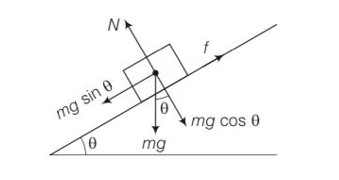
tan =
b) when angle of inclination is increased to
F1= mgsin
= mg ( )
c) to keep the box stationary, upward force needed F2= m +f= mg ( )
d) if the box is to move
Upvote Assertion (A): At critical temperature liquid passes into gaseous state imperceptibly and continuously.
Reason (R) : The density of liquid and gaseous phase is equal to critical temperature.
<!-- [if !supportLists]-->(i) Both A and R are true and R is the correct explanation of A.
<!-- [if !supportLists]-->(ii) Both A and R are true but R is not the correct explanation of A.
<!-- [if !supportLists]-->(iii) A is true but R is false.
<!-- [if !supportLists]-->(iv) A is false but R is true.
Assertion (A): At critical temperature liquid passes into gaseous state imperceptibly and continuously.
Reason (R) : The density of liquid and gaseous phase is equal to critical temperature.
<!-- [if !supportLists]-->(i) Both A and R are true and R is the correct explanation of A.
<!-- [if !supportLists]-->(ii) Both A and R are true but R is not the correct explanation of A.
<!-- [if !supportLists]-->(iii) A is true but R is false.
<!-- [if !supportLists]-->(iv) A is false but R is true.
This is a assertion and reason answer type question as classified in NCERT Exemplar
(i) Both A and R are true and R is the correct explanation of A.
Upvote Assertion (A): Gases do not liquefy above their critical temperature, even on applying high pressure.
Reason (R) : Above critical temperature, the molecular speed is high and intermolecular attractions cannot hold the molecules together because they escape because of high speed.
<!-- [if !supportLists]-->(i) Both A and R are true and R is the correct explanation of A.
<!-- [if !supportLists]-->(ii) Both A and R are true but R is not the correct explanation of A.
<!-- [if !supportLists]-->(iii) A is true but R is false.
<!-- [if !supportLists]-->(iv) A is false but R is true.
Assertion (A): Gases do not liquefy above their critical temperature, even on applying high pressure.
Reason (R) : Above critical temperature, the molecular speed is high and intermolecular attractions cannot hold the molecules together because they escape because of high speed.
<!-- [if !supportLists]-->(i) Both A and R are true and R is the correct explanation of A.
<!-- [if !supportLists]-->(ii) Both A and R are true but R is not the correct explanation of A.
<!-- [if !supportLists]-->(iii) A is true but R is false.
<!-- [if !supportLists]-->(iv) A is false but R is true.
This is a assertion and reason answer type question as classified in NCERT Exemplar
(i) Both A and R are true and R is the correct explanation of A.
Upvote Assertion (A): The temperature at which vapour pressure of a liquid is equal to the external pressure is called boiling temperature.
Reason (R) : At high altitude atmospheric pressure is high.
<!-- [if !supportLists]-->(i) Both A and R are true and R is the correct explanation of A.
<!-- [if !supportLists]-->(ii) Both A and R are true but R is not the correct explanation of A.
<!-- [if !supportLists]-->(iii) A is true but R is false.
<!-- [if !supportLists]-->(iv) A is false but R is true.
Assertion (A): The temperature at which vapour pressure of a liquid is equal to the external pressure is called boiling temperature.
Reason (R) : At high altitude atmospheric pressure is high.
<!-- [if !supportLists]-->(i) Both A and R are true and R is the correct explanation of A.
<!-- [if !supportLists]-->(ii) Both A and R are true but R is not the correct explanation of A.
<!-- [if !supportLists]-->(iii) A is true but R is false.
<!-- [if !supportLists]-->(iv) A is false but R is true.
This is a assertion and reason answer type question as classified in NCERT Exemplar
option (iii). A is true but R is false.
At high altitude, the atmospheric pressure is low.
Upvote There are four forces acting at a point P produced by strings as shown in Fig. , which is at rest. Find the forces F1 and F2
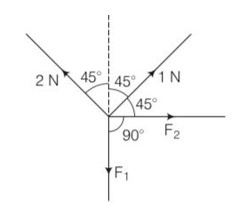
There are four forces acting at a point P produced by strings as shown in Fig. , which is at rest. Find the forces F1 and F2
This is a Long Answer type Questions as classified in NCERT Exemplar
Explanation- on resolving forces into rectangular components in equilibrium forces (F1+1/ )N are equal to and F2 is equal to ( )N
F1+1/ =
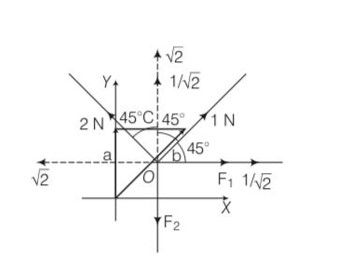
F1= =
F2=
Upvote Assertion (A): At constant temperature, pV vs V plot for real gases is not a straight line.
Reason (R) : At high pressure all gases have Z > 1 but at intermediate pressure most gases have Z < 1.
(i) Both A and R are true and R is the correct explanation of A.
(ii) Both A and R are true but R is not the correct explanation of A.
(iii) A is true but R is false.
(iv) A is false but R is true.
Assertion (A): At constant temperature, pV vs V plot for real gases is not a straight line.
Reason (R) : At high pressure all gases have Z > 1 but at intermediate pressure most gases have Z < 1.
(i) Both A and R are true and R is the correct explanation of A.
(ii) Both A and R are true but R is not the correct explanation of A.
(iii) A is true but R is false.
(iv) A is false but R is true.
This is a assertion and reason answer type question as classified in NCERT Exemplar
At constant temperature, the pV vs V plot for real gases is not a straight line because there is intermolecular attraction present in real gases which is absent in ideal gases; hence ideal gases form a straight line i
Upvote