
Exemplar Solution
Get insights from 1.3k questions on Exemplar Solution, answered by students, alumni, and experts. You may also ask and answer any question you like about Exemplar Solution
- 1.3k
Questions
- 0
Discussions
- 0
Active Users
- 0
Followers
Have a question about Exemplar Solution? Ask our experts
Keep it short & simple. Type complete word. Avoid abusive language.
Physical properties of ice, water and steam are very different. What is the chemical composition of water in all the three states.
Physical properties of ice, water and steam are very different. What is the chemical composition of water in all the three states.
This is a short answer type question as classified in NCERT Exemplar
Physical state of ice, water and steam are very different but the chemical composition of water in all the three states is H2O.
 Upvote

If 1 gram of each of the following gases are taken at STP. which of the gases will occupy
(a) greatest volume and
(b) smallest volume ?
CO, H2O, CH4, NO
If 1 gram of each of the following gases are taken at STP. which of the gases will occupy
(a) greatest volume and
(b) smallest volume ?
CO, H2O, CH4, NO
This is a short answer type question as classified in NCERT Exemplar
(a) the greatest volume is occupied by CH4 and
(b) the smallest volume by NO
According to Avagadro’s Law,
Volume of 1 mole of a gas at STP = 22.4 L
Now, we know,
1 mole = Molar mass
∴ Vol
Upvote There are three forces F1, F2 and F3 acting on a body, all acting on a point P on the body. The body is found to move with uniform speed.
(a) Show that the forces are coplanar.
(b) Show that the torque acting on the body about any point due to these three forces is zero.
There are three forces F1, F2 and F3 acting on a body, all acting on a point P on the body. The body is found to move with uniform speed.
(a) Show that the forces are coplanar.
(b) Show that the torque acting on the body about any point due to these three forces is zero.
This is a Long Answer type Questions as classified in NCERT Exemplar
Explanation – as body moving with uniform acceleration a=0
The sum of forces is zero F1+F2+F3=0
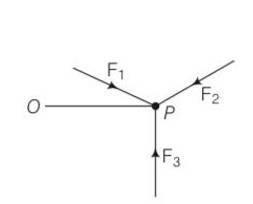
a)let F1, F2, F3 be the three forces passing through the point . let F1and F2 be in the plane A
so F3 =- (F1+F2) so F3 is also in plan
Upvote A person in an elevator accelerating upwards with an acceleration of 2 m s–2, tosses a coin vertically upwards with a speed of 20 m s-1. After how much time will the coin fall back into his hand? ( g = 10 m s–2)
A person in an elevator accelerating upwards with an acceleration of 2 m s–2, tosses a coin vertically upwards with a speed of 20 m s-1. After how much time will the coin fall back into his hand? ( g = 10 m s–2)
This is a Short Answer type Questions as classified in NCERT Exemplar
Explanation -initial speed of coin u= 20m/s
Acceleration of elevator =2m/s2 acceleration due to gravity = 10m/s2
Effective acceleration =g+a=12m/s2
We know that v=u +at
0= 20+ (-12)t
So t= 20/12=5/3 s
Time of ascent = time of descent
Tot
Upvote Figure 5.8 shows (x, t), (y, t ) diagram of a particle moving in 2-dimensions If the particle has a mass of 500 g, find the force (direction and magnitude) acting on the particle.
Figure 5.8 shows (x, t), (y, t ) diagram of a particle moving in 2-dimensions If the particle has a mass of 500 g, find the force (direction and magnitude) acting on the particle.
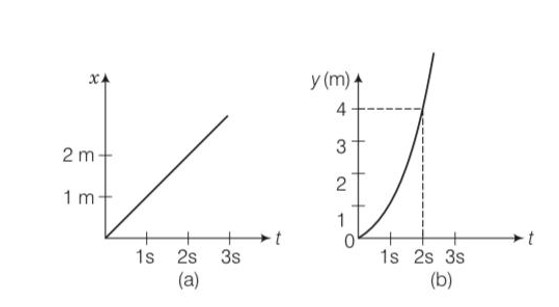
Explanation- from the diagram x= t=dx/dt=1m/s
So ax= 0
From the diagram y =t2
dy/dt=2t or ay=d2y/dt2=2m/s2
Iy= may=500 (10-3) (2) =1N
Fx=max=0
F= = 1N
Upvote A 100 kg gun fires a ball of 1kg horizontally from a cliff of height 500m. It falls on the ground at a distance of 400m from the bottom of the cliff. Find the recoil velocity of the gun. (acceleration due to gravity = 10 m/s-2)
A 100 kg gun fires a ball of 1kg horizontally from a cliff of height 500m. It falls on the ground at a distance of 400m from the bottom of the cliff. Find the recoil velocity of the gun. (acceleration due to gravity = 10 m/s-2)
This is a Short Answer type Questions as classified in NCERT Exemplar
Explanation- mass of gun =100kg
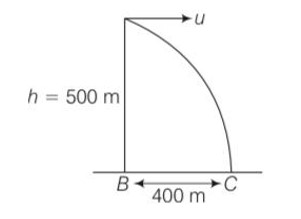
Mass of ball =1kg and height of cliff = 500m
So horizontal distance travelled by the ball is x = 400m
So h =1/2gt2
500= 2 so t= 10s
X=ut then u= 400/10=40m/s
According to principle of conservat
Upvote A block of mass M is held against a rough vertical wall by pressing it with a finger. If the coefficient of friction between the block and the wall is µ and the acceleration due to gravity is g, calculate the minimum force required to be applied by the finger to hold the block against the wall ?
A block of mass M is held against a rough vertical wall by pressing it with a finger. If the coefficient of friction between the block and the wall is µ and the acceleration due to gravity is g, calculate the minimum force required to be applied by the finger to hold the block against the wall ?
This is a Short Answer type Questions as classified in NCERT Exemplar
Explanation-given mass of the block =M
Coefficient of friction between block and the wall =
In equilibrium condition vertical and horizontal component balance each other
So f=mg
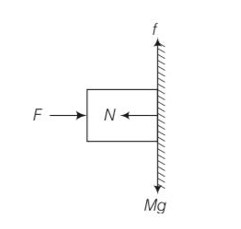
And F=N but the force of friction f=
F=
Upvote Block A of weight 100 N rests on a frictionless inclined plane of slope angle 30° (Fig. 5.7). A flexible cord attached to A passes over a frictionless pulley and is connected to block B of weight W. Find the weight W for which the system is in equilibrium.
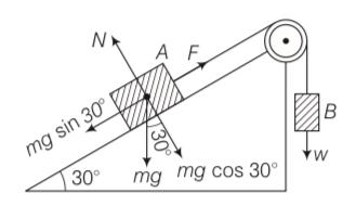
Block A of weight 100 N rests on a frictionless inclined plane of slope angle 30° (Fig. 5.7). A flexible cord attached to A passes over a frictionless pulley and is connected to block B of weight W. Find the weight W for which the system is in equilibrium.
This is a Short Answer type Questions as classified in NCERT Exemplar
Explanation- in equilibrium, The force mgsin acting on the block A is parallel to the plane should be balanced by the tension in the string
mgsin
and for block B, w=T=F
from these two above equation
w=mgsin = 100s
Upvote Two masses of 5 kg and 3 kg are suspended with help of massless inextensible strings as shown in Fig. 5.6. Calculate T1 and T2 when whole system is going upwards with acceleration = 2 m/s2 (use g = 9.8 m/s2).
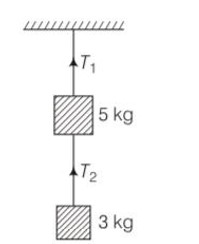
Two masses of 5 kg and 3 kg are suspended with help of massless inextensible strings as shown in Fig. 5.6. Calculate T1 and T2 when whole system is going upwards with acceleration = 2 m/s2 (use g = 9.8 m/s2).
This is a Short Answer type Questions as classified in NCERT Exemplar
Explanation- m1= 5kg, m2= 3kg
And g= 9.8m/s2 and a= 2m/s2
For the upper block T1-T2-5g=5a
T1-T2= 5 (g+a)
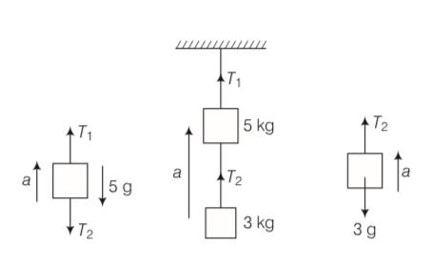
For the lower block T2-3g =3a
T2=3 (g+a)=3 (9.8+2)=35.4N
T1=T2+5 (g+a)=94.4N
Upvote In the above given problem if the lower thread is pulled with a jerk, what happens?
In the above given problem if the lower thread is pulled with a jerk, what happens?
This is a Short Answer type Questions as classified in NCERT Exemplar
Explanation – when the lower thread CD is pulled with a * the thread Cd itself break because the thread CD is not transmitted to the thread Ab instantly.
Upvote