Faraday Law of Induction
Get insights from 6 questions on Faraday Law of Induction, answered by students, alumni, and experts. You may also ask and answer any question you like about Faraday Law of Induction
- 6
Questions
- 0
Discussions
- 0
Active Users
- 0
Followers
Have a question about Faraday Law of Induction? Ask our experts
Keep it short & simple. Type complete word. Avoid abusive language.
Why did faraday use two separate laws to explain his concept and didn't just combine both of these into a single statement?
The first and second laws weren't created together and have a gap of many years between them. Earlier, he just found out a way to calculate whether the EMF was produced or not. But with time, its direction and magnitude also needed to be calculated which resulted in him giving a second law to suppor
Faraday's first law only tells us if the EMF is induced or not. Unlike the second law, it doesn't have any connection with the EMF's magnitude or direction. Therefore, only the second law of faraday has a formula since it is used to calculate both the magnitude and direction of the induced EMF.
What is the core difference between Faraday law and Lenz's law?
The actual role of these laws is that faraday's law tells us the magnitude of induced EMF and Lenz's law was a modification of faraday which also could tell the direction of induced EMF. These two laws are combined together to form the base of any concept related to electromagnetic induction.
The magnetic flux through a coil perpendicular to its plane is varying according to the relation Weber. If the resistance of the coil is 5 ohm, then the induced current through the coil at t = 2s will be,
at t = 2 sec, V = - (15 × 4 + 8 × 2 + 2)
= 78 V
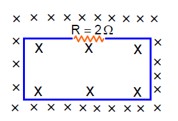
In the given figure the magnetic flux through the loop increases according to the relation φB(t) = 10t² + 20t, where φB is in milliwebers and t is in seconds. The magnitude of current through R = 2Ω resistor at t = 5s is _____ mA.
E = -dφ/dt = - (20t + 20) mV.
At t=5s, E = - (100+20) = -120mV.
I = |E|/R = 120mV/2Ω = 60mA.
Related Tags
0 Followers
0 Followers
0 Followers
0 Followers
0 Followers
0 Followers
5 Followers
0 Followers
0 Followers
0 Followers
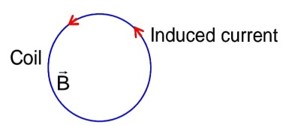
A coil is placed in a magnetic field as shown below: B
A current is induced in the coil because <!-- [if gte mso 9]><xml>
</xml><![endif]--> is:
A coil is placed in a magnetic field as shown below: B
A current is induced in the coil because <!-- [if gte mso 9]><xml>
Using faraday's law magnetic field should be outward and decreasing with time