

Maths
Get insights from 6.5k questions on Maths, answered by students, alumni, and experts. You may also ask and answer any question you like about Maths
Follow Ask QuestionQuestions
Discussions
Active Users
Followers
New answer posted
a year agoContributor-Level 10
8. Let P (x, –1), Q (2, 1) and R (4, 5) be the collinear points. Then,
Slope of PQ = Slope of QR
New answer posted
a year ago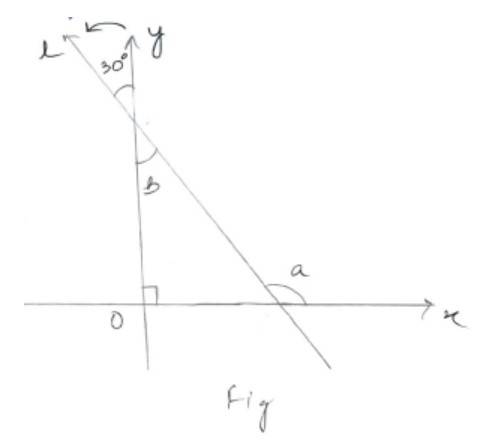
Contributor-Level 10
7.
Let l be the line making 30° with y-axis as shown in figure. Then,
Angle a = + 90° (Sum of exterior angle of a triangle)
( vertically opposite angle)
So, slope of line l = tan a
= m = tan 120°
= tan (180° – 60°)
= –tan 60°
New answer posted
a year agoContributor-Level 10
6.
. Let the given point be A (4, 4), B (3, 5) and C (–1, –1)
Then, slope of AB, m1 =
Slope of AC, m2 =
And slope of BC, m3 =
As m1 – m2 = –1 * 1 = –1
We conclude that AB and AC are perpendicular to each other.
Hence, ABC is a right-angle triangle right-angled at A
New answer posted
a year agoContributor-Level 10
5.
Let 0 (0, 0) be the origin and A be the mid-point of line joining P (0, –4) and B (8, 0)
Then, co-ordinate of A =
Slope of OA, m =
New answer posted
a year agoContributor-Level 10
4.
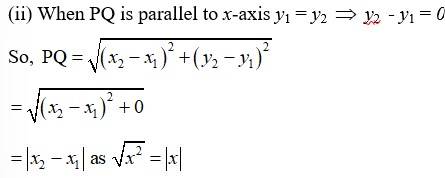
Let A (x, 0) be the point on x-axis when is equidistant from P (7, 6) and Q (3, 4)
Then, PA = QA

Squaring both sides, we get,
The required point on x-axis is
New question posted
a year agoNew answer posted
a year agoContributor-Level 10
2. Let ABC be the equilateral triangle of side 2a and 0 be the origin. Then
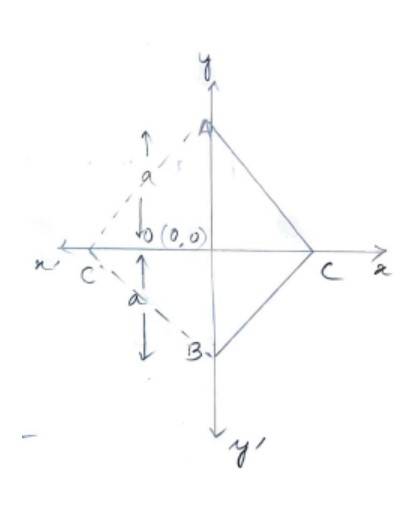
AB = BC = AC = 2a
O is the mid-point of AB we have AO = a
BO = a
We know that A and B lies on y-axis so they have co-ordinate of the form (0, y).
Hence, co-ordinate of A is (0, a) and that of B is (0, –a)
Since OC, bisects AB at right angle, by Pythagoras theorem,
AC2= OA2 + OC2

And as C we on x-axis it has co-ordinate of the form (x, 0)

New answer posted
a year agoContributor-Level 10
Exercise 9.1
1. Let the given points be A(–4, 5), B(0, 7), C(5, –5) and D(–4, –2).
Then quadrilated ABCD can be plotted on the graph by joining the points A, B, C and D.
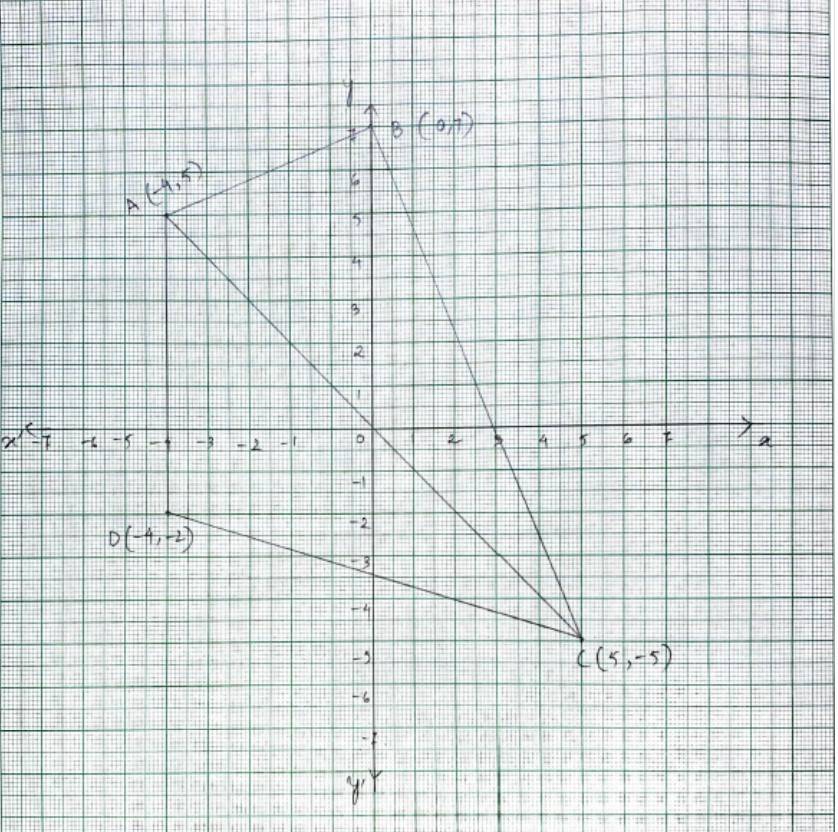
We connect diagonal AC such that
area (ABCD) = (ΔABC) + (ΔADC)
Now,
Similarly,
Hence, area (ABCD) =
New answer posted
a year agoBeginner-Level 5
students can check the table for the principal values for all ITFs below;
| Function | Principal Value Range (in radians) |
|---|---|
| sin? ¹x | –? /2 to? /2 |
| cos? ¹x | 0 to? |
| tan? ¹x | –? /2 to? /2 |
| cot? ¹x | 0 to? |
| sec? ¹x | 0 to? (except? /2) |
| cosec? ¹x | –? /2 to? /2 (except 0) |
Taking an Exam? Selecting a College?
Get authentic answers from experts, students and alumni that you won't find anywhere else
Sign Up on ShikshaOn Shiksha, get access to
- 66k Colleges
- 1.2k Exams
- 712k Reviews
- 1850k Answers