
Ncert Solutions Maths class 11th
Get insights from 1.6k questions on Ncert Solutions Maths class 11th, answered by students, alumni, and experts. You may also ask and answer any question you like about Ncert Solutions Maths class 11th
- 1.6k
Questions
- 0
Discussions
- 0
Active Users
- 83
Followers
Have a question about Ncert Solutions Maths class 11th? Ask our experts
Keep it short & simple. Type complete word. Avoid abusive language.
The combined equation of 2 altitudes of an equilateral triangle is x2 – 3y2 – 4x + <!-- [if gte mso 9]><xml>
The combined equation of 2 altitudes of an equilateral triangle is x2 – 3y2 – 4x + <!-- [if gte mso 9]><xml>
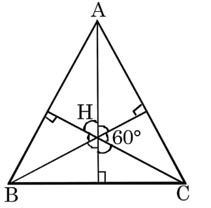
The two altitudes are
Point of int. of the 2 altitudes is
Let slope of 3rd altitude be ‘m’
then
The third altitude is x = 2
 Upvote

Let α, β and γ are the real roots of equation x3 + ax2 + bx + c = 0(a, b, c ∈ R, a ≠ 0). if system of equations αx + βy + γz = 0, βx + γy + αz = 0, γx + αy + βz = 0 has non trivial solution then the value of a2/b is:
<!-- [if !supportLineBreakNewLine]-->
<!--[endif]-->
Let α, β and γ are the real roots of equation x3 + ax2 + bx + c = 0(a, b, c ∈ R, a ≠ 0). if system of equations αx + βy + γz = 0, βx + γy + αz = 0, γx + αy + βz = 0 has non trivial solution then the value of a2/b is:
<!-- [if !supportLineBreakNewLine]-->
<!--[endif]-->
Kindly consider the following figure
Upvote Two teachers are taking 6 students to a zoo. The teachers decide to split up. Each student must choose one of the teachers, with the condition that each teacher must take at least one student. Number of possible ways of doing this is:
<!-- [if !supportLineBreakNewLine]-->
<!--[endif]-->
Two teachers are taking 6 students to a zoo. The teachers decide to split up. Each student must choose one of the teachers, with the condition that each teacher must take at least one student. Number of possible ways of doing this is:
<!-- [if !supportLineBreakNewLine]-->
<!--[endif]-->
(6!/ (5!1!) * 2! + (6!/ (4!2!) * 2! + (6!/ (3!)²2!) * 2! = 62
Upvote The series of natural numbers is divided into groups as (1), (2, 3, 4), (3, 4, 5, 6, 7), (4, 5, 6, 7, 8, 9, 10) …………. . If sum of elements in the 20th group is <!-- [if gte mso 9]><xml>
The series of natural numbers is divided into groups as (1), (2, 3, 4), (3, 4, 5, 6, 7), (4, 5, 6, 7, 8, 9, 10) …………. . If sum of elements in the 20th group is <!-- [if gte mso 9]><xml>
First element in 20th group is equal to ‘20’.
(20, 21, ….upto 39 times)
Upvote A variable line passing through the point P(2, 3/2) meets co-ordinate axes at points A and B, then locus of the foot of perpendicular from origin on the line is:
<!-- [if !supportLineBreakNewLine]-->
<!--[endif]-->
A variable line passing through the point P(2, 3/2) meets co-ordinate axes at points A and B, then locus of the foot of perpendicular from origin on the line is:
<!-- [if !supportLineBreakNewLine]-->
<!--[endif]-->
(k-3)/ (h-2) × (k-0)/ (h-0) = -1
⇒ k (2k – 3) = -2 (h – 2)h
⇒ 2h² + 2k² – 4h – 3k = 0
2x² + 2y² – 4x – 3y = 0
(0,0)
Upvote The tangent at a point where eccentric angle 60° on the ellipse x2/a2 + y2/b2 = 1(a > b) meet the auxiliary circle at L and M. If LM subtends a right angle at the centre, then eccentricity of the ellipse is:
<!-- [if !supportLineBreakNewLine]-->
<!--[endif]-->
The tangent at a point where eccentric angle 60° on the ellipse x2/a2 + y2/b2 = 1(a > b) meet the auxiliary circle at L and M. If LM subtends a right angle at the centre, then eccentricity of the ellipse is:
<!-- [if !supportLineBreakNewLine]-->
<!--[endif]-->
Equation of tangent is (x/a) (1/2) + (y/b) (√3/2) = 1
Equation of auxiliary circle is x² + y² = a²
Homogenising (ii) with (i) and making coefficient of x² + coefficient of y² = 0
⇒ (3a²/4b²) - (7/4) = 0 ⇒ e = 2/√7
Upvote a, b, c are positive integers forming an increasing G.P. whose common ratio is a natural number. b – a is cube of a natural number and log? a + log6 b + loge c = 6, then a + b + c =
<!-- [if !supportLineBreakNewLine]-->
<!--[endif]-->
a, b, c are positive integers forming an increasing G.P. whose common ratio is a natural number. b – a is cube of a natural number and log? a + log6 b + loge c = 6, then a + b + c =
<!-- [if !supportLineBreakNewLine]-->
<!--[endif]-->
log? (abc) = 6 ⇒ abc = 6?
a = b/r & c = br
⇒ b = 36 and a = 36/r
⇒ r = 2,3,4,6,9,12,18
Also b - a = 36 (1 - 1/r) is a perfect cube.
∴ r = 4 ⇒ a + b + c = 9 + 36 + 144 = 189
Upvote Let α and β are roots of the equation x2 – 6x + 12 = 0. The value of the [removed]α – 2)12 + (β−6)12/α12 – 1 is:
<!-- [if !supportLineBreakNewLine]-->
<!--[endif]-->
Let α and β are roots of the equation x2 – 6x + 12 = 0. The value of the [removed]α – 2)12 + (β−6)12/α12 – 1 is:
<!-- [if !supportLineBreakNewLine]-->
<!--[endif]-->
β² – 6β + 12 = 0 β − 6 = -12/β
∴ Reqd. Expression is (α – 2)³)? + (-12)¹² / (αβ)¹²) - 1
= (α³ – 8 – 6α (α – 2)? + (12)¹² / (12)¹²) - 1 = (α (α² – 6α + 12) – 8)? = 8? = 2¹²
Upvote The parabola y = x2 – 9 and y = kx2 intersect each other at the points A and B. If the length AB is equal to 10 units then the value of k is:
<!-- [if !supportLineBreakNewLine]-->
<!--[endif]-->
The parabola y = x2 – 9 and y = kx2 intersect each other at the points A and B. If the length AB is equal to 10 units then the value of k is:
<!-- [if !supportLineBreakNewLine]-->
<!--[endif]-->
Solving, x² – 9 = kx² ⇒ x² (k − 1) + 9 = 0 ⇒ x? + x? = 0 and x? = 9 / (k-1)
|x? - x? | = 10 = √ (x? + x? )² - 4x? x? ) ⇒ k = 16/25
Upvote The statement p → (q → p) is equivalent is:
<!-- [if !supportLineBreakNewLine]-->
<!--[endif]-->
The statement p → (q → p) is equivalent is:
<!-- [if !supportLineBreakNewLine]-->
<!--[endif]-->
Kindly consider the following figure
Upvote