
Ncert Solutions Maths class 12th
Get insights from 2.5k questions on Ncert Solutions Maths class 12th, answered by students, alumni, and experts. You may also ask and answer any question you like about Ncert Solutions Maths class 12th
- 2.5k
Questions
- 0
Discussions
- 1
Active Users
- 65
Followers
Have a question about Ncert Solutions Maths class 12th? Ask our experts
Keep it short & simple. Type complete word. Avoid abusive language.
26. Find values of k if area of triangle is 4 sq. units and vertices are
(i) (k, 0), (4, 0), (0, 2) (ii) (–2, 0), (0, 4), (0, k)
26. Find values of k if area of triangle is 4 sq. units and vertices are
(i) (k, 0), (4, 0), (0, 2) (ii) (–2, 0), (0, 4), (0, k)
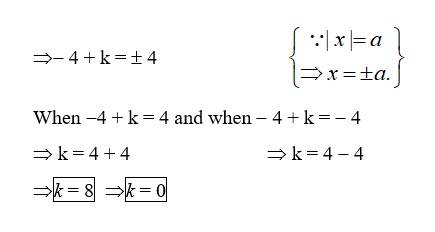
(i) Area of the triangle = 4 sq. units (given)

(ii) Area of the triangle = 4 sq units

 Upvote

25. Show that points
A (a, b + c), B (b, c + a), C (c, a + b) are collinear.
25. Show that points
A (a, b + c), B (b, c + a), C (c, a + b) are collinear.
The area of triangle from by the given points is area ( ΔABC) =
C1→ C1 + C2 + C3
Taking (a + b + c + 1) common from C1
= 0
Hence the points A, B C are collinear.
Upvote 24. Find area of the triangle with vertices at the point given in each of the following:
(i) (1, 0), (6, 0), (4, 3)
(ii) (2, 7), (1, 1), (10, 8)
(iii) (–2, –3), (3, 2), (–1, –8)
24. Find area of the triangle with vertices at the point given in each of the following:
(i) (1, 0), (6, 0), (4, 3)
(ii) (2, 7), (1, 1), (10, 8)
(iii) (–2, –3), (3, 2), (–1, –8)
(i) Area of triangle is given by,
Δ =

=7.5sq. units.
(ii) Area of the triangle is given by,
Δ =

= =23.5 sq. units
(iii) Area of triangle is given by,
Δ =

= 15 sq. units.
Upvote 23. Which of the following is correct
(A) Determinant is a square matrix.
(B) Determinant is a number associated to a matrix.
(C) Determinant is a number associated to a square matrix.
(D) None of these
23. Which of the following is correct
(A) Determinant is a square matrix.
(B) Determinant is a number associated to a matrix.
(C) Determinant is a number associated to a square matrix.
(D) None of these
Option 'C' is correct as determinant is a number associated to a square matrix.
Upvote 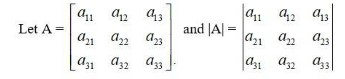
LHS =

Taking a, b&c common from R1, R2&R3
C1→ C2 + C3.
 Upvote
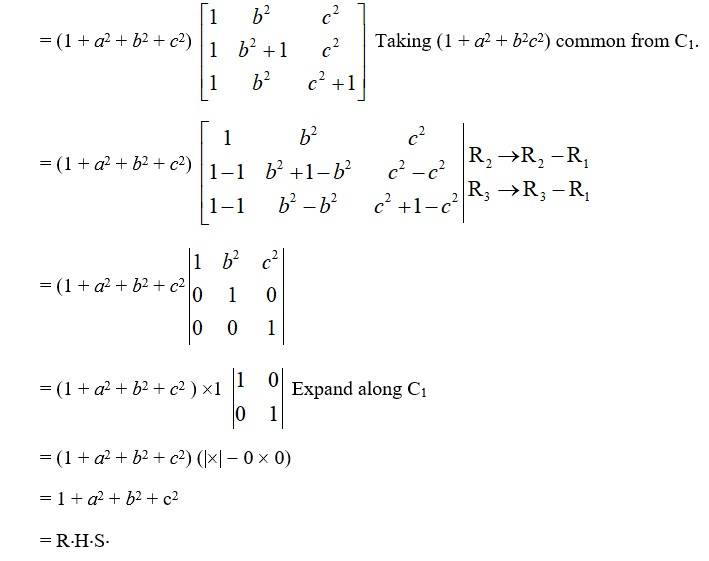
LHS =


= (1 + a2 + b2)2 [(1 -a2 + b2) - 2a (-a)]
= (1 + a2 + b2)2 (1 -a2 + b2 + 2a2)
= (1 + a2 + b2)2 (1 + a2 + b2)
= (1 + a2 + b2)3 = R.H.S.
Upvote LHS =
R1→ R1 + R2 + R3
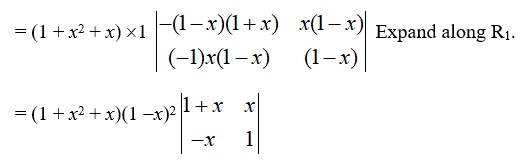

= (1 + x2 + x) (1 -x)2 [ (1 + x)× 1 - (-x) x].
= (1 + x2 + x) (1 -x)2 (1 + x + x2).
= { (1 + x2 + x) (1 -x)}2
= {1 -x + x2-x3 + x-x2}2
= (1 -x3)2 = R.H.S.
Upvote (i) LHS =
R1→ R1 + R2 + R3
= (a + b + c) Taking (a + b + c) common from R1
= (a + b+ c)
= (a + b + c)
= (a + b + c) × 1. Expand along R1
= (a + b + c){(a + b + c)2- 0}
= (a + b +c)3 = R.H.S
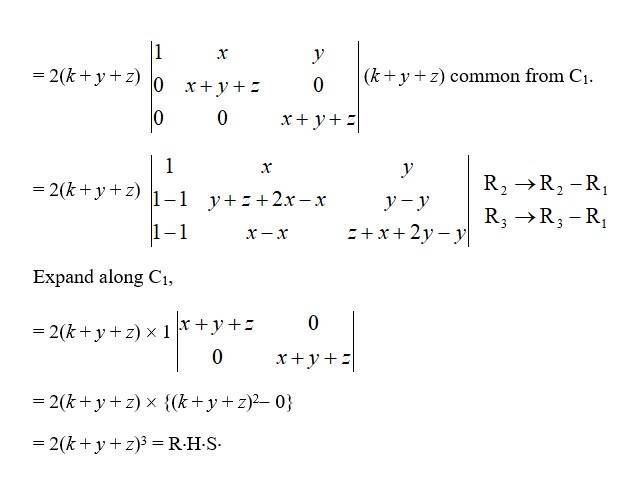
(ii) LHS =
C1→ C1 + C2 + C3.
= 2 (k + y + z) Taking 2
 Upvote

(i) LHS =
R1→R1 + R2 + R3
Taking (5x + 4) common from R1.

= (5x + 4)[0 - (4 -x)(x- 4)]
= (5x + 4)(4 -x)(4 -x)
= (5x + 4)(4 -x)2 = R.H.S.

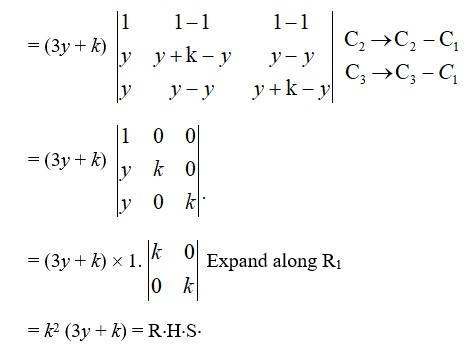
= R1→R1 + R2+ R3
= (3y + k)
Upvote