
Ncert Solutions Maths class 12th
Get insights from 2.5k questions on Ncert Solutions Maths class 12th, answered by students, alumni, and experts. You may also ask and answer any question you like about Ncert Solutions Maths class 12th
- 2.5k
Questions
- 0
Discussions
- 1
Active Users
- 65
Followers
Have a question about Ncert Solutions Maths class 12th? Ask our experts
Keep it short & simple. Type complete word. Avoid abusive language.
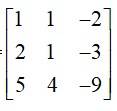 ,find | A |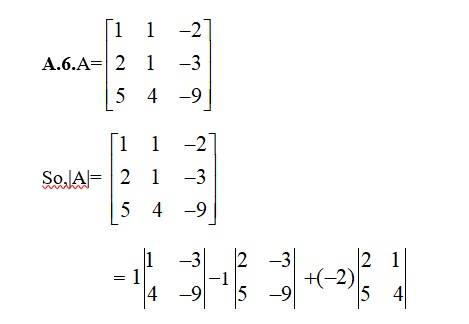
= 1 [1× (−9) – 4× (−3)]–1 [2× (–9)–5× (– 3)]– 2 [2×4 −5×1]
= 1 [− 9 + 12] −1 [− 18+15] − 2 [8 − 5]
= 3 + 3 −6
= 0
 Upvote

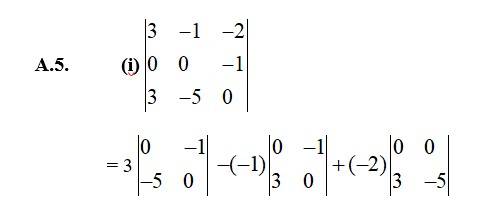
= 15 + 3
= 12

=3 [1×1− (−2)×3]+4 [1×1− (−2)×2]+5 [3×1−2×1]
= 3 [1+6]+4 [1+4]+5 (3−2)
= 3×7+4×5+5×1
= 21+20+5
= 46

= 0 –1 [ − 1×0 – (−2)× (−3)] + 2 [−1×3 – (−2)×0]
= (− 1)× ( − 6)+2 (− 3)
= 6 – 6
= 0

= 2 [2×0− ( − 5)× (−1)]+3 [ (−1)× (− 1) – (− 2)×2]
= 2 (−5)+3 (1+4)
= 2 (−5) + 3× (5)
= −10+15
= 5
Upvote 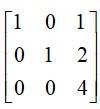 ,then show that | 3 A | = 27 | A |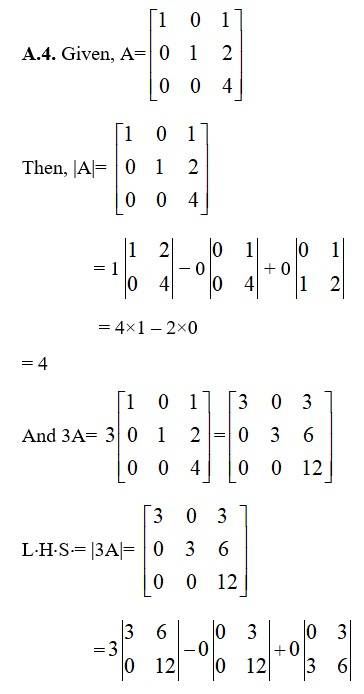
=3 [36 – 6×0]
= 108
RHS = 27. |A| = 27 4 = 108
∴ LHS = RHS
Upvote Given, A=
So, 2A= 2
= .
L.H.S. = = = 2×4 – 4×8 = 8−32 = −24
R.H.S. = 4 = 4 = 4 (1×2 – 2×4)
= 4 [2 − 8]
= 4 [−6] = 24.
LHS = RHS
Upvote (i)
= cos²θ + sin²θ
=1
(ii)
= + − − + +1 – + 1
= - + 2
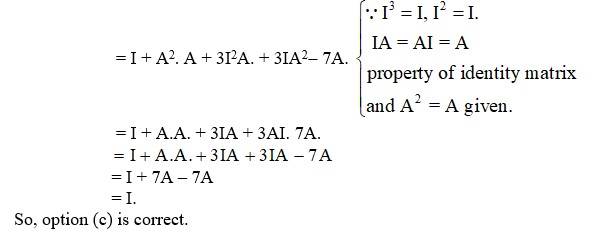
Upvote 77. If A is square such that A2 = A, then (I + A)3 – 7A is equal to
(A) A (B) I – A (C) I (D) 3A
77. If A is square such that A2 = A, then (I + A)3 – 7A is equal to
(A) A (B) I – A (C) I (D) 3A
Given, A2= A.
(E) we need to calculate,
(I + A)3- 7A = I3 + A3 + 3IA (I + A) - 7A { (x + y)3 = x3 + y3 + 3xy (a + y)}
 Upvote
 76.If the matrix A is both symmetric and skew symmetric, then
(A) A is a diagonal matrix (B) A is a zero matrix
(C) A is a square matrix (D) None of these
76.If the matrix A is both symmetric and skew symmetric, then
(A) A is a diagonal matrix (B) A is a zero matrix
(C) A is a square matrix (D) None of these
Given, A is both symmetric and skew-symmetric.
(E) Then, A' = A ____ (1) and A' = -A ____ (2)
So using (2), A' = -A.
A = -A {eqn (I)}
A + A = 0
2A = 0
A = 0.
A is a zero matrix
So, option B is correct.
Upvote 
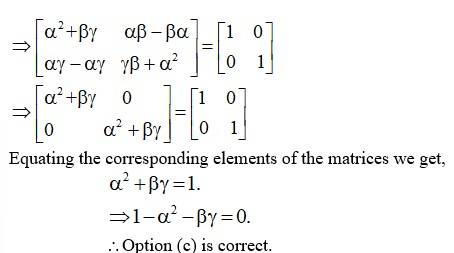
74. If A and B are square matrices of the same order such that AB = BA, then prove by induction that ABn = BnA. Further, prove that (AB)n = AnBn for all n Î N.
74. If A and B are square matrices of the same order such that AB = BA, then prove by induction that ABn = BnA. Further, prove that (AB)n = AnBn for all n Î N.
We have, AB = BA. (given)
(E) P (n):AB’ = B’A.
P (i):AB1 = B1A. Þ AB = BA
so, the result is true for n = 1.
Let the result be true for n = k.
P (k):ABk = BkA
Then,
P (k + 1) : ABk + 1 = A. Bk. B = BkA.B = Bk.BA
= Bk + 1.A .
So, ABk + 1 = Bk + 1A.
The result also holds for n = k + 1.
Hence, AB^n = B^n A^n ho
Upvote