
Ncert Solutions Maths class 12th
Get insights from 2.5k questions on Ncert Solutions Maths class 12th, answered by students, alumni, and experts. You may also ask and answer any question you like about Ncert Solutions Maths class 12th
- 2.5k
Questions
- 0
Discussions
- 1
Active Users
- 65
Followers
Have a question about Ncert Solutions Maths class 12th? Ask our experts
Keep it short & simple. Type complete word. Avoid abusive language.

Given A = [ ]
So;
∴ A2 - 5A + 7I =
Hence Showed.
 Upvote


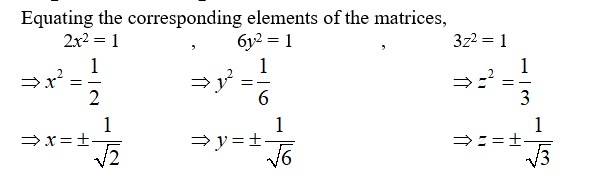
68. Find the values of x, y, z if the matrix A = satisfy the equation A’A = I.
68. Find the values of x, y, z if the matrix A = satisfy the equation A’A = I.
67. Show that the matrix B’AB is symmetric or skew symmetric according as A is symmetric or skew symmetric.
67. Show that the matrix B’AB is symmetric or skew symmetric according as A is symmetric or skew symmetric.
We have,
(E) (B'AB)' = [B' (AB]'
= (AB)' (B')'
= B'A'B.
When A is symmetric, A' = A
(B'AB)' = B'AB
ie, B'AB is symmetric.
And when A is skew-symmetric, A1 = -A
(B'AB)' = -B'AB.
ie, B'AB is skew-symmetric.
Upvote 66. If A and B are symmetric matrices, prove that AB – BA is a skew symmetric matrix.
66. If A and B are symmetric matrices, prove that AB – BA is a skew symmetric matrix.
Given, A and B are symmetric matrices.
(E) Then A' = A and B' = B.
Now, (AB - BA)' = (AB)' - (BA)'
= B'A' - A'B'
= BA - AB
= - (AB - BA).
Hence, AB BA is skew-symmetric matrix
Upvote 65. If A = , then prove that An = , where n is any positive integer.
65. If A = , then prove that An = , where n is any positive integer.
We have,

The results also holds for n = k + 1. Hence, An
Holds for all natural number n.
Upvote We have,
(E) P (n) : If A =
]. then An = n ? N.
P (1) : A1= = =
]
So, the result holds true for n = 1.
Let the result be for n = k. So,
P (k): Au=
Then P (k+1): Ak + 1 = Ak. A =
]
=
= Ak + 1 =
The result holds for n = k + 1. Hence,
An = holds fo
Upvote