
Photoelectric Effect
Get insights from 18 questions on Photoelectric Effect, answered by students, alumni, and experts. You may also ask and answer any question you like about Photoelectric Effect
- 18
Questions
- 0
Discussions
- 0
Active Users
- 0
Followers
Have a question about Photoelectric Effect? Ask our experts
Keep it short & simple. Type complete word. Avoid abusive language.
Maximum wavelength of light source such that photoelectron can be ejected from material of work function 3 eV is
Maximum wavelength of light source such that photoelectron can be ejected from material of work function 3 eV is
In a photoelectric experiment, frequency f = 1.5f0 (f0 : threshold frequency). If the frequency of light is changed to f/2, then photocurrent becomes (intensity of light has doubled)
In a photoelectric experiment, frequency f = 1.5f0 (f0 : threshold frequency). If the frequency of light is changed to f/2, then photocurrent becomes (intensity of light has doubled)
Kindly go through the solution
Since
->current = 0
 Upvote

Photocell works on photoelectric effect.
Upvote The work function of a metal is w0 and l is wavelength of incident radiation. There is no emission of photoelectron when
The work function of a metal is w0 and l is wavelength of incident radiation. There is no emission of photoelectron when
For no emission of electron
λ > λ0
Q λ0 = hc/w0, so λ > hc/w0
Upvote The work function of a metal is w0 and is wavelength of incident radiation. There is no emission of photoelectron when
The work function of a metal is w0 and is wavelength of incident radiation. There is no emission of photoelectron when
For no emission of electron
Upvote Two stream of photons, possessing energies equal to twice and ten times the work function of metal are incident on the metal surface successively. The value of ratio of maximum velocities of the photoelectrons emitted in the two respective cases is x : y. The value of x is………
Two stream of photons, possessing energies equal to twice and ten times the work function of metal are incident on the metal surface successively. The value of ratio of maximum velocities of the photoelectrons emitted in the two respective cases is x : y. The value of x is………
Case I :-
Case II :-
-
Upvote The electric field at a point associated with a light wave is given by
E = 200
Given : h = 4.14 × 10⁻¹⁵ eVs
If the light fall on a metal surface having a work function of 2.50 eV, the maximum kinetic energy of the photoelectrons will be
The electric field at a point associated with a light wave is given by
E = 200
Given : h = 4.14 × 10⁻¹⁵ eVs
If the light fall on a metal surface having a work function of 2.50 eV, the maximum kinetic energy of the photoelectrons will be
The light wave contains two lights of different frequencies, so
Maximum kinetic energy of the photoelectron = 5.9-2.5 = 3.42 eV
Upvote Figure shows the anode potential vs photo-current graph when photons of 6 eV are incident on cathode in a photoelectric experiment set-up. In the same experimental set-up, if photons of 8 eV and same intensity are incident on cathode, then anode-potential vs photo-current graph will be (assume 100% efficiency of photons to eject photo-electrons in both cases)
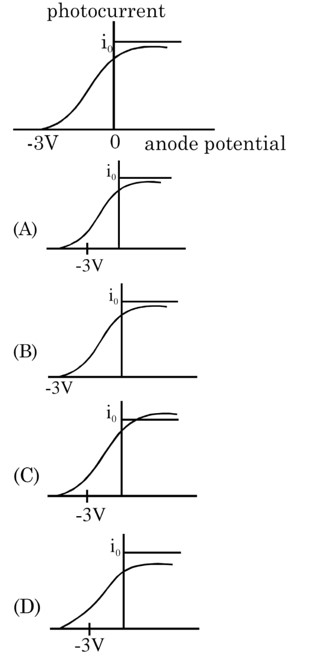
Figure shows the anode potential vs photo-current graph when photons of 6 eV are incident on cathode in a photoelectric experiment set-up. In the same experimental set-up, if photons of 8 eV and same intensity are incident on cathode, then anode-potential vs photo-current graph will be (assume 100% efficiency of photons to eject photo-electrons in both cases)
Stopping potential increases and number of photons decreases.
Upvote When monochromatic light of wavelength 620 nm is used to illuminate a metallic surface, the maximum kinetic energy of photoelectrons emitted is 1 eV. Find the maximum kinetic energy of photoelectron emitted (in eV) if a wavelength of 155 nm is used on the same metallic surface. (hc = 1240 eV-nm)
When monochromatic light of wavelength 620 nm is used to illuminate a metallic surface, the maximum kinetic energy of photoelectrons emitted is 1 eV. Find the maximum kinetic energy of photoelectron emitted (in eV) if a wavelength of 155 nm is used on the same metallic surface. (hc = 1240 eV-nm)
In case 1, E? = 2eV; φ? ? = E? - KE? = 1eV
In case 2, E? = 12400/1550 = 8eV; max.KE = 8eV - 1eV = 7eV
Upvote