
Physics Magnetism and Matter
Get insights from 56 questions on Physics Magnetism and Matter, answered by students, alumni, and experts. You may also ask and answer any question you like about Physics Magnetism and Matter
- 56
Questions
- 0
Discussions
- 0
Active Users
- 0
Followers
Have a question about Physics Magnetism and Matter? Ask our experts
Keep it short & simple. Type complete word. Avoid abusive language.
In ferromagnetic material, below Curie's temperature, a domain is defined as macroscopic region with zero magentisation.
 Upvote

Match List-I with List-II.
List-I List-II
(Material) (Susceptibility ( ))
A. Diamagnetic I. <!--[endif]--><!-- [if gte mso 9]><xml>
B. Ferromagnetic II. <!--[endif]--><!-- [if gte mso 9]><xml>
C. Paramagnetic III. <!--[endif]--><!-- [if gte mso 9]><xml>
D. Non-magnetic IV. (a small positive number)
Choose the correct answer from the options given below
(Material) (Susceptibility ( )
Diamagnetic (II)
Ferromagnetic (III)
Paramagnetic &nbs
Upvote In a uniform magnetic field of 0.049 T, a magnetic needle performs 20 complete oscillations in 5 seconds as shown. The moment of inertia of the needle is . If the magnitude of magnetic moment of the needle is , then the value of ' ' is :
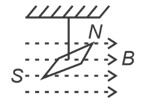
In a uniform magnetic field of 0.049 T, a magnetic needle performs 20 complete oscillations in 5 seconds as shown. The moment of inertia of the needle is . If the magnitude of magnetic moment of the needle is , then the value of ' ' is :
Time period of Oscillation,
Upvote True dip is less than the apparent dip.
Upvote Statement I : The ferromagnetic property depends on temperature. At high temperature, ferromagnet becomes paramagnet.
Statement II : At high temperature, the domain wall are of a ferromagnetic substance increases.
In the light of the above statements, choose the most appropriate answer from the options given below:
Statement I : The ferromagnetic property depends on temperature. At high temperature, ferromagnet becomes paramagnet.
Statement II : At high temperature, the domain wall are of a ferromagnetic substance increases.
In the light of the above statements, choose the most appropriate answer from the options given below:
I : at high temperature, ferromagnet becomes paramagnet.
II : at high temperature, domains of ferromagnet will break
Upvote The magnetic susceptibility of a material of a rod is 499. Permeability in vacuum is 4π × 10-7 H/m. Absolute permeability of the material of the rod is:
The magnetic susceptibility of a material of a rod is 499. Permeability in vacuum is 4π × 10-7 H/m. Absolute permeability of the material of the rod is:
Given
As we know that
Relative permeability
Absolute permeability =
Upvote Following plots show Magnetization (M) vs Magnetising field (H) and Magnetic susceptibility <!-- [if gte mso 9]><xml>
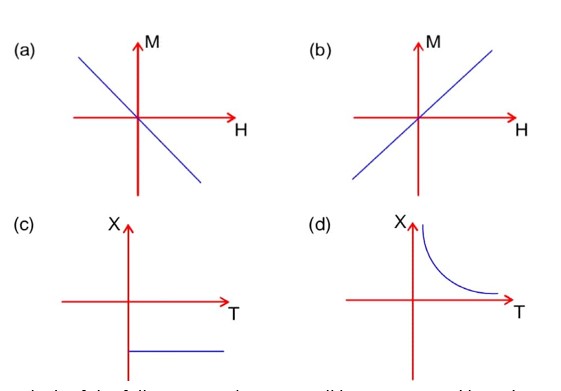
Which of the following combination will be represented by a diamagnetic material?
Following plots show Magnetization (M) vs Magnetising field (H) and Magnetic susceptibility <!-- [if gte mso 9]><xml>
Which of the following combination will be represented by a diamagnetic material?
Magnetization (M) is directly proportional to magnetizing field and magnetic susceptibility does not depend on temperature so option 3 is correct.
Upvote A long solenoid with 1000 turns/m has a core material with relative permeability 500 and volume 103 cm3. If the core material is replaced by another material having relative permeability of 750 with same volume maintaining same current of 0.75A in the solenoid, the fractional change in the magnetic moment of the core would be approximately <!-- [if gte mso 9]><xml>
A long solenoid with 1000 turns/m has a core material with relative permeability 500 and volume 103 cm3. If the core material is replaced by another material having relative permeability of 750 with same volume maintaining same current of 0.75A in the solenoid, the fractional change in the magnetic moment of the core would be approximately <!-- [if gte mso 9]><xml>
Following plots show Magnetization (M) vs Magnetising field (H) and Magnetic susceptibility <!-- [if gte mso 9]><xml>
Which of the following combination will be represented by a diamagnetic material?
Following plots show Magnetization (M) vs Magnetising field (H) and Magnetic susceptibility <!-- [if gte mso 9]><xml>
Which of the following combination will be represented by a diamagnetic material?
Magnetization (M) is directly proportional to magnetizing field and magnetic susceptibility does not depend on temperature so option 3 is correct.
Upvote