

physics ncert solutions class 11th
Get insights from 951 questions on physics ncert solutions class 11th, answered by students, alumni, and experts. You may also ask and answer any question you like about physics ncert solutions class 11th
Follow Ask QuestionQuestions
Discussions
Active Users
Followers
New answer posted
10 months agoContributor-Level 10
(a) The given function is sin t – cos t
= =
= )
This function represents SHM as it can be written in the form: a sin ( t + )
Its period is . It is periodic, but not SHM
(b) Sin3 t =
The terms t and t individually represents simple harmonic motion. However, the superposition of two SHM is periodic but not simple harmonic.
(c) The given function is 3 cos ( /4 – 2 t) = -3cos(2 t - /4)
This function represents simple harmonic motion because it can be written in the form: a cos(
New answer posted
10 months ago
Contributor-Level 10
(a) It is not a periodic motion. It represents a unidirectional, linear uniform motion. There is no repetition of motion
(b) In this case, the motion of the particle repeats itself after 2 s. Hence, it is a periodic motion, having a period of 2 s
(c) It is not a periodic motion. This is because the particle repeats the motion in one position only. For a periodic motion, the entire motion of the particle must be repeated in equal intervals of time
(d) In this case, the motion of the particle repeats itself after 2 s. Hence, it is periodic motion, having a period of 2 s
New answer posted
10 months agoContributor-Level 10
(a) During its rotation about its axis, earth comes to the same position again and again in equal intervals of time. Hence it is a periodic motion. However, this motion is not simple harmonic, as earth does not have to and fro motion about its axis.
(b) An oscillating mercury column in a U-tube is simple harmonic. This is because the mercury moves to and fro on the same path, about the fixed position, with a certain period of time.
(c) The ball moves to and fro about the lowermost point of the bowl when released. Also the ball comes back to its initial position in the same period of time, again and again. Hence, its motion
New answer posted
10 months agoContributor-Level 10
(a) The swimmer's motion is not periodic. The motion of the swimmer between the banks of a river is back and forth. However, it does not have a definite period. This is because the time taken by the swimmer during his back and forth journey may not be the same.
(b) The motion of a freely-suspended magnet, if displaced from its N-S direction and released, is periodic. This is because the magnet oscillates about its position with a definite period of time.
(c) When a hydrogen molecule rotates about its centre of mass, it comes to the same position again and again, after an equal interval of time. Such motion is periodic.
&nbs
New question posted
10 months agoNew answer posted
11 months agoContributor-Level 6
Q.4.6 Establish the following vector inequalities geometrically or otherwise:
(a) |a+b| < |a| + |b|
(b) |a+b| > |a|? |b|
(c) |a? b| < |a| + |b|
(d) |a? b| > |a|? |b|
New answer posted
11 months agoContributor-Level 10
velocity of a freely falling body is v=
And
-1
The wavelength of a photon needed to remove a proton from a nucleus which is bound to the nucleus with 1 MeV energy is nearly
a) 1.2 nm (b) 1.2 x 10⁻³ nm
(c) 1.2 x 10⁻⁶ nm (d). 1.2 x 10 nm
New answer posted
11 months agoContributor-Level 10
(d)

We can write
OS + PS > OP …….(i)
OS > PS – OP …….(ii)
+ ….(iii)
The quantity on the LHS is always positive and that on the RHS can be positive or negative. To make both quantities positive, we take modulus of both sides as:
> ….(iv)
If the two vectors and act along a straight line but in the opposite direction, then we can write = -
Combining (iv) and (v), we get
-
New answer posted
11 months ago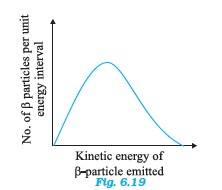
Contributor-Level 10
6.30 The decay process of free neutron at rest is given as:
n
From Einstein's mass-energy relation, we have the energy of electron as? where,
? m = Mass defect = Mass of neutron – ( Mass of proton + mass of electron)
c = speed of light
? m and c are constant. Hence, the given two-body decay is unable to explain the continuous energy distribution in the -decay of a neutron or a nucleus. The presence of neutrino von the LHS of the decay correctly explain the continuous energy distribution.
New answer posted
11 months ago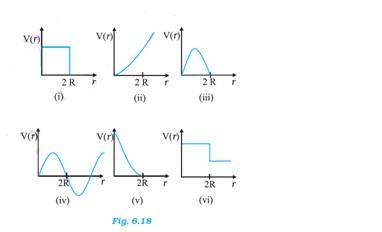
Contributor-Level 10
6.29 The potential energy of two masses in a system is inversely proportional to the distance between them. The potential energy of the system of two balls will decrease as they get closer to each other. When the balls touch each other, the potential energy becomes zero, I.e. at r = 2R. The potential energy curve in (i), (ii), (iii), (iv) and (vi) do not satisfy these conditions. So there is no elastic collision.
Taking an Exam? Selecting a College?
Get authentic answers from experts, students and alumni that you won't find anywhere else
Sign Up on ShikshaOn Shiksha, get access to
- 66k Colleges
- 1.2k Exams
- 687k Reviews
- 1800k Answers