

Physics
Get insights from 5.6k questions on Physics, answered by students, alumni, and experts. You may also ask and answer any question you like about Physics
Follow Ask QuestionQuestions
Discussions
Active Users
Followers
New answer posted
a year ago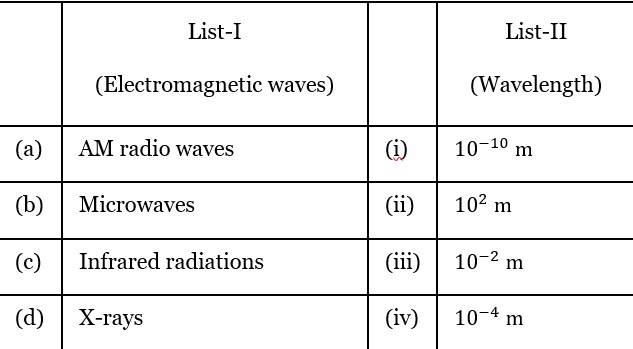
Contributor-Level 9
(a) Radio wave (ii)
(ii)
(b) Microwave
(iii)
(iii)
(c) Infrared radiations (iv) (iv)
(d) - ray (i) (i)
(a) - (ii), (b) - (iii), (c) - (iv), (d) - (i)
New answer posted
a year agoContributor-Level 10
You can identify whether a medium has higher or lower refractive index through the three ways. The first step is to observe the direction of bending. In this case, if the light is bending towards the normal, the second medium has higher refractive index. If the light bends away from normal, first medium has higher index of refraction.
In the second method, you can use Snell's law. If the second angle is smaller than the first one, second medium has higher refractive index. In case the first angle is smaller than second one, first medium has higher index of refraction. The third method is critical angle method where, if the light u
Taking an Exam? Selecting a College?
Get authentic answers from experts, students and alumni that you won't find anywhere else
Sign Up on ShikshaOn Shiksha, get access to
- 67k Colleges
- 1.2k Exams
- 718k Reviews
- 1850k Answers