

Physics
Get insights from 5.6k questions on Physics, answered by students, alumni, and experts. You may also ask and answer any question you like about Physics
Follow Ask QuestionQuestions
Discussions
Active Users
Followers
New answer posted
a year agoContributor-Level 10
When these two media are compared, then, it is evident that rarer medium has lower refracted index as compared to denser medium. Denser media like glass and water have higher refractive index whereas rarer medium like air and vacuum have lower refractive index. Due to this, the light will bend towards the normal when it travels from rarer to denser medium. On the other hand, light will bend away from normal when it travels from denser to a rarer medium.
New answer posted
a year agoContributor-Level 10
Whenever a light ray travels from a rarer medium to a denser medium through a spherical surface, relationship between object distance (u), image distance (v), radius of curvature (R) and refractive index ( and ) is given by refraction formula for spherical surfaces as follows.
- is the refractive index of medium that contains the object (on the left side)
- is refractive index of medium that will contain the image (on the right side)
New answer posted
a year agoContributor-Level 10
This is because the terms used in rotational motion are analogous to the terms used in linear motion and can interchange each other with variation in the topic since their meaning is exactly the same. For example, what you call force in linear motion can be called torque in terms of rotational motion. Just replace the linear terms with angular terms and you are done with the major process.
New answer posted
a year agoContributor-Level 10
This is because using radians will simplify the procedure of solving various numerical problems and complex mathematical equations. They help consider the terms such as arc length, centre, radius etc. directly into account which are connected to a circular path which eases our task of computing the formulas.
New answer posted
a year agoContributor-Level 10
This is the type of acceleration due to which a circular moment of the object is possible. This force constantly directs the motion of the body towards the centre of gravitation. Without this motion, the object will move away in a straight line. It ensures that the object stays in a circular path by changing the direction of object's velocity towards the centre.
New answer posted
a year ago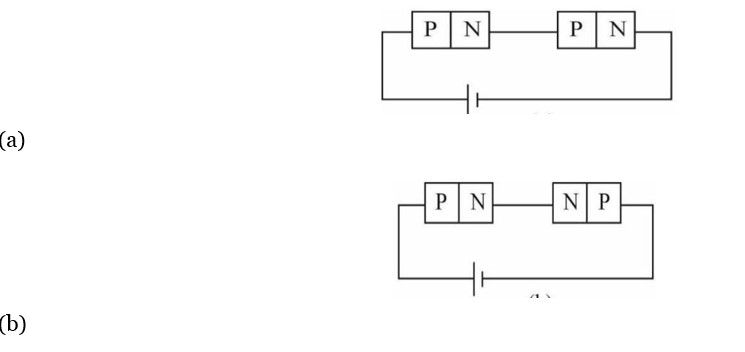
Contributor-Level 9
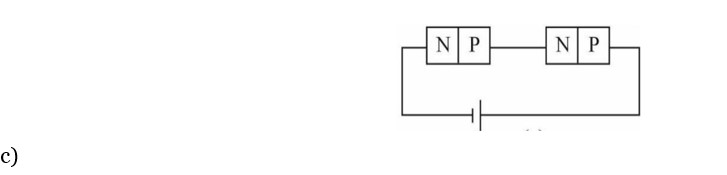
In (a) & (c) circuits, both the junctions are in same biasing conditions so offers equal resistances.
Taking an Exam? Selecting a College?
Get authentic answers from experts, students and alumni that you won't find anywhere else
Sign Up on ShikshaOn Shiksha, get access to
- 67k Colleges
- 1.2k Exams
- 718k Reviews
- 1850k Answers