Physics

Get insights from 5.6k questions on Physics, answered by students, alumni, and experts. You may also ask and answer any question you like about Physics

Follow Ask Question
5.6k

Questions

0

Discussions

28

Active Users

0

Followers

New answer posted

11 months ago

0 Follower 1 View

S
Syed Aquib Ur Rahman

Contributor-Level 10

Both torque and angular momentum have direction. We determine their direction based on the right-hand rule. That makes them vector quantities in rotational motion. 

New answer posted

11 months ago

0 Follower 1 View

S
Syed Aquib Ur Rahman

Contributor-Level 10

Yes, an object can have angular momentum without torque. The physics behind it is that if no external force act on an object, its angular momentum is constant. That is based on the law of conservation of momentum. 

New answer posted

11 months ago

0 Follower 2 Views

S
Syed Aquib Ur Rahman

Contributor-Level 10

Torque is the measure of rotational force on an object (rigid or extended body). It changes the object's angular momentum. To calculate in physics, torque equals the rate of change of angular momentum. The formula for that is

? = d L d t  

New answer posted

11 months ago

0 Follower 2 Views

A
alok kumar singh

Contributor-Level 10

Structure of Bithinol is;


New answer posted

11 months ago

0 Follower 4 Views

A
alok kumar singh

Contributor-Level 10

C = 500   μ F , V = 100 v, L = 50 mH                                                        

In this LC – oscillation

q = q0 cos   ω t

i = d q d t = q 0 ω s i n ω t ω = 1 2 c = 1 5 0 * 1 0 3 * 5 * 1 0 4

1 0 0 0 5 = 2 0 0  

So,     imax =   q 0 ω = 5 0 0 * 1 0 6 * 1 0 0 * 2 0 0

= 10A


New answer posted

11 months ago

0 Follower 2 Views

A
alok kumar singh

Contributor-Level 10

  λ A = 2 5 λ , λ B = 1 6 λ      

At t = 0 Þ NA = NB = N0

after t =  1 a λ : N B N A = N 0 e 1 6 λ t N 0 e 2 5 λ t = e ( 2 5 λ 1 6 λ ) t  

->e =  e ( 9 λ 1 a λ )  


9 a = 1 a = 9      

New answer posted

11 months ago

0 Follower 3 Views

A
alok kumar singh

Contributor-Level 10

i ( z e n e r m a x ) = 2 5 m A                                                                

 20 – imax R – 8 = 0

imax R = 12At minimum zener current ( μ A ) :  

2 0 i m i n R i m i n R L = 0  

  R R L = 1 2 8 = 3 2

l m i n R = 1 2

  i m i n R L = 8

At maxm zener current –

2 0 i m a x R 8 = 0  

i L = O { a s i z m a x m = 2 5 m A }             

imaxR = 12v

25 * 10-3 R = 12

R = 1 2 * 1 0 3 2 5 = 1 2 * 4 0 = 4 8 0 Ω


New answer posted

11 months ago

0 Follower 17 Views

V
Vishal Baghel

Contributor-Level 10

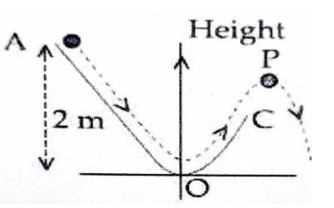
From conservation of Energy

1 2 m v 0 2 = m g h

v 0 = 1 0 2

For A to B

a = g s i n 4 5 ° = 1 0 2

T = t1 + t2

= 2 2 + 2 = 2 ( 2 + 1 )

New answer posted

11 months ago

0 Follower 4 Views

A
alok kumar singh

Contributor-Level 10

geff = g –   ( ρ w ρ b ) g

T = 2 π l g

T ' = 2 π l g e f f

T ' = 5 4 T

  5 4 * 1 0

  5 5 s e c

So, x = 5

New answer posted

11 months ago

0 Follower 7 Views

V
Vishal Baghel

Contributor-Level 10

.From conservation of energy

mgh = 1 2 m v 2 + 1 2 l ω 2

m g h = 1 2 m v 2 + 1 2 m R 2 2

10 h = 1 6 2 + 1 6 4

h = 1.2 m = 120 cm

Get authentic answers from experts, students and alumni that you won't find anywhere else

Sign Up on Shiksha

On Shiksha, get access to

  • 66k Colleges
  • 1.2k Exams
  • 705k Reviews
  • 1850k Answers

Share Your College Life Experience

×

This website uses Cookies and related technologies for the site to function correctly and securely, improve & personalise your browsing experience, analyse traffic, and support our marketing efforts and serve the Core Purpose. By continuing to browse the site, you agree to Privacy Policy and Cookie Policy.