

Physics
Get insights from 5.6k questions on Physics, answered by students, alumni, and experts. You may also ask and answer any question you like about Physics
Follow Ask QuestionQuestions
Discussions
Active Users
Followers
New answer posted
a year agoContributor-Level 10
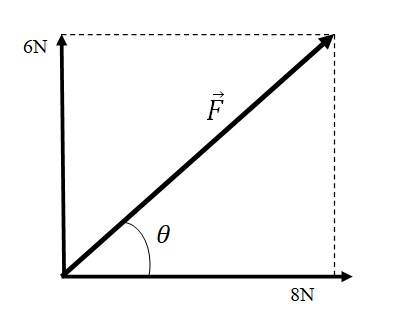
The resultant force F of the two forces 6N and 8N is given by,
F = = 10 N
Acceleration is given by F = ma, a = F/m = 10/5 m/s2 = 2 m/s2
= 6/8, = 36.86
New answer posted
a year agoContributor-Level 10
Initial speed, u = 2.0 m/s, the final speed v = 3.5 m/s, the time t = 25 s
From the relation v = u + at, we get acceleration a = (v-u)/t = (3.5 – 2.0 )/ 25s = 0.06 m/s2
The force F = ma, F = 3 0.06 N = 0.18 N
New answer posted
a year agoContributor-Level 10
The retarding force, F = 50N, the mass m = 20 kg
From the equation F = ma, we get acceleration a = 50 / 20 m/s2 = 2.5 m/s2
The initial speed, u = 15 m/s, the final speed v =0, from the relation v = u-at, we get
T = u/a = 15/2.5 s = 6s
New answer posted
a year agoContributor-Level 10
(a) Mass of the stone, m = 0.1 kg, Acceleration due to gravity = 10 m/s2
Net force = 0.1 10 N = 1.0 N. The direction of force is downwards
(b) Since the train is moving at a constant velocity, the acceleration imparted by the train is zero. Only acceleration acting on the stone is gravity. So the force will be 1.0 N, acting downwards
(c) The acceleration of the train = 1 m/s2 so the force exerted by the train = 0.1 1 N = 0.1 N and it is acting in the horizontal direction. But when the stone is dropped, the force started acting on the stone is only due to gravity, the train moving force has no effect. So the net
New answer posted
a year agoContributor-Level 10
(a) During the upward motion f the pebble, the acceleration due to gravity acts downwards. The magnitude of the force is
F = MA = 0.05 kg 10 m/s2 = 0.5 N and the direction of force is downwards.
(b) During its downward motion – the force is 0.5 N and the direction is downwards.
(c) When the pebble is thrown at an angle of 45 with the horizontal direction, it will have both horizontal component of force and vertical component of force during its upward journey, When it reaches the maximum height, the vertical component of velocity will becomes zero and the force acting will be 0.5 N and acting downwards.
New answer posted
a year agoContributor-Level 10
(a) Since the raindrop is falling at a constant speed, the acceleration is zero. When the acceleration is 0, the force acting on the drop will also become zero ( since F = ma)
(b) Since the cork is floating on water, the weight of the cork is balanced by upward force of water. So the net force on the cork is 0
(c) Since the kite is held stationary in the sky, the net force is 0
(d) Since the car is moving at a constant velocity, the acceleration is 0, hence the net force is also 0
(e) The net force acting on the high-speed electron will be zero since the electron is far from the material objects and free of electric and magnetic field
New answer posted
a year agoContributor-Level 10
Temperature inside the refrigerator, = 9 = 9 + 273 K = 282 K
Room temperature, = 36 = 36 + 273 = 309 K
Coefficient of performance = = = 10.44
Therefore, the coefficient of performance is 10.44
New answer posted
a year ago
Contributor-Level 10
Total work done by the gas from D to E to F = Area of = EF
Where DF = Change in pressure = 600 – 300 = 300 N/
FE = change in volume = 5-2 = 3
Area of 3 = 450 J
Therefore work done by the gas from D to E to F is 450 J.
New answer posted
a year agoContributor-Level 10
Heat is supplied to the system at a rate of 100W
Hence, heat supplied, Q = 100 J/s
The system performs at the rate of 75 J/s
Hence, work done, W = 75 J/s
From the 1st law of Thermodynamics, we have Q = U + W, where U is the internal energy
U = Q – W = 100 – 75 = 25 J/s = 25 W
Therefore the internal energy of the given electric heater increases at a rate of 25 W.
New answer posted
a year agoContributor-Level 10
Work done by the steam engine per minute, W = 5.4 J
Heat supplied by the boiler, H = 3.6 J
Efficiency of the engine, = = = 0.15
Amount of heat wasted = Input energy – Output energy
= 3.6 5.4 J
Taking an Exam? Selecting a College?
Get authentic answers from experts, students and alumni that you won't find anywhere else
Sign Up on ShikshaOn Shiksha, get access to
- 67k Colleges
- 1.2k Exams
- 718k Reviews
- 1850k Answers