

Physics
Get insights from 5.6k questions on Physics, answered by students, alumni, and experts. You may also ask and answer any question you like about Physics
Follow Ask QuestionQuestions
Discussions
Active Users
Followers
New answer posted
a year agoContributor-Level 10
Mass of the automobile, m = 3000 kg
Displacement of the suspension system, x = 15 cm = 0.15 m
There are 4 springs in parallel to the support of the mass of the automobile.
(a) The equation for restoring force for the system, F = -4kx = mg, where k is the spring constant of the suspension system
Time period, T = 2 and
k = = N/m
(b) Each wheel supports a mass, M = 3000/4 = 750 kg
For damping factor b, the equation for displacement is written as
x =
The amplitude of oscillation decrease by 50%. Therefore x = =
=
b =
T = 2 = 2 = 0.7773 s
b =
New answer posted
a year ago
Contributor-Level 10
Volume of the air chamber = V
Area of cross-section of the neck = a
Mass of the ball = m
The pressure inside the chamber is equal to atmospheric pressure.
Let the ball be depressed by x units. As a result of depression, there would be decrease in volume and an increase of pressure inside the cylinder.
Decrease in the volume, = ax
Volumetric strain = =
Bulk modulus of air, B = = : here stress is the increase in pressure. The negative sign indicates that pressure increases with a decrease in volume.
So p =
The restoring force acting on the ball, F = p = …. (i)
In SHM,
New answer posted
a year agoContributor-Level 10
Area of cross section of the U tube = A
Density of the mercury column =
Acceleration due to gravity = g
Restoring force, F = Weight of the mercury column of a certain height = - (Volume
F = -(A = -2A = -k
Where, 2h is the height of the mercury columns in two arms
The constant k is given by k = = 2A
Time period, T = 2 = 2 , where m is the mass of the mercury column
Let l be the length of the total mercury in the U tube
Mass of the mercury, m = Volume of the mercury density of mercury = Al
Hence T = 2 = 2
New answer posted
a year agoContributor-Level 10
Base area of the cork = A
Height of the cork = h
Density of the liquid =
Density of the cork =
In equilibrium, Weight of the cork = Weight of the liquid displaced by the floating cork
Let the cork be depressed slightly by an amount x, as a result, some extra water of a certain volume is displaced. Hence, an extra up-thrust acts upward and provides restoring force to the cork.
Up-thrust (Restoring force) = weight of the extra water displaced
F = mg =
Volume = Area distance through which the cork is depressed
V = Ax
F = A ….(i)
According to force law, F= kx, where k is constant
k = = A
New answer posted
a year agoContributor-Level 10
The bob of the simple pendulum will experience the acceleration due to gravity and the centripetal acceleration provided by the circular motion of the car.
Acceleration due to gravity = g
Centripetal acceleration = , where v is the uniform speed of the car and R is radius of the track.
Effective acceleration is given by
Time period, T = 2 , where l = length of the pendulum
New answer posted
a year agoContributor-Level 10
(a) The time period of a simple pendulum, T = 2
For a simple pendulum, k is expressed in terms of mass, m as : k or = constant
Hence, the time period of a simple pendulum is independent of the mass of the bob. In the case of a simple pendulum, the restoring force acting on bob is given as F = -mg , where
F = restoring force
m = mass of the bob
g = acceleration due to gravity
(b) For small sin . For larger sin is greater than . This decreases the effective value of g.
Hence the time period increase as : T = 2 , where l is the length of
New answer posted
a year agoContributor-Level 10
Acceleration due to gravity on Moon surface, g' = 1.7 m/
Acceleration due to gravity on Earth surface, g = 9.8 m/
Time period on Earth, T = 3.5 s
We know T = 2 where l = length of the pendulum
l = = = 3.041 m
On Moon surface, the length of the pendulum remained same = 3.041 m
So time period on moon surface, T' = 2 = 2 = 8.40 s
New answer posted
a year agoContributor-Level 10
Angular frequency of the piston,
Stroke = 1 m
Amplitude, A = Stroke/2 = 0.5 m
The maximum piston speed, A = 200 = 100 m/min
New answer posted
a year ago
Contributor-Level 10
(a) For figure (a) : When a force F is applied to the free end of the spring, an extension l is produced. For the maximum extension, it can be written as:
F – kl, where k is the spring constant.
For maximum =extension of the spring, l =
For figure (b): The displacement (x) produced in this case is x =
Net force F = +2kx = 2k . So l =
(b) For figure (a) : For mass (m) of the block, force is written as : F = ma = m ,
where x is the displacement of the block in time t, then
m , it is negative because the direction of the elastic force is opposite to the direction of displacement.
=&
New answer posted
a year agoContributor-Level 10
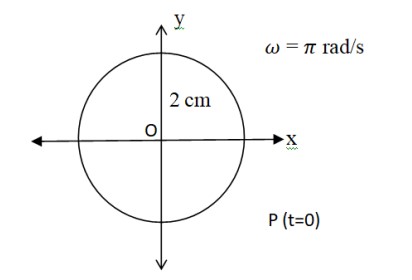
(a) X = -2 sin( 3t + ) = +2cos ( 3t + + = 2 cos (3t + )
when we compare this equation with standard SHM equation
x = Acos ( t + ), then we get
Amplitude A = 2 cm. Phase angle = 150 , angular velocity = 3 rad/s

(b) X= cos ( t) = cos ( )
when we compare this equation with standard SHM equation
x = Acos( t + ), then we get
Amplitude A = 1 cm. Phase angle = - 30 , angular velocity = 1 rad/s

(c) X = 3sin (2 t + ) = -3cos
when we compare this equation w

Taking an Exam? Selecting a College?
Get authentic answers from experts, students and alumni that you won't find anywhere else
Sign Up on ShikshaOn Shiksha, get access to
- 67k Colleges
- 1.2k Exams
- 718k Reviews
- 1850k Answers