

Physics
Get insights from 5.6k questions on Physics, answered by students, alumni, and experts. You may also ask and answer any question you like about Physics
Follow Ask QuestionQuestions
Discussions
Active Users
Followers
New answer posted
a year agoContributor-Level 10
Given
Mass of the helicopter m1 = 1000 kg
Mass of the crew and passenger m2 = 300 kg
The vertical acceleration of the helicopter, a = 15 m/s2 and acceleration due to gravity g = 10 m/s2
The total mass of the system, m = m1 + m2 = 1000 + 300 = 1300 kg
(a) Force on the floor by the crew and passengers :
R – m2g =m2a
R = m2 (g+a) = 300 ( 10 + 15 ) N = 7500 N
(b) Action of the rotor of the helicopter on the surrounding air
R' – mg = ma
R' = m (g+a) = 1300 = 32500 N
(c) Force on the helicopter due to the surrounding air
It is the reaction of the force applied by the rotor on the air. As action and reaction are
New answer posted
a year agoContributor-Level 10
The net force at the lowest point is denoted by (mg – T1)and the net force at the highest point is denoted by (mg + T2 ), hence option (a) is correct. The forces mg and T1 are in mutually opposite direction at the lowest point and mg and T2 are in the same direction at the highest point.
New answer posted
a year ago
Contributor-Level 10
The acceleration of the conveyer belt, a = 1 m/s2
Coefficient of static friction, = 0.2
Mass of the man, m = 65 kg
The net force experienced by the man, MA = 1 N = 65 N
This net force is due to the friction between the belt and the man
At maximum static friction
= = 0.2 m/s2
New answer posted
a year ago
Contributor-Level 10
This graph could be of a ball rebounding between two walls separated by a distance of 2 cm.
The ball rebounds every 2 secs between the walls with uniform velocity.
Velocity of rebounding = displacement / time = ( 2 )/2 = 0.01 m/s
Initial momentum = mu = 0.04 4 kgm/s
Final momentum = -mu = -4 kgm/s
Magnitude of Impulse = Initial momentum – final momentum = 8 kgm/s
The time between two consecutive impulses is 2 secs, so the ball receives an impulse every 2 seconds.
New answer posted
a year agoContributor-Level 10
(a) A horse can pull a cart by the reaction force generated by the ground to its feet. In an empty space, no reaction force will be generated and it cannot pull a cart.
(b) During the movement of the bus, passenger's whole body experiences the inertia of motion of the bus. When a bus brakes, the lower part comes to stand still along with the bus but the upper part continues with the same inertia of motion.
(c) While pulling a lawn mower, the vertical component of the applied force acts upwards and it reduces the effective weight of the lawn mower, make it easy to operate. In case of pushing the lawn mower, the vertical com
New answer posted
a year agoContributor-Level 10
(a) & (c) solution not possible as the stone will fly off tangentially. The answer is (b)
New answer posted
a year agoContributor-Level 10
Mass of the stone, m = 0.25 kg
Radius of the circular path = 1.5 m
Speed = 40 rev/min = 0.67 rev/s
Angular velocity, = 2 = 2 = 4.19 rev/s
The tension of the string, T = m r = 0.25 = 6.59 N
Maximum tension of the string, = 200 N
From the equation = /r, =
= 200 /0.25
= 34.64 m/s
New answer posted
a year agoContributor-Level 10
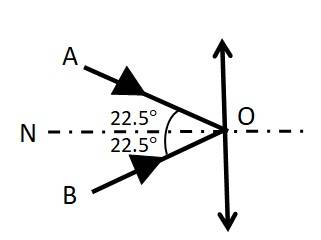
Velocity of the ball, u = 54 km/h = 15 m/s, mass of the ball, m = 0.15 kg
The ball is deflected back such that the included angle is 45
The initial momentum of the ball, along the direction of NO is = mu = 0.15 15 cos 22.5 = 2.0787 kg-m/s
The final momentum of the ball = mu along ON
Impulse = change of momentum = mu - (-mu ) = 2mu = 4.16 kg-m/s
New answer posted
a year agoContributor-Level 10
The mass of the shell, m = 0.020 kg
The mass of the gun, M = 100 kg
Speed of the shell, v = 80 m/s
The initial velocity of the shell and the gun = 0, so the initial momentum of the system = 0
Applying the law of conservation of momentum, the initial momentum = final momentum
0 = mv – MV, where V is the recoil speed of the gun
V = mv/M = 0.020 80 / 100 = 0.016 m/s
New answer posted
a year agoContributor-Level 10
Mass of each ball, m = 0.05 kg
Initial velocity of each ball, u = 6 m/s
The initial momentum of each ball before collision = mu = 0.05 x 6 = 0.3 kg-m/s
After the collision, the ball changes the direction of motion without the change in magnitude of the velocity, so
The final momentum after collision of the first ball = - 0.05 6 = - 0.3 kg-m/s
The final momentum after collision of the second ball = 0.05 6 = 0.3 kg-m/s
Impulse imparted to the first ball = (-0.3) – (0.3) = -0.6 kg-m/s
Impulse imparted to the second ball = (0.3) – (-0.3) = 0.6 kg-m/s
The two impulses are opposite in direction.
Taking an Exam? Selecting a College?
Get authentic answers from experts, students and alumni that you won't find anywhere else
Sign Up on ShikshaOn Shiksha, get access to
- 67k Colleges
- 1.2k Exams
- 718k Reviews
- 1850k Answers