

Physics
Get insights from 5.6k questions on Physics, answered by students, alumni, and experts. You may also ask and answer any question you like about Physics
Follow Ask QuestionQuestions
Discussions
Active Users
Followers
New answer posted
a year agoContributor-Level 10
13.5 Volume of the air bubble = 1.0 = 1
Height achieved by bubble, d = 40 m
Temperature at a depth of 40 m, = 12 = 285 K
Temperature at the surface of the lake, = 35 = 308 K
The pressure at the surface of the lake, = 1 atm = 1.013 Pa
The pressure at 40m depth: = 1 atm + d
Where is the density of water = kg/
G = acceleration due to gravity = 9.8 m/
Hence = 1.013 = 493300 Pa
From the relation = , where is the volume of bubble when it
New answer posted
a year agoContributor-Level 10
4.19
(a) The net acceleration of a particle in circular motion is always directed along the radius of the circle towards the centre (centripetal force), in the case of a circular uniform motion. Hence the statement is False.
(b) The centrifugal force direction is always along the tangent, hence the statement is True.
(c) In uniform circular motion, the direction of the acceleration vector points is always toward the centre of the circle. The average of these vectors over one cycle is a null vector. Hence the statement is True.
New answer posted
a year agoContributor-Level 10
4.18 The radius of the loop, r = 1 km = 1000 m
Speed, v = 900 km/h = 250 m/s
Centripetal acceleration, AC = = 250 / 1000 m/s2 = 62.5 m/s2 = g = 6.37g
New answer posted
a year agoContributor-Level 10
4.17 Given, the length of the string, l = 80 cm, No. of revolution = 14, Time taken = 25 s
We know Frequency, v = = Hz
Angular frequency = 2?v = 2 rad/s = 3.52 rad/s
Centripetal acceleration ac = r = m/s2 = 9.91 m/s2
The direction of acceleration is towards the centre.
New answer posted
a year agoContributor-Level 10
13.4 Volume of oxygen, = 30 litres = 30
Gauge pressure, = 15 atm = 15 Pa
Temperature, = 27 = 300 K
Universal gas constant, R = 8.314 J/mole/K
Let the initial number of moles of oxygen gas cylinder be
From the gas equation, we get
= = 18.276
But = , where = initial mass of oxygen
M = Molecular mass of oxygen = 32 g
= M = 18.276 g
After some oxygen is withdrawn from the cylinder, the pressure and temperature reduces, but volume remained unchanged.
Hence, Volume, = 30 litres = 30
New answer posted
a year agoContributor-Level 10
4.16 We know for a projectile motion, horizontal range is given by
R = , where R is the horizontal range, u is the velocity and is the angle of projectile
So = 100/sin 2
The cricketer will only be able to throw the ball to the maximum horizontal distance when the angle of projection = 45 , = 100 …….(1)
The ball will achieve max height when it is thrown vertically upward. For such motion, final velocity v = 0
From the equation - =2gH, where acceleration a = -g, we get
0 - = -2gH, H = = = 50m
New answer posted
a year agoContributor-Level 10
4.15 The speed of the ball, u = 40 m/s
Ceiling height, h = 25m
Since the ball is thrown, it will follow the path of a projectile. For projectile motion, the maximum height for a body projected at an angle is given by
h= , sin2 = (25 ,
Horizontal range is given by,=
R = = ((40 ) )/9.81 = 150.38m
New answer posted
a year ago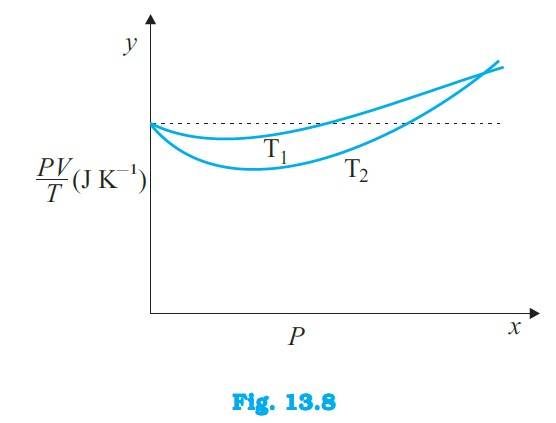
Contributor-Level 10
13.3 (a) The dotted plot in the graph signifies the ideal behaviour of the gas, i.e. = R, (where is the number of moles and R is the universal gas constant) is a constant quantity. It is not dependent on the pressure of the gas. The curve of the gas at temperature is closer to the dotted plot than the curve of the gas at temperature
(b) A real gas approaches the behaviour of an ideal gas when its temperature increases. Therefore > is true for the given plot.
(c) The value of the ratio , where the two curves meet, is R. This is because the ideal gas e
New answer posted
a year agoContributor-Level 10
4.14

The velocity of the boat = 51 km/h, the velocity of the wind = 72 km/h
Flag is fluttering in N-E direction, so the direction is N-E.
When the ship begins to sail towards North, the flag will flutter along the direction of relative velocity of the wind w.r.t. the boat.
The angle between & - = 90
tan = = =
tan-1( ) = 45.099
Angle with respect to East direction = 45.099 - 45 = 0.099
Hence the flag will flutter almost due East.
New answer posted
a year agoContributor-Level 10
4.13 Swimming speed = 4 km/h, Width of the river = 1.0 km
Time required to cross the river = = h= 15 min
Speed of the river = 3 km/h
Distance covered by the river in 15 min = 3 = 750 m
Taking an Exam? Selecting a College?
Get authentic answers from experts, students and alumni that you won't find anywhere else
Sign Up on ShikshaOn Shiksha, get access to
- 67k Colleges
- 1.2k Exams
- 718k Reviews
- 1850k Answers