

Physics
Get insights from 5.6k questions on Physics, answered by students, alumni, and experts. You may also ask and answer any question you like about Physics
Follow Ask QuestionQuestions
Discussions
Active Users
Followers
New answer posted
a year agoContributor-Level 10
6.22 Mass lifted, m = 10 kg
Height to which the mass lifted, h = 0.5 m
No of repetitions, n = 1000
(a) Work done against gravitational force,
W = nmgh = 1000 49050 J
(b) Mechanical energy supplied by 1 kg fat, with 20% efficiency rate = 0.2 3.8 = 0.76 J/kg
Fat used by dieter = 49050 / (0.76 kg = kg
New answer posted
a year agoContributor-Level 10
6.21 Given, the area of the windmill sweep = A, Wind velocity = v
The volume of air passing through the blade = Av
Let the density of air be , the mass of air passing through the blade =
(a) The mass of air passing through the blade in time t =
(b) The kinetic energy of air = = = /2 …. (1)
(c) Area, A = 30 , v = 36 km/h = 10 m/s, density of air be = 1.2 kg/
Total wind energy, from eqn. (1) = 18 kW
Electrical energy = 25 % of wind energy = 0.25
New answer posted
a year agoContributor-Level 10
6.20 Mass of the body = 0.5 kg
Velocity, v = a x 3/2
a = 5 m–1/2 s–1
At x =0, the initial velocity, u = 0
At x = 2, the final velocity, v = 5 = 14.142 m/s
Work done by the system = increase in K.E. of the body = (1/2)m ( - )
= (1/2) 14.142 = 50 J
New answer posted
a year agoContributor-Level 10
6.19 Given, the mass of the trolley, = 300 kg, mass of the sand bag, = 25 kg, uniform velocity of the trolley, v = 27 kmph = 0.75 m/s
Since there is no external force acting on the system, the speed of the trolley will remain unchanged even after entire sand is empty. 27 kmph is the answer.
New answer posted
a year agoContributor-Level 10
6.18 The length of the pendulum, l = 1.5 m
The potential energy of the bob at horizontal position = mgl
Since it dissipates 5% of its kinetic energy to come to the horizontal position, from the law of conservation of energy we get,
= (0.95)
= 2
v = 5.287 m/s
New answer posted
a year ago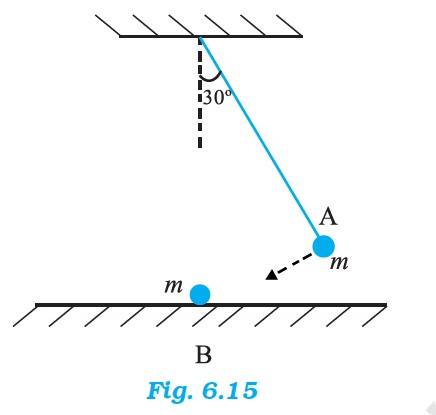
Contributor-Level 10
6.17 In an elastic collision, when the ball A will hit the ball B, A comes to rest immediately and the ball B acquires the velocity of ball A. The momentum thus gets transferred from a moving body to a stationary body.
New answer posted
a year ago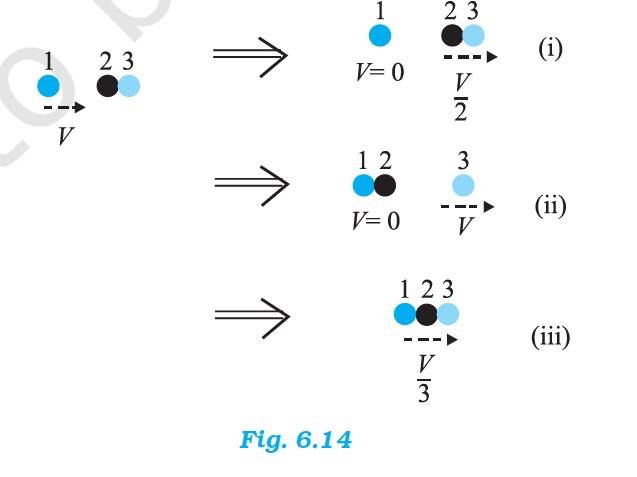
Contributor-Level 10
6.16 The mass of the ball bearing = m
Before the collision, the total K.E. of the system = K.E. of the stationary ball bearing + K.E. of the striking ball bearing = 0 +
After the collision, the K.E. of the total system is
(a) Case (i) = 0 + =
(b) Case (ii) = 0 +
(c) Case (iii) = =
Case (ii) is possible since K.E. is conserved in this case.
New answer posted
a year agoContributor-Level 10
6.15 Given, the volume of the tank, V = 30
Time required to fill the tank, t = 15 min = 900 s
Height of the tank above the ground, h = 40 m
The efficiency of the pump? = 30%
The density of water, = kg/
Now, the mass of the water pumped, m = = 30 kg = 3 kg
Power consumed = W/t = mgh/t = 3 40 / 900 = 13066 W
P input = Power consumed /? = 43.6 kW
New answer posted
a year agoContributor-Level 10
6.14 Momentum is always conserved for an elastic or inelastic collision.
The molecule's initial velocity, u = final velocity v = 200 m/s
Initial kinetic energy = (1/2)m
Final kinetic energy = (1/2)m = (1/2)m
Therefore, kinetic energy is also conserved
New answer posted
a year agoContributor-Level 10
6.13 The radius of the rain drop = 2 mm = 2 m
The height of drop, s = 500 m
Density of water, = kg/
Mass of the rain drop = volume = (4/3) = 3.35 kg
The gravitational force on the raindrop, F = mg = 3.28 N
Work done by the gravity on the drop is = mgs where s = 250 m
Work done = 0.082 J
The work done during the second half will remain same.
The total energy of the raindrop will be conserved during the motion.
Total energy at the top
E1 = mgh where h = 500 m, E1 = 0.164 J
Due to resistive force, the energy of the drop on reaching the ground
E2 = (1/2)mv2 where
Taking an Exam? Selecting a College?
Get authentic answers from experts, students and alumni that you won't find anywhere else
Sign Up on ShikshaOn Shiksha, get access to
- 67k Colleges
- 1.2k Exams
- 718k Reviews
- 1850k Answers