
Sets
Get insights from 131 questions on Sets, answered by students, alumni, and experts. You may also ask and answer any question you like about Sets
- 131
Questions
- 0
Discussions
- 1
Active Users
- 2
Followers
Have a question about Sets? Ask our experts
Keep it short & simple. Type complete word. Avoid abusive language.
If tan(π/9), x, tan(7π/18) are in arithmetic progression and tan(π/9), y, tan(5π/18) are also in arithmetic progression, then |x - 2y| is equal to :
<!-- [if !supportLineBreakNewLine]-->
<!--[endif]-->
If tan(π/9), x, tan(7π/18) are in arithmetic progression and tan(π/9), y, tan(5π/18) are also in arithmetic progression, then |x - 2y| is equal to :
<!-- [if !supportLineBreakNewLine]-->
<!--[endif]-->
2x=tan (π/9)+tan (7π/18)
=sin (π/9+7π/18) / cos (π/9)cos (7π/18)
=sin (π/2) / cos (π/9)cos (7π/18)
=1 / cos (π/9)cos (7π/18)
=1 / cos (π/9)sin (π/2−7π/18)
=1 / cos (π/9)sin (π/9)
⇒x=1 / 2cos (π/9)sin (π/9)
=1 / sin (2π/9)=cosec (2π/9)
Again 2y=tan (π/9)+tan (5π/18)
⇒2y=sin (π/9+5π/18) / cos (π/9)cos (5π/18)
=
 Upvote

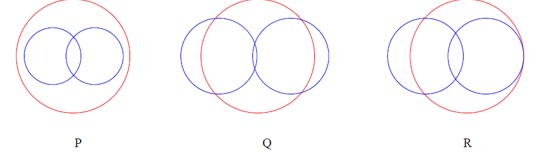
In a school, there are three types of games to be played. Some of the students play two types of games, but none play all the three games. Which Venn diagrams can justify the above statement?
<!-- [if !supportLineBreakNewLine]-->
<!--[endif]-->
In a school, there are three types of games to be played. Some of the students play two types of games, but none play all the three games. Which Venn diagrams can justify the above statement?
<!-- [if !supportLineBreakNewLine]-->
<!--[endif]-->
P, Q, R represents some students which play all three games. Hence no any option is correct.
Upvote A survey shows that 73% of the persons working in an office like coffee, whereas 65% like tea. If x denotes the percentage of them, who like both coffee and tea, then x cannot be:
<!-- [if !supportLineBreakNewLine]-->
<!--[endif]-->
A survey shows that 73% of the persons working in an office like coffee, whereas 65% like tea. If x denotes the percentage of them, who like both coffee and tea, then x cannot be:
<!-- [if !supportLineBreakNewLine]-->
<!--[endif]-->
n (C) = 73, n (T) = 65, n (C ∩ T) = x
n (C ∪ T) ≤ 100
⇒ n (C) + n (T) - n (C ∩ T) ≤ 100
⇒ x ≥ 38
n (C ∩ T) ≤ min (n (C), n (T) ⇒ x ≤ 65
⇒ 38 ≤ x ≤ 65
Upvote Let U(i=1 to n)Xᵢ = U(i=1 to 50)Yᵢ = T, where each Xᵢ contains 10 elements and each Yᵢ contains 5 elements. If each element of the set T is an element of exactly 20 of sets Xᵢ 's and exactly 6 of sets Yᵢ 's then n is equal to:
Let U(i=1 to n)Xᵢ = U(i=1 to 50)Yᵢ = T, where each Xᵢ contains 10 elements and each Yᵢ contains 5 elements. If each element of the set T is an element of exactly 20 of sets Xᵢ 's and exactly 6 of sets Yᵢ 's then n is equal to:
Let number of elements in T is R.
∴ 20R = 500 ⇒ R = 25
and 6R = 5N ⇒ N = 30
Upvote A survey shows that 63% of the people in a city read newspaper A whereas 76% read newspaper B. if x% of the people read both the newspapers, then a possible value of x can be:
<!-- [if !supportLineBreakNewLine]-->
<!--[endif]-->
A survey shows that 63% of the people in a city read newspaper A whereas 76% read newspaper B. if x% of the people read both the newspapers, then a possible value of x can be:
<!-- [if !supportLineBreakNewLine]-->
<!--[endif]-->
max {n (A), n (B)} ≤ n (A U B) ≤ n (U)
⇒ 76 ≤ 76 + 63 - x ≤ 100
⇒ -63 ≤ -x ≤ -39
⇒ 63 ≥ x ≥ 39
Upvote Is the Bihar BEd CET Answer Key available for all sets?
Yes, the Bihar BEd CET Answer Key is released separately for all paper sets – A, B, C, and D. Candidates must download the key according to their question paper set.
Upvote Let . If is a multiple of 2 and is a multiple of 7 , then the number of elements in the smallest subset of containing both and is
Let . If is a multiple of 2 and is a multiple of 7 , then the number of elements in the smallest subset of containing both and is
A = {2,4,6,8, . . .50} ⇒ 25 element
A = {7,14,21, . . . .49} ⇒ 7 elements
A ∩ B = {14,28,42} = 3 elements
Required number of elements = 25 + 7 - 3 = 29
Upvote Let A = <!-- [if gte mso 9]><xml>
B = <!-- [if gte mso 9]><xml>
And C = <!-- [if gte mso 9]><xml>
If the sum of all the elements of the set <!-- [if gte mso 9]><xml>
Let A = <!-- [if gte mso 9]><xml>
B = <!-- [if gte mso 9]><xml>
And C = <!-- [if gte mso 9]><xml>
If the sum of all the elements of the set <!-- [if gte mso 9]><xml>
Sum of elements
In set B numbers of the form 9k + 2 are {101, 109, .992}
Another possible number is 9k + 5 forms are {104, .995}
possible value of = 5
Upvote The sum of all the elements in the set is equal to………
The sum of all the elements in the set is equal to………
2040 = 23 × 3 × 5 × 17
If HCF between {n & 2040} = 1
n can not be multiple of 2, 3, 5, 17.
Let S(n) denote sum of numbers divisible by n.
Upvote The numbers of elements in the set <!-- [if gte mso 9]><xml>
The numbers of elements in the set <!-- [if gte mso 9]><xml>

->For the inequality Satisfies.
For n= 4. 2 [4 × 10³ + 4 × 10] > 104
->8 × 10¹⁰ > 104 which is a contradiction
all values
Upvote