
Thermal Properties of Matter Overview
Get insights from 25 questions on Thermal Properties of Matter Overview, answered by students, alumni, and experts. You may also ask and answer any question you like about Thermal Properties of Matter Overview
- 25
Questions
- 0
Discussions
- 0
Active Users
- 0
Followers
Have a question about Thermal Properties of Matter Overview? Ask our experts
Keep it short & simple. Type complete word. Avoid abusive language.
<div class="photo-widget-full"> </div>
<p><strong>The velocity of liquid coming out of a small hole of a large vessel containing two different liquids shown in figure is</strong></p>
<div class="photo-widget-full">
<div class="figure"><picture><source srcset="" media="(max-width: 500px)"><img src="https://images.shiksha.com/mediadata/images/1758516943phpbpRk8n.jpeg" alt="" width="141" height="136" loading="lazy"></picture></div>
</div>
<p> </p>
Given below are two statements : one is labelled as Assertion A and the other is labelled as Reason R.
Assertion A : When a rod lying freely is heated, no thermal stress is developed in it.
Reason R : On heating, the length of the rod increases.
In the light of the above statements, choose the correct answer from the options given below:
Thermal stress is developed on heating when expansion of rod is hindered.
 Upvote

At what temperature a gold ring of diameter 6.230cm be heated so that it can be fitted on a wooden bangle of diameter. 6.241cm? Both the diameters have been measured at room temperature (27°C).
(Given : coefficient of linear thermal expansion of gold aL = 1.4 × 10⁻⁵ K-1)
At what temperature a gold ring of diameter 6.230cm be heated so that it can be fitted on a wooden bangle of diameter. 6.241cm? Both the diameters have been measured at room temperature (27°C).
(Given : coefficient of linear thermal expansion of gold aL = 1.4 × 10⁻⁵ K-1)
According to question, we can write
Upvote A calorimeter consists of 400g of water at A 500g piece of copper at is thrown into the water and the equilibrium temperature is found to be What is the molar heat capacity of copper in cal/mol k, given that 1 mol of copper has a mass of 63.5g? Neglect the heat capacity of the container.
A calorimeter consists of 400g of water at A 500g piece of copper at is thrown into the water and the equilibrium temperature is found to be What is the molar heat capacity of copper in cal/mol k, given that 1 mol of copper has a mass of 63.5g? Neglect the heat capacity of the container.
400 × 1 × 12.5 = 500 × 5 × (100 – 36.5)
S = 10 cal/mol °C
Upvote An igloo, a hemispherical enclosure built of ice , has as inner radius of 2.50m. The thickness of the ice is 0.5m. At what rate must thermal energy be generated to maintain the air inside the igloo at when the outside temperature is - Ignore all thermal energy losses through the ground or by air currents.
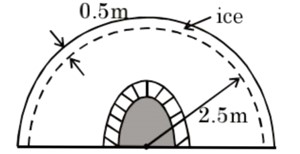
An igloo, a hemispherical enclosure built of ice , has as inner radius of 2.50m. The thickness of the ice is 0.5m. At what rate must thermal energy be generated to maintain the air inside the igloo at when the outside temperature is - Ignore all thermal energy losses through the ground or by air currents.
A wooden wheel having radius of 1 m is to be fitted with an iron ring around it. The diameter of the ring is 6 mm smaller than the wooden wheel. If the coefficient of linear expansion of iron is 1.2 × 10⁻⁵/ °C, then find the minimum increase in temperature (in °C) to fit the ring on the wheel.
A wooden wheel having radius of 1 m is to be fitted with an iron ring around it. The diameter of the ring is 6 mm smaller than the wooden wheel. If the coefficient of linear expansion of iron is 1.2 × 10⁻⁵/ °C, then find the minimum increase in temperature (in °C) to fit the ring on the wheel.
r = r? (1 + αΔT) ⇒ r – r? = r? αΔT
⇒ 3 × 10? ³ = 1 × 1.2 × 10? ΔT ⇒ ΔT = 250°C
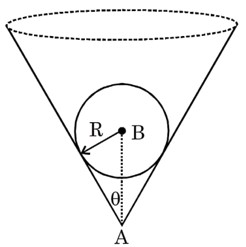
Upvote A hollow sphere (mass m, radius R) is put inside a hollow cone (mass m, radius 3R and semi-angle <!-- [if gte mso 9]><xml>
A hollow sphere (mass m, radius R) is put inside a hollow cone (mass m, radius 3R and semi-angle <!-- [if gte mso 9]><xml>
A cylindrical metal rod BC of length 1 m and radius 1 cm is joint in series to another rod AB of same material and length but having twice the radius as shown in the figure.
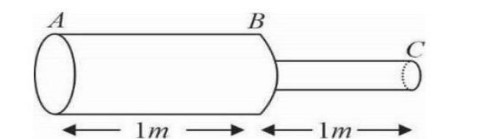
End A is placed at a temperature of 100°C and end C is placed at 50°C temperature. Find the temperature of the junction B.
<!-- [if !supportLineBreakNewLine]-->
<!--[endif]-->
A cylindrical metal rod BC of length 1 m and radius 1 cm is joint in series to another rod AB of same material and length but having twice the radius as shown in the figure.
End A is placed at a temperature of 100°C and end C is placed at 50°C temperature. Find the temperature of the junction B.
<!-- [if !supportLineBreakNewLine]-->
<!--[endif]-->
(K (4A)/l) (100 – θ) = (KA/l) (θ – 50)
⇒ 400 – 4θ = θ – 50 ⇒ 5θ = 450 ⇒ θ = 90°C
Upvote Two identical metal of thermal conductivities K₁ and K₂ respectively are connected in series. The effective thermal conductivity of the combination is:
Two identical metal of thermal conductivities K₁ and K₂ respectively are connected in series. The effective thermal conductivity of the combination is:
R_eq = R? + R?
L_total / (K_eq * A) = L? / (K? A) + L? / (K? A)
Assuming L? = L? = l, L_total = 2l
2l / (K_eq * A) = l/ (K? A) + l/ (K? A)
2/K_eq = 1/K? + 1/K? = (K? + K? )/ (K? )
K_eq = 2K? K? / (K? + K? )
Upvote