Thermal Properties of Matter Overview
Get insights from 25 questions on Thermal Properties of Matter Overview, answered by students, alumni, and experts. You may also ask and answer any question you like about Thermal Properties of Matter Overview
- 25
Questions
- 0
Discussions
- 0
Active Users
- 0
Followers
Have a question about Thermal Properties of Matter Overview? Ask our experts
Keep it short & simple. Type complete word. Avoid abusive language.
Two different wires having lengths and , and respective temperature coefficient of linear 4expansion and , are joined end-to-end. Then the effective temperature coefficient of linear expansion is:
Two different wires having lengths and , and respective temperature coefficient of linear 4expansion and , are joined end-to-end. Then the effective temperature coefficient of linear expansion is:
At T°C L = L? + L?
At T +? T Leq = L'? + L'?
where L'? = L? (1 + α? T)
L'? = L? (1 + α? T)
Leq = (L? + L? ) (1 + αavg? T)
⇒ (L? + L? ) (1 + αavg? T) = L? + L? + L? α? T + L? α? T
⇒ (L? + L? )αavg = L? α? + L? α?
⇒ αavg = (L? α? + L? α? )/ (L? + L? )
 Upvote

Two different metal bodies A and B of equal mass are heated at a uniform rate under similar conditions. The variation of temperature of the bodies is graphically represented as shown in the figure. The ratio of specific heat capacities is :
(The graph shows Temperature (°C) on the y-axis and Time (s) on the x-axis. Both A and B are straight lines starting from the origin. For body A, temperature reaches 120°C in 4s. For body B, temperature reaches 90°C in 6s.)
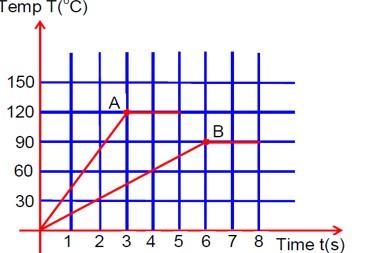
Two different metal bodies A and B of equal mass are heated at a uniform rate under similar conditions. The variation of temperature of the bodies is graphically represented as shown in the figure. The ratio of specific heat capacities is :
(The graph shows Temperature (°C) on the y-axis and Time (s) on the x-axis. Both A and B are straight lines starting from the origin. For body A, temperature reaches 120°C in 4s. For body B, temperature reaches 90°C in 6s.)
dQA = mACA dTA
dQB = mBCB dTB
dQA/dt = dQB/dt
⇒ mACA (dTA/dt) = mBCB (dTB/dt)
⇒ (dTA/dt)/ (dTB/dt) = (mBCB)/ (mACA)
Assuming mA = mB
(dTA/dt)/ (dTB/dt) = CB/CA
CA/CB = (dTB/dt)/ (dTA/dt) = (90/6)/ (120/3) = 15/40 = 3/8
Upvote A steel rod with y = 2.0 × 10¹¹ Nm-2 and a = 10-5 °C-1 of length 4m and area of cross-section 10cm2 is heated from 0°C to 400°C without being allowed to extend. The tension produced in the rod is x × 105 N where the value of x is_________.
A steel rod with y = 2.0 × 10¹¹ Nm-2 and a = 10-5 °C-1 of length 4m and area of cross-section 10cm2 is heated from 0°C to 400°C without being allowed to extend. The tension produced in the rod is x × 105 N where the value of x is_________.
Force = Aya
Force
x = 8
Upvote 
For an ideal gas PT3 = constant. Find the coefficient of volume expansion of the gas is:
For an ideal gas PT3 = constant. Find the coefficient of volume expansion of the gas is:
PT3 = k (constant)
- (i) >
- (ii) >
Comparing I > & ii >
Upvote The temperature of equals masses of three different liquids x, y and z are 10°C, 20°C and 30°C respectively. The temperature of mixture when x is mixed with y is 16°C and that when y is mixed with z is 26°C. Temperature of mixture when x and z are mixed will be:
The temperature of equals masses of three different liquids x, y and z are 10°C, 20°C and 30°C respectively. The temperature of mixture when x is mixed with y is 16°C and that when y is mixed with z is 26°C. Temperature of mixture when x and z are mixed will be:
msx (16 – 10) = msy (20 – 16)
Upvote Read the following statements:
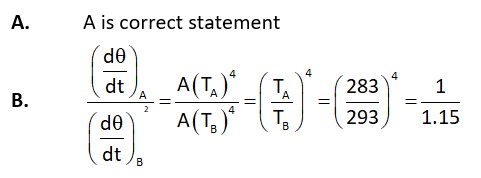
(A) When small temperature difference between a liquid and its surrounding is doubled, the rate of loss of heat of the liquid becomes twice.
(B) Two bodies P and Q having equal surface areas are maintained at temperature 10°C and 20°C. The thermal radiation emitted in a given time by P and Q are in the ratio 1:1. 15.
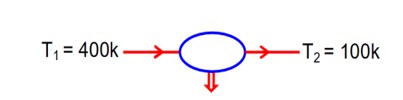
(C) A Carnot Engine working between 100K and 400K has an efficiency of 75%.
(D) When small temperature difference between a liquid and its surrounding is quadrupled, the rate of loss of heat of the liquid becomes twice.
Choose the correct answer from the options given below:
Read the following statements:
(A) When small temperature difference between a liquid and its surrounding is doubled, the rate of loss of heat of the liquid becomes twice.
(B) Two bodies P and Q having equal surface areas are maintained at temperature 10°C and 20°C. The thermal radiation emitted in a given time by P and Q are in the ratio 1:1. 15.
(C) A Carnot Engine working between 100K and 400K has an efficiency of 75%.
(D) When small temperature difference between a liquid and its surrounding is quadrupled, the rate of loss of heat of the liquid becomes twice.
Choose the correct answer from the options given below: