

Class 11th
Get insights from 8k questions on Class 11th, answered by students, alumni, and experts. You may also ask and answer any question you like about Class 11th
Follow Ask QuestionQuestions
Discussions
Active Users
Followers
New answer posted
a year agoContributor-Level 10
57. Let a and b be the x & y intercept. Then,
_____ (1)
Given, a + b = 1. ______ (2) b = 1 -a _____ (3)
and ab = -6 _____ (4)
Putting eqn (B) in (iii) we get a
a (1- a) = - 6
a - a2 = - 6
a2 - a - 6 = 0
a2 + 2a - 3a - 6 = 0
a (a + 2) - 3 (a + 2) = 0
(a + 2) (a -3) = 0
(a + 2) (a -3) = 0.
a = 3 or a = -2.
When a = 3, b = 1- a = 1 - 3 = - 2
When a = - 2, b = 1 - (-2) = 1 + 2 = 3
So, (a, b) = (3, -2) and (-2, 3)
Hence, eqn (1) becomes,
and
2x – 3y = 6 and 2y - 3x = 6
Gives the read eqn of lines
New answer posted
a year agoContributor-Level 10
22. Give, f (x) = 2x – 5.
(i) f (0)= (2 * 0) –5=0 – 5= –5
(ii) f (7)= (2 * 7) –5=14 – 5=9
(iii) f (–3)=2 * (–3) –5= –6 – 5= –11.
New question posted
a year ago
New answer posted
a year agoContributor-Level 10
55. We have (k - 3) x - (4 - k2) y + k2 - 7 y + 6 = 0.
(i) When the line is parall to x-axis, all x coefficient = 0. then,
(k - 3)x - (4 -k2)y + k2 - 7y + 6 = 0 x.x - a x y where a = constant
Equating the co-efficient,
K – 3 = 0
=> k = 3
(ii) When the line is parallel to y-axis all y co-efficient = 0 then
- (4 -k)2 = 0
=> – 4 + x2 = 0
k2 = 4
k = ± 2.
(iii) When the line pares through origin, (0, 0) need satisfy the given eqn then,
k2 - 7k + 6 = 0
k2 - k – 6k + 6 = 0
k (k- 1) - 6 (k - 1) = 0
(k = 1) (k - 6) = 0
k = 1 and k = 6
New answer posted
a year agoContributor-Level 10
54. The equation of line whose intercept on axes are a and b is given by,
Multiplying both sides by ab we get,

New answer posted
a year agoContributor-Level 10
53. Let P be the point on the BC dropped from vertex A.

Slope of BC
= 1.
As A P BC,
Slope of AP=
Using slope-point form the equation of AP is,
x 2 = y 3
x – y – 2 + 3 = 0 x – y + 1 = 0
The equation of line segment through B(4, -1) and C(1, 2) is.
So, A=1, B=1 and C= 3.
Hence, length of AP=length of distance of A(2,3) from BC.

New answer posted
a year agoContributor-Level 10
52. The given equation lines are.
line 1: xcosθ-y sin θcos 2θ
⇒ xcosθ-y sin θ - kcos 2θ = 0
The perpendicular distance from origin (0,0) to line 1 is


New answer posted
a year agoContributor-Level 10
51.
Let 0 (o, o) be the origin and P (-1, 2) be the given point on the line y = mx + c.
Then, slope of OP, =

Slope of OP = -2
As the line y = mx + c is ⊥ to OP we can write
New answer posted
a year ago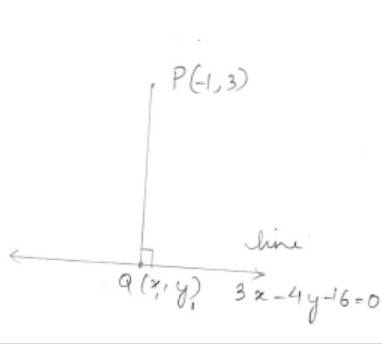
Contributor-Level 10
50. Let P(-1, 3) be the given point and Q(x, y,) be the Co-ordinate of the foot of perpendicular
So, slope of line 3x - 4y - 16 = 0 is
And slope of line segment joining P(-1, 3) and Q(x, y,) is
As they are perpendicular we can write as,
(y1-3)3 = - 4(x1 +1)
3y1- 9 = - 4x1- 4.
4x1 + 3y1-9 + 4 = 0
4x1 + 3y1-5 = 0 ___ (1)
As point Q(x1, y1) lies on the line 3x- 4y - 16 = 0 it must satisfy the equation hence,
3x1- 4y1- 16 = 0 ____ (2)
Now, multiplying equation (1) by 4 and equation (2) by 3 and adding then,
4* (4x1 + 3y1- 5) + 3(3x1- 4y1- 16) = 0.
16x1 + 12y1- 20 + 9x1- 12y1- 48 = 0
25x1 = 48 + 20
.
Putting value of x1 in equation (1) we get,
Taking an Exam? Selecting a College?
Get authentic answers from experts, students and alumni that you won't find anywhere else
Sign Up on ShikshaOn Shiksha, get access to
- 67k Colleges
- 1.2k Exams
- 718k Reviews
- 1850k Answers