

Class 11th
Get insights from 8k questions on Class 11th, answered by students, alumni, and experts. You may also ask and answer any question you like about Class 11th
Follow Ask QuestionQuestions
Discussions
Active Users
Followers
New answer posted
a year agoContributor-Level 10
6. Given,
A *B = { (a, x), (a, y), (b, x), (b, y)}
We know that,
A *B = { (p, q); p ∈ A and q ∈ B}
So, A = {a, b} and B = {x, y}.
New answer posted
a year ago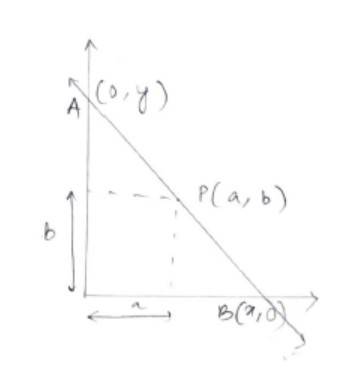
Contributor-Level 10
34.
Since P (a, b) is the mid-point of the line segment say AB with points A (0, y) and B (x, 0) we can write,
So, the equation of line with x and y intercept 2a and 2b using intercept form is
Hence, proved
New answer posted
a year agoContributor-Level 10
5. Given, A = {1,1}
So, A* A = { (1,1), (1,1), (1,1), (1,1)}
A *A *A = { (1,1), (1,1), (1,1), (1,1)} * {1,1}
= { (1,1.1), (1, 1), (1, ), (1,1,1), (1,1,1), (1,1), (1,1), (1,1,1)}
New answer posted
a year agoContributor-Level 10
4. (i) False. Here P = {m, n}, n (p)=2
Q = {n, m}, n (Q)=2
n (P* Q) = n (P)* n (Q) = 2* 2 = 4.
So, P *Q = { (m, n), (m, m), (n, n), (n, m)}
(ii) True.
(iii) True. { A * (B ∩ ?) = A* ? . {∴ B ∩ ? = ? }
= n (A) *0 {? is empty set}
= ?
New answer posted
a year agoContributor-Level 10
33. Assuming the price per litre say P in x-axis and the corresponding demand say D in y-axis, we have two point (14, 980) and (16, 1220) in xy plane. Then the points (P, D) will satisfy the equation.

Which is the required relation
Where P = 17, we have
D = 120 * 17 – 700
D = 1340
Hence, the owner can sell 1340 litres of milk weekly at? 17/litre
New answer posted
a year agoContributor-Level 10
3. Given, G = {7, 8} and H = {5, 4, 2}
By the definition of the Cartesian product,
G *H = { (x, y): x∈G and y = ∈ H}
= { (7, 5), (7, 4), (7, 2), (8, 5), (8,4), (8,2)}
H* G = { (x, y): x∈ H and y ∈G}
= { (5, 7), (5, 8), (4,7), (4, 8), (2, 7), (2,8)}
New answer posted
a year ago2. If the set A has 3 elements and the set B = {3, 4, 5}, then find the number of elements in (A*B).
Contributor-Level 10
2. Given, n (A) = 3
n (B) = 3 or B = {3,4,5}
So, number of elements in A* B = n (A* B) = n (A)* n (B) = 3 *3 = 9.
New answer posted
a year agoContributor-Level 10
33. (i) False, as {2,3,4,5} ∩ {3,6} = {3} ≠ .Hence sets are not disjoint.
(ii) False as {a, e, i, o, u} ∩ {a, b, c, d} = {a} ≠ Hence sets are not disjoint.
(iii) True as {2,6,10,14} ∩ {3,7,11,15} = . Hence sets are disjoint.
(iv) True as {2,6,10} ∩ {3,7,11}= . Hence sets are disjoint.
New answer posted
a year agoContributor-Level 10
32. R – Q = {x: x is a real number but not rational number}
= {x: x is an irrational number}
Since real number = rational number + irrational number
New answer posted
a year agoContributor-Level 10
31. (i) X – Y = {a, b, c, d} – (f, b, d, g}
= {a, c}
(ii) Y – X = {f, b, d, g} – {a, b, c, d}
= {f, g}
(iii) X ∩ Y = {a, b, c, d} ∩ {f, b, d, g}
= {b, d}.
Taking an Exam? Selecting a College?
Get authentic answers from experts, students and alumni that you won't find anywhere else
Sign Up on ShikshaOn Shiksha, get access to
- 67k Colleges
- 1.2k Exams
- 718k Reviews
- 1850k Answers