Class 11th

Get insights from 8k questions on Class 11th, answered by students, alumni, and experts. You may also ask and answer any question you like about Class 11th

Follow Ask Question
8k

Questions

0

Discussions

5

Active Users

0

Followers

New answer posted

6 months ago

0 Follower 1 View

R
Raj Pandey

Contributor-Level 9

At maximum height velocity (v) = 0

So, momentum = mv = m * 0 = 0

New answer posted

6 months ago

0 Follower 2 Views

A
alok kumar singh

Contributor-Level 10

f ( x ) = x + x 0 1 f ( t ) d t 0 1 t 0 f ( t ) d t

 Let 1 + 0 1 f ( t ) d t = α  

0 1 t f ( t ) d t = β  

So, f(x) = ax - b

Now,  α = 0 1 f ( t ) d t + 1  

α = 0 1 ( a t β ) d t + 1  

β = 0 1 t f ( t ) d t  

β = 4 1 3 , α = 1 8 1 3  

f(x) = ax – b

= 1 8 x 4 1 3

option (D) satisfies

New answer posted

6 months ago

0 Follower 3 Views

R
Raj Pandey

Contributor-Level 9

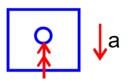
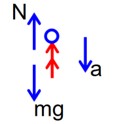
.B.D of person w.r.t. elevator

mg – N = ma

N = mg – ma

N decreases so, person experiences weight loss

New answer posted

6 months ago

0 Follower 3 Views

R
Raj Pandey

Contributor-Level 9

P = α β l o g e ( k t β x )

k t β x = Dimensionless

β = k t x = [ M L 2 T 2 k 1 ] [ k ] [ L ]

α β = dimensionless

a = dimensionless of b

a = MLT-2

New answer posted

6 months ago

0 Follower 1 View

A
Aadit Singh Uppal

Contributor-Level 10

This refers to the highest limit of pressure which the body can tolerate in order to regain its original shape after removing the pressure. If the pressure exceeds the elastic limit, the body will never be able to regain its original shape agian. example: rubber stretching.

New answer posted

6 months ago

0 Follower 3 Views

V
Vishal Baghel

Contributor-Level 10

According to question, we can write

d = d 0 ( 1 + α Δ T ) 6 . 2 4 1 = 6 . 2 3 0 ( 1 + 1 . 4 * 1 0 5 * Δ T )

T = 1 2 6 . 1 8 + 2 7 = 1 5 3 . 1 8 ° C  

New answer posted

6 months ago

0 Follower 2 Views

A
alok kumar singh

Contributor-Level 10

Let S = 1 + 5 6 + 1 2 6 2 + 2 2 6 3 + . . . .  

S 6 = 1 6 + 5 6 2 + . . . . _  

5 S 6 = 1 + 4 6 + 7 6 2 + 1 0 6 3 + . . . .  

5 S 3 6 = 1 6 + 4 6 2 + 7 6 3 + . . . . . _  

2 5 S 3 6 = 1 + 3 6 + 3 6 2 + 3 6 3 + . . . . . .  

2 5 S 3 6 = 1 + 3 / 6 1 1 / 6  

2 5 S 3 6 = 1 + 3 / 5 1  

S = 2 8 8 1 2 5

New answer posted

6 months ago

0 Follower 2 Views

V
Vishal Baghel

Contributor-Level 10

According to question, we can write

10 = 1 2 a t 2 . . . . . . . . . . . . . . . ( 1 ) a n d

1 0 + x = 1 2 a ( 2 t ) 2 . . . . . . . . . . . . . . . . ( 2 )

X = 1 2 A [ ( 2 t ) 2 t 2 ] = 3 ( 1 2 a t 2 ) = 3 0 m


New answer posted

6 months ago

0 Follower 1 View

A
Aadit Singh Uppal

Contributor-Level 10

This is the case of fluids or gases. In such scenarios, the material does not have any limit to its flexibility and can be deformed to any extent. Such materials do not possess any stiffness and cannot regain their original form as they show no resistance towards any kind of pressure.

New answer posted

6 months ago

0 Follower 7 Views

A
alok kumar singh

Contributor-Level 10

| z | = 3 circle with radius = 3

arg ( z 1 z + 1 ) = π 4 , part of a circle (with radius 2 ). no common points

Get authentic answers from experts, students and alumni that you won't find anywhere else

Sign Up on Shiksha

On Shiksha, get access to

  • 66k Colleges
  • 1.2k Exams
  • 687k Reviews
  • 1800k Answers

Share Your College Life Experience

×

This website uses Cookies and related technologies for the site to function correctly and securely, improve & personalise your browsing experience, analyse traffic, and support our marketing efforts and serve the Core Purpose. By continuing to browse the site, you agree to Privacy Policy and Cookie Policy.