

Class 12th
Get insights from 12k questions on Class 12th, answered by students, alumni, and experts. You may also ask and answer any question you like about Class 12th
Follow Ask QuestionQuestions
Discussions
Active Users
Followers
New answer posted
a year ago
Contributor-Level 10
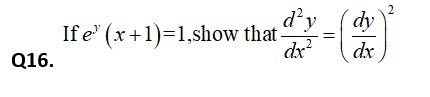
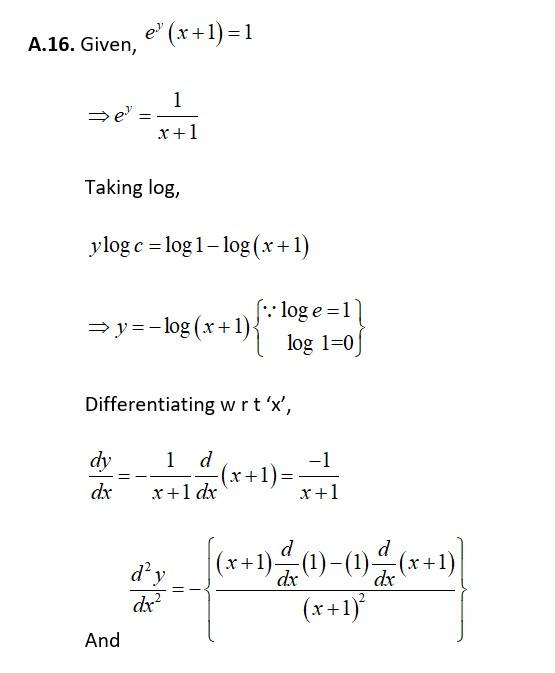
So,
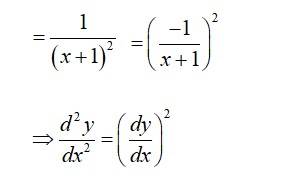
Differentiating again w r t 'x' we get,
Hence proved.
New answer posted
a year agoContributor-Level 10
Let 'r' and U be the radius and volume of the spherical balloon.
Then, k = constant
Integrating both sides,
Given at t = 0, r = 3
So, 4π(3)3 = c
C = 36π
And, at t=3, r=6
So,
Hence, putting value of c and k in,
, we get,
New question posted
a year agoNew answer posted
a year agoContributor-Level 10
The slope of tangent is and slope of line joining line (-4,-3) and point say P(x,y)
So,
Integrating both sides,
Since, the curve passes through (-2,1) we get,
The equation of the curve is
New answer posted
a year agoContributor-Level 10
The slope of the tangent to then curve is
So,
Integrating both sides,
As the curve passes through (0, -2) we have,
The equation of the curve is

New answer posted
a year agoContributor-Level 10
The Given D.E is
Integrating both sides,
A the curve passes through (-1,1) then
So,
The required equation of curve is,
New answer posted
a year agoContributor-Level 10
The given D.E. is
Integrating both sides,
Where,
Hence,
When the curve passed point (0,0),
The required equation of the curve is
New answer posted
a year ago
Contributor-Level 10
So, _______(2)
_________(3)
So, L.H.S =
= 0 = R.H.S.
Taking an Exam? Selecting a College?
Get authentic answers from experts, students and alumni that you won't find anywhere else
Sign Up on ShikshaOn Shiksha, get access to
- 67k Colleges
- 1.2k Exams
- 718k Reviews
- 1850k Answers