Class 12th

Get insights from 12k questions on Class 12th, answered by students, alumni, and experts. You may also ask and answer any question you like about Class 12th

Follow Ask Question
12k

Questions

0

Discussions

28

Active Users

0

Followers

New answer posted

a year ago

0 Follower 7 Views

A
alok kumar singh

Contributor-Level 10

  f ( x ) = 2 x − 1         g : R − { 1 } → R       

  g ( x ) = x − 1 / 2 x − 1         

  f { g ( x ) } = 2 ( x − 1 / 2 x − 1 ) − 1 = 2 x − 1 − x + 1 x − 1 = x x − 1 , x ≠ 1          

y = x x − 1 ⇒ x = y y − 1 ∴ y ≠ 1           

One – one but not onto

New answer posted

a year ago

0 Follower 2 Views

R
Raj Pandey

Contributor-Level 9

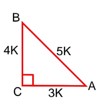
a + b 7 = b + c 8 = c + a 9 = 2 ( a + b + c ) 2 4 = c 5 = a 4 = b 3

r = Δ S = 6 k 2 6 k = k

R = 5 k 2 ⇒ R r = 5 2

New answer posted

a year ago

0 Follower 2 Views

A
alok kumar singh

Contributor-Level 10

l i m x → 0 ∫ 0 x 2 ( s i n t ) d t x 3 ( 0 0 )   aplying L' Hospital rule

= l i m x → 0 s i n ( x 2 ) . 2 x 3 x 2

= 2 3 , f o r     x > 0


New answer posted

a year ago

0 Follower 2 Views

R
Raj Pandey

Contributor-Level 9

l = ∫ 0 π e c o s x s i n x d x ( 1 + c o s 2 x ) ( e c o s x + e − c o s x )

2 l = ∫ 0 π s i n d x 1 + c o s 2 x = 2 ∫ 0 π / 2 s i n x d x 1 + c o s 2 x

l = ∫ 1 0 − d t 1 + t 2 = ∫ 0 1 d t 1 + t 2 = π 4

New answer posted

a year ago

0 Follower 3 Views

A
alok kumar singh

Contributor-Level 10

  ∫ ( c o s x − s i n x ) d x 8 − s i n 2 x = a s i n − 1 ( s i n x + c o s x b ) + c

∫ ( c o s x − s i n x ) d x 9 − ( s i n x + c o s x ) 2 =           

Put (sin x + cos x) = t Þ (cos x – sin x) dx = dt

= ∫ d t 3 2 − t 2 = s i n − 1 t 3 + c = s i n − 1 ( s i n x + c o s x 3 ) + c        

= a = 1, b = 3

∴ ( a , b ) ≡ ( 1 , 3 )        

New answer posted

a year ago

0 Follower 3 Views

V
Vishal Baghel

Contributor-Level 10

Temperature coefficient is 2 that means rate of reaction doubles at every 10°C rise in temperature.
Thus, k? °C = 2? = 64 k? °C

New answer posted

a year ago

0 Follower 20 Views

V
Vishal Baghel

Contributor-Level 10

To decompose 1 mole of H? O, we need two moles of electrons i.e. 2 faraday
To decompose 4 moles of H? O, we need 8 faraday.
Now, Q = I * t? t = (8 * 96500) / 4 = 1.93*10? sec

New answer posted

a year ago

0 Follower 5 Views

A
alok kumar singh

Contributor-Level 10

  Δ − | 3 − 2 − k 2 − 4 − 2 1 2 − 1 | = | 3 − 2 − k 0 − 8 0 1 2 − 1 | , [ R 2 − R 1 − 2 R 3 ]

= -8 (-3 + k)

For inconsistent Δ = 0 ⇒ k = 3  

Δ x = | 1 0 − 2 − k 6 − 4 − 2 5 m 2 − 1 | = 3 2 − 4 0 m ≠ 0 ⇒ m ≠ 4 5

New answer posted

a year ago

0 Follower 2 Views

A
alok kumar singh

Contributor-Level 10

y = x3

d y d x = 3 x 2 ⇒ d y d x | ( t , t 3 ) = 3 t 2           

Equation of tangent y – t3 = 3t2 (x – t)  

Let again meet the curve at Q ( t 1 , t 1 3 )  

⇒ t 1 3 − t 3 = 3 t 2 ( t 1 − t )           

t 1 2 + t t 1 + t 2 = 3 t 2 [ ? t 1 ≠ t ]           

t 1 2 + t t 1 − 2 t 2 = 0            

->t1 = -2t

Required ordinate = 2 t 3 + t 1 3 3 = 2 t 3 − 8 t 3 3 = − 2 t 3

New answer posted

a year ago

0 Follower 3 Views

V
Vishal Baghel

Contributor-Level 10

The number of chiral carbons in open-chain aldohexose (such as glucose) is four, therefore, the number of stereoisomers = 2? = 16.

Get authentic answers from experts, students and alumni that you won't find anywhere else

Sign Up on Shiksha

On Shiksha, get access to

  • 67k Colleges
  • 1.2k Exams
  • 716k Reviews
  • 1850k Answers

Share Your College Life Experience

×
×

This website uses Cookies and related technologies for the site to function correctly and securely, improve & personalise your browsing experience, analyse traffic, and support our marketing efforts and serve the Core Purpose. By continuing to browse the site, you agree to Privacy Policy and Cookie Policy.