

Class 12th
Get insights from 12k questions on Class 12th, answered by students, alumni, and experts. You may also ask and answer any question you like about Class 12th
Follow Ask QuestionQuestions
Discussions
Active Users
Followers
New answer posted
a year ago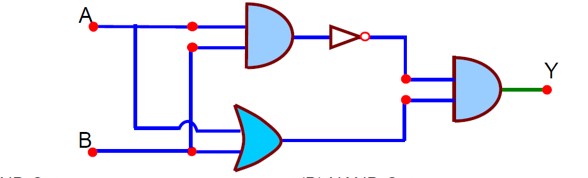
Contributor-Level 10
The circuit diagram represents an XOR Gate. The output Y is derived as:
Y = (A? B? ) (A + B) = (A? + B? ) (A + B) = A? B + AB? (XOR Gate)
New answer posted
a year agoContributor-Level 10
Solid sol is a colloidal system consisting of a gas dispersed in a solid, e.g., pumice stone, foam rubber.
New answer posted
a year agoContributor-Level 9
Fringe width, β = (λD) / d = (5890 * 10? ¹? * 0.5) / (0.5 * 10? ³) = 589 * 10? m
Distance between first and third bright fringe = 2β = 1178 * 10? m.
New answer posted
a year ago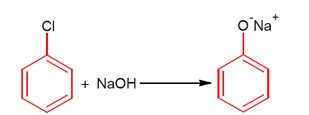
Contributor-Level 10
This describes a nucleophilic aromatic substitution reaction. Aryl halides are very less reactive toward this reaction, so the reaction takes place at a high temperature, i.e., 623K, and high pressure of 300 atm.
New answer posted
a year agoContributor-Level 9
qE = mg ⇒ neE = (4/3)πr³ρg
⇒ n = (4πr³ρg) / (3eE) = (4 * 3.14 * (2 * 10? ³ )³ * 3 * 10³ * 9.81) / (3 * 1.6 * 10? ¹? * 3.55 * 10? ) = 1.73 * 10¹?

New answer posted
a year agoTaking an Exam? Selecting a College?
Get authentic answers from experts, students and alumni that you won't find anywhere else
Sign Up on ShikshaOn Shiksha, get access to
- 67k Colleges
- 1.2k Exams
- 716k Reviews
- 1850k Answers