

Class 12th
Get insights from 12k questions on Class 12th, answered by students, alumni, and experts. You may also ask and answer any question you like about Class 12th
Follow Ask QuestionQuestions
Discussions
Active Users
Followers
New answer posted
a year agoContributor-Level 10
The major functions of hormones are:
- Regulating Metabolism
- Controlling Growth and Development
- Managing Stress and Energy
- Regulating Sleep and Mood
New answer posted
a year agoContributor-Level 10
The relationship between the de Broglie wavelengths of an electron (λe) and a photon (λp) is derived as follows:
For an electron: λe = h / mv = h / √ (2mE)
For a photon: λp = h / p = hc / E
Taking the ratio of the wavelengths squared:
(λe / λp)² = [h / √ (2mE)]² / [hc / E]²
(λe / λp)² = (h² / 2mE) * (E² / h²c²)
(λe / λp)² = E / 2mc²
(λe / λp) = (1/c) * √ (E / 2m)
New answer posted
a year agoContributor-Level 10
Given:
- i = 10
- e = 1.6 x 10? ¹? C
- A = 5 x 10?
- V = 2 x 10? ³
The formula for current is I = neAV.
Rearranging for n (number of free electrons per unit volume):
n = I / (eAV)
n = 10 / (1.6 * 10? ¹? * 5 * 10? * 2 * 10? ³)
n = 625 * 10²?
New answer posted
a year agoContributor-Level 10
Hormones present in the human body are:
- Thyrotropin-releasing hormone (TRH)
Dopamine (prolactin-inhibiting hormones)
Gonadotropin-releasing hormone (GnRH)
Adrenal Glands
Androgens
Estrogen
Inhibin
Testosterone
Gastrin
Melatonin
New answer posted
a year agoContributor-Level 10
P (at least 2 show 3 or 5) =? C? (2/6)² (4/6)² +? C? (2/6)³ (4/6)¹ +? C? (2/6)?
= (384+128+16)/6? = 11/27
n=27
∴ expectation of number of times = np
= 27 ⋅ (11/27) = 11
New answer posted
a year agoContributor-Level 10
Below is the list of hormones:
- Cortisol
- Estrogen & Progesterone
- Aldosterone
- Insulin
- Growth Hormone
- Glucagon
- Adrenaline (Epinephrine)
- Thyroxine (T4) and Triiodothyronine (T3)
- Melatonin
New answer posted
a year agoContributor-Level 10
We have, 1 - (probability of all shots result in failure) > 1/4
? 1 - (9/10)? > 1/4
? 3/4 > (9/10)? ? n? 3 > (9/10)? ? n? 3
New answer posted
a year agoContributor-Level 10
-5 ≤ [x/2] < 5
I ⇒ [x/2] = -5, -4, -3, -2, -1,0,1,2,3,4
Hence, function is discontinues at = -4, -3, -2, -1,1,2,3,4 Number of values is 8.
New answer posted
a year agoContributor-Level 10
-5? [x/2] < 5
I? [x/2] = -5, -4, -3, -2, -1,0,1,2,3,4
Hence, function is discontinues at = -4, -3, -2, -1,1,2,3,4 Number of values is 8.
New answer posted
a year ago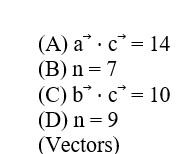
Contributor-Level 10
Volume of parallelepiped v = | [a? b? c? ]|
v = | 1 n |
| 2 4 -n| = ±158
| 1 n 3 |
1 (12+n²) - 1 (6+n) + n (2n-4) = ±158
3n²-5n+152=0 or 3n²-5n+164=0
D<0 (no real roots)
n=8, -19/3 ⇒ n=8
then b? ⋅c? = 2+4n-3n=10
a? ⋅c? = 1+n+3n=33
Taking an Exam? Selecting a College?
Get authentic answers from experts, students and alumni that you won't find anywhere else
Sign Up on ShikshaOn Shiksha, get access to
- 67k Colleges
- 1.2k Exams
- 716k Reviews
- 1850k Answers