Class 12th

Get insights from 12k questions on Class 12th, answered by students, alumni, and experts. You may also ask and answer any question you like about Class 12th

Follow Ask Question
12k

Questions

0

Discussions

62

Active Users

0

Followers

New answer posted

6 months ago

0 Follower 3 Views

P
Payal Gupta

Contributor-Level 10

x = s i n π ( t + 1 3 )

v = d x d t = c o s [ π ( t + 1 3 ) ] * π

= c o s ( π + π 3 ) * π

= c o s π 3 * ( π )

= π 2 = 1 . 5 7 m / s e c              

Speed = 157 cm/sec

New answer posted

6 months ago

0 Follower 3 Views

P
Payal Gupta

Contributor-Level 10

40% of K.E. = m c Δ T + m L  

0 . 4 * 1 2 * m v 2 = m [ 1 2 5 ( 3 2 7 1 2 7 ) + 2 . 5 * 1 0 4 ]                

0 . 2 v 2 = [ 2 5 0 * 1 0 2 + 2 5 * 1 0 3 ]                

v 2 = 2 * 2 5 * 1 0 3 0 . 2                

v = 5 * 100

v = 500 m/sec

New answer posted

6 months ago

0 Follower 4 Views

P
Payal Gupta

Contributor-Level 10

x ¯ (mean free path) = 1 2 π d 2 n v  

n v = n N A v , n → No. of moles in volume v NA ® Avogadro's Number

n v = P R T

x ¯ v 1 ρ ( d e n s i t y & x ¯ α T a t c o n s t a n t P )

ρ x ¯ | x ¯ T                           

The motion of the gas molecules freezes at 0K not 0° C

Average kinetic Energy per molecule per degree of freedom is  = 1 2 k B T (for Mono atomic gases)

New answer posted

6 months ago

0 Follower 15 Views

P
Payal Gupta

Contributor-Level 10

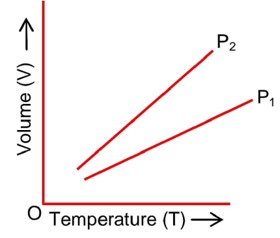
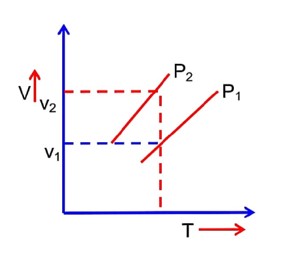
At constant Temp

P α 1 v

v2 > v1

⇒ P1 > P2

New answer posted

6 months ago

0 Follower 5 Views

P
Payal Gupta

Contributor-Level 10

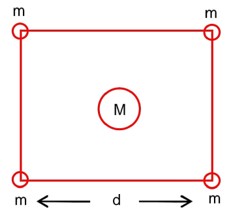
Amount of work done to bring mass from infinity to point (1) u1 = 0

Similarly, to bring mass (2) u 2 = G m d m
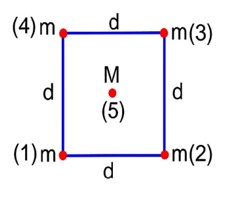
u 3 = G m d [ m 1 + m 2 ]

u 4 = G m d [ 2 m + m 2 ]

u 5 = G m d [ 4 2 M ]

U T = u 1 + u 2 + u 3 + u 4 + u 5

U T = G m d [ ( 4 + 2 ) m + 4 2 M ]


New answer posted

6 months ago

0 Follower 2 Views

P
Payal Gupta

Contributor-Level 10

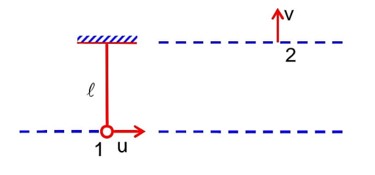
Conservation of Energy b/w (1) & (2)

1 2 m v 2 + m g l = 1 2 m u 2

v = u 2 2 g l

Δ v = v j ^ u i ^

| Δ v | = ( u ) 2 + ( u 2 2 g l ) 2

= u 2 + u 2 2 g l

= 2 ( u 2 g l )

x = 2

New answer posted

6 months ago

0 Follower 2 Views

P
Payal Gupta

Contributor-Level 10

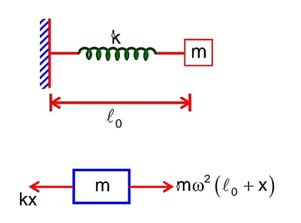
F.B.D, with respect to Non-Inertial frame

k x = m ω 2 ( l 0 + x )

x | k m ω 2 ( l 0 + x )

x = m ω 2 l 0 k m ω 2


New answer posted

6 months ago

0 Follower 8 Views

P
Payal Gupta

Contributor-Level 10

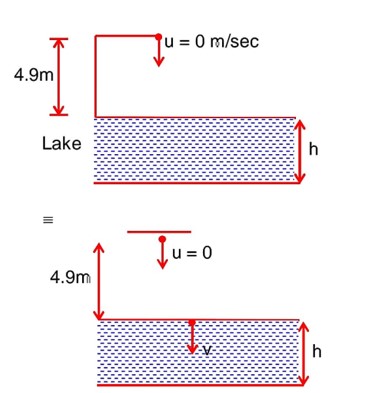
Total time (T) = 4 sec

Given u = 0 m/sec

a = g = 9.8 m/sec2

h = 4.9 m, t =?

h = u t + 1 2 a t 2                

4 . 9 = 0 . t + 1 2 * 9 . 8 t 2                

t = 1 sec

'v' be the velocity with which ball hits the water v = u + at

= 0 + 9.8 * 1 = 9.8 m/sec

Time taken to reach the bottom of the lake from surface of the lake

= 4 – 1 = 3 sec

v = 9.8 m/sec

H = u t + 1 2 g t 2 = 9 . 8 * 3 + 1 2 * 9 . 8 * 9                

29.4 + 4.9 * 9 = 29.4 + 44.1

H = 73.5 m
New answer posted

6 months ago

0 Follower 21 Views

P
Payal Gupta

Contributor-Level 10

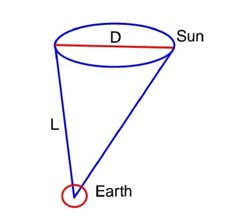
1° →  60'

⇒ 60' → 10°

6 0 ' π 1 8 0 C

θ = π * 2 * 1 0 3 1 8 0 * 3 6 0 0          

L = 1.5 * 1011 m

D = L θ = 1 . 5 * 1 0 1 1 * π 1 8 0 * 3 6 0 0 * 2 * 1 0 3 = 1 . 4 5 * 1 0 9 m    


New question posted

6 months ago

0 Follower 2 Views

Get authentic answers from experts, students and alumni that you won't find anywhere else

Sign Up on Shiksha

On Shiksha, get access to

  • 66k Colleges
  • 1.2k Exams
  • 684k Reviews
  • 1800k Answers

Share Your College Life Experience

×
×

This website uses Cookies and related technologies for the site to function correctly and securely, improve & personalise your browsing experience, analyse traffic, and support our marketing efforts and serve the Core Purpose. By continuing to browse the site, you agree to Privacy Policy and Cookie Policy.