Maths NCERT Exemplar Solutions Class 12th Chapter Eight: Overview, Questions, Preparation

Maths NCERT Exemplar Solutions Class 12th Chapter Eight 2025 ( Maths NCERT Exemplar Solutions Class 12th Chapter Eight )

Payal Gupta
Updated on Jul 9, 2025 10:48 IST

By Payal Gupta, Retainer

Table of contents
  • Applications of Integrals Short Answer Type Questions
  • Applications of Integrals Long Answer Type Questions
  • Applications of Integrals Objective Type Questions
Maths NCERT Exemplar Solutions Class 12th Chapter Eight Logo

Applications of Integrals Short Answer Type Questions

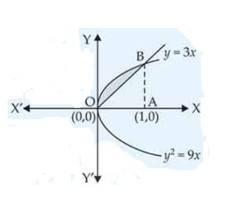
1. Find the area of the region bounded by the curves y 2 = 9 x  and  y = 3 x  .

Sol:

W e     h a v e ,     y 2 = 9 x ,     y = 3 x S o l v i n g     t h e     t w o     e q u a t i o n s ,     w e     h a v e                                     ( 3 x ) 2 = 9 x ⇒               9 x 2 − 9 x = 0         ⇒ 9 x ( x − 1 ) = 0 ∴                                                   x = 0 , 1 A r e a     o f     t h e     s h a d e d     r e g i o n = a r ( r e g i o n     O A B ) − a r ( Δ O A B ) = ∫ 0 1 y 1 d x = ∫ 0 1 9 x d x − ∫ 0 1 3 x d x = 3 ∫ 0 1 x d x − 3 ∫ 0 1 x d x = 3 × 2 3 [ x 3 / 2 ] 0 1 − 3 [ x 2 2 ] 0 1 = 2 [ ( 1 ) 3 / 2 − 0 ] − 3 2 [ ( 1 ) 2 − 0 ] = 2 ( 1 ) − 3 2 ( 1 ) = 2 − 3 2 = 1 2 s q .   u n i t s H e n c e ,     t h e     r e q u i r e d     a r e a = 1 2 s q .   u n i t s .

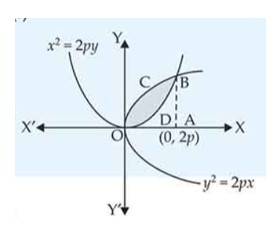
2. Find the area of the region bounded by the parabolas y 2 = 2 p x  and x 2 = 2 p y .

Sol:

W e     a r e     g i v e n     t h a t     x 2 = 2 p y                                                                                     … ( i ) a n d                                                                   y 2 = 2 p x                                                                                   … ( i i ) F r o m     e q n . ( i )     w e     g e t     y = x 2 2 p P u t t i n g     t h e     t h e     o f     y     i n     e q n . ( i i ) ,   w e     h a v e                                     ( x 2 2 p ) 2 = 2 p x         ⇒ x 4 4 p 2 = 2 p x ⇒ x 4 = 8 p 3 x         ⇒ x 4 − 8 p 3 x = 0 ⇒ x ( x 3 − 8 p 3 ) = 0 ∴                                                       x = 0 , 2 p Required     a r e a = A r e a     o f     t h e     r e g i o n ( O C B A − O D B A ) = ∫ 0 2 p 2 p x d x − ∫ 0 2 p x 2 2 p d x = 2 p ∫ 0 2 p x d x − 1 2 p ∫ 0 2 p x 2 d x = 2 p . 2 3 [ x 3 / 2 ] 0 2 p − 1 2 p . 1 3 [ x 3 ] 0 2 p = 2 2 3 [ ( 2 p ) 3 / 2 − 0 ] − 1 6 p [ ( 2 p ) 3 − 0 ] = 2 2 3 p . 2 2 p 3 2 − 1 6 p . 8 p 3 = 8 3 . p 2 − 8 6 p 2 = 8 6 p 2 = 4 3 p 2 s q .   u n i t s H e n c e ,     t h e     r e q u i r e d     a r e a = 4 3 p 2 s q .   u n i t s .

Q&A Icon
Commonly asked questions
Q:  

Find the area of the region bounded by the curves y2=9x and y=3x .

A: 

This is a short answer type question as classified in NCERT Exemplar
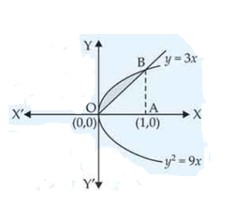
W e     h a v e ,     y 2 = 9 x ,     y = 3 x S o l v i n g     t h e     t w o     e q u a t i o n s ,     w e     h a v e                                     ( 3 x ) 2 = 9 x ⇒               9 x 2 − 9 x = 0         ⇒ 9 x ( x − 1 ) = 0 ∴                                                   x = 0 , 1 A r e a     o f     t h e     s h a d e d     r e g i o n = a r ( r e g i o n     O A B ) − a r ( Δ O A B ) = ∫ 0 1 y 1 d x = ∫ 0 1 9 x d x − ∫ 0 1 3 x d x = 3 ∫ 0 1 x d x − 3 ∫ 0 1 x d x = 3 × 2 3 [ x 3 / 2 ] 0 1 − 3 [ x 2 2 ] 0 1 = 2 [ ( 1 ) 3 / 2 − 0 ] − 3 2 [ ( 1 ) 2 − 0 ] = 2 ( 1 ) − 3 2 ( 1 ) = 2 − 3 2 = 1 2 s q .   u n i t s H e n c e ,     t h e     r e q u i r e d     a r e a = 1 2 s q .   u n i t s .

Q:  

Find the area of the region included between the curves   y 2 = 9 x and y = x .

Read more
A: 

This is a short answer type question as classified in NCERT Exemplar
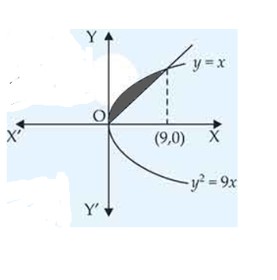
W e     a r e     g i v e n     t h a t     y 2 = 9 x                                                                                                     … ( i ) a n d                                                                     y = x                                                                                                           … ( i i ) S o l v i n g     e q n . ( i )     a n d     ( i i )     w e     h a v e ⇒                                         x 2 = 9 x         ⇒ x 2 − 9 x = 0                           x ( x − 9 ) = 0           ∴         x = 0 ,     x = 9 Required  area=∫099xdx−∫09xdx=3∫09xdx−∫04xdx                                                                   = 3 . 2 3 [ x 3 / 2 ] 0 9 − 1 2 [ x 2 ] 0 9                                                                   = 2 [ ( 9 ) 3 / 2 − 0 ] − 1 2 [ ( 9 ) 2 − 0 ]                                                                   = 2 ( 2 7 ) − 1 2 ( 8 1 ) = 5 4 − 8 1 2 = 1 0 8 − 8 1 2                                                                   = 2 7 2   s q .   u n i t s H e n c e ,     t h e     r e q u i r e d     a r e a = 2 7 2   s q .   u n i t s .

Q:  

Find the area of the region bounded by the parabolas y 2 = 2 p x  and x 2 = 2 p y .

A: 

This is a short answer type question as classified in NCERT Exemplar
W e     a r e     g i v e n     t h a t     x 2 = 2 p y                                                                                     … ( i ) a n d                                                                   y 2 = 2 p x                                                                                   … ( i i ) F r o m     e q n . ( i )     w e     g e t     y = x 2 2 p P u t t i n g     t h e     t h e     o f     y     i n     e q n . ( i i ) ,   w e     h a v e                                     ( x 2 2 p ) 2 = 2 p x         ⇒ x 4 4 p 2 = 2 p x ⇒ x 4 = 8 p 3 x         ⇒ x 4 − 8 p 3 x = 0 ⇒ x ( x 3 − 8 p 3 ) = 0 ∴                                                       x = 0 , 2 p Required  area=Area  of  the  region(OCBA−ODBA) = ∫ 0 2 p 2 p x d x − ∫ 0 2 p x 2 2 p d x = 2 p ∫ 0 2 p x d x − 1 2 p ∫ 0 2 p x 2 d x = 2 p . 2 3 [ x 3 / 2 ] 0 2 p − 1 2 p . 1 3 [ x 3 ] 0 2 p = 2 2 3 [ ( 2 p ) 3 / 2 − 0 ] − 1 6 p [ ( 2 p ) 3 − 0 ] = 2 2 3 p . 2 2 p 3 2 − 1 6 p . 8 p 3 = 8 3 . p 2 − 8 6 p 2 = 8 6 p 2 = 4 3 p 2 s q .   u n i t s H e n c e ,     t h e     r e q u i r e d     a r e a = 4 3 p 2 s q .   u n i t s .

Q:  

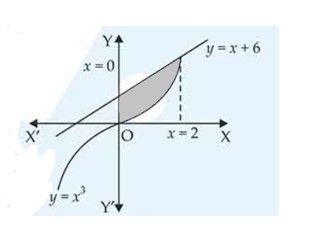
Find the area of the region bounded by the curves y = x 3 , y = x + 6 , and x = 0 .

Read more
A: 

This is a short answer type question as classified in NCERT Exemplar
W e     a r e     g i v e n     t h a t     y = x 3 ,     y = x + 6     a n d     x = 0 S o l v i n g     y = x 3     a n d     y = x + 6 ,     w e     g e t                                                                                                                             x + 6 = x 3 ⇒                                                                                                 x 3 − x − 6 = 0 ⇒ x 2 ( x − 2 ) + 2 x ( x − 2 ) + 3 ( x − 2 ) = 0 ⇒                                                       ( x − 2 ) ( x 2 + 2 x + 3 ) = 0 x 2 + 2 x + 3     h a s     n o     r e a l     r o o t s . ∴         x = 2 Required  area  of  the  shaded  region=∫02(x+6)dx−∫02x3dx = [ x 2 2 + 6 x ] 0 2 − 1 4 [ x 4 ] 0 2 = ( 4 2 + 1 2 ) − ( 0 + 0 ) − 1 4 [ ( 2 ) 4 − 0 ] = 1 4 − 1 4 × 1 6 = 1 4 − 4 = 1 0   s q .   u n i t s H e n c e ,     t h e     r e q u i r e d     a r e a = 1 0   s q .   u n i t s .

Q:  

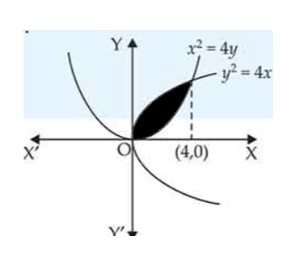
Find the area of the region bounded by the curves   y 2 = 4 x and x 2 = 4 y .

Read more
A: 

This is a short answer type question as classified in NCERT Exemplar
W e     a r e     g i v e n     t h a t     y 2 = 4 x     a n d     x 2 = 4 y                                                                                       y = x 2 4 ⇒                                                         ( x 2 4 ) 2 = 4 x ⇒                                                                         x 4 1 6 = 4 x ⇒                                                                           x 4 = 6 4 x         ⇒ x 4 − 6 4 x = 0 ⇒                                         x ( x 3 − 6 4 ) = 0 ∴         x = 0 ,     x = 4 Required  area=∫044xdx−∫04x24dx=2∫04xdx−14∫04x2dx                                                                   = 2 . 2 3 [ x 3 / 2 ] 0 4 − 1 4 . 1 3 [ x 3 ] 0 4                                                                   = 4 3 [ ( 4 ) 3 / 2 − 0 ] − 1 1 2 [ ( 4 ) 3 − 0 ]                                                                   = 4 3 [ 8 ] − 1 1 2 [ 6 4 ] = 1 1 2 [ 6 4 ] = 3 2 3 − 1 6 3 = 1 6 3   s q .   u n i t s H e n c e ,     t h e     r e q u i r e d     a r e a = 1 6 3   s q .   u n i t s .

Q:  

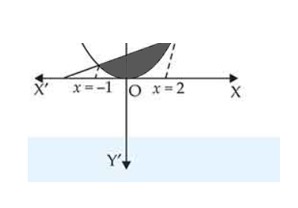
Find the area of the region enclosed by the parabola x 2 = y and the line y = x + 2 .

Read more
A: 

This is a short answer type question as classified in NCERT Exemplar
H e r e ,     x 2 = y       a n d         y = x + 2 ∴                                                                             x 2 = x + 2 ⇒                                           x 2 − x − 2 = 0 ⇒                       x 2 − 2 x + x − 2 = 0 ⇒       x ( x − 2 ) + 1 ( x − 2 ) = 0 ⇒                             ( x − 2 ) ( x + 1 ) = 0           ∴ x = − 1 ,   x = 2 G r a p h     o f     y = x + 2           x 0 − 2 y 2 0 Area  of  the  required  region=∫−12(x+2)dx−∫−12x2dx                                                                   = [ x 2 2 + 2 x ] − 1 2 − 1 3 [ x 3 ] − 1 2                                                                   = [ ( 4 2 + 4 ) − ( 1 2 − 2 ) ] − 1 3 [ 8 − ( − 1 ) ]                                                                   = ( 6 + 3 2 ) − 1 3 ( 9 ) = 1 5 2 − 3 = 9 2   s q .   u n i t s H e n c e ,     t h e     r e q u i r e d     a r e a = 9 2   s q .   u n i t s .

Q:  

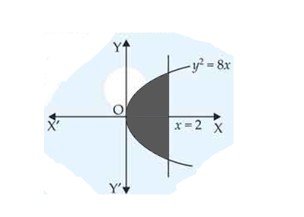
Find the area of the region bounded by the line x = 2 and the parabola y 2 = 8 x .

Read more
A: 

This is a short answer type question as classified in NCERT Exemplar
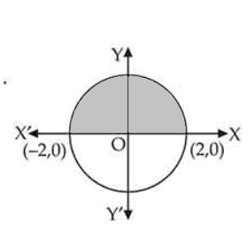
W e     a r e     g i v e n     t h a t     y 2 = 8 x     a n d     x = 2                                                                                   y 2 = 8 ( 2 ) = 1 6 ∴                                                                                   y = ± 4 Required  area=∫028xdx=2×22∫02xdx                                                                   = 4 2 × 2 3 [ x 3 / 2 ] 0 2                                                                   = 8 2 3 [ ( 2 ) 3 / 2 − 0 ] = 8 2 3 × 2 2 = 3 2 3   s q .   u n i t s H e n c e ,     t h e     r e q u i r e d     a r e a = 3 2 3   s q .   u n i t s .

Q:  

Sketch the region { ( x , 0 ) : y = 4 − x 2 } and the x-axis. Find the area of the region using integration.

A: 

This is a short answer type question as classified in NCERT Exemplar
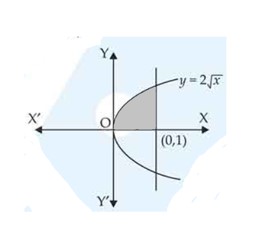
W e     a r e     g i v e n     t h a t     { ( x , 0 ) : y = 4 − x 2 } ⇒                           y 2 = 4 − x 2 ⇒       x 2 + y 2 = 4     w h i c h     i s     a     c i r c l e . Required  area=2.∫024−x2dx [ Since  circle  is  symmetrical  about  y−axis. ]                                                                 = 2 . ∫ 0 2 ( 2 ) 2 − x 2 d x                                                                   = 2 . [ x 2 4 − x 2 + 4 2 s i n − 1 x 2 ] 0 2                                                                   = 2 [ ( 2 2 − 4 − 4 + 2 s i n − 1 ( 1 ) ) − ( 0 + 0 ) ] = 2 [ 2 . π 2 ] = 2 π   s q .   u n i t s H e n c e ,     t h e     r e q u i r e d     a r e a = 2 π   s q .   u n i t s .

Q:  

Calculate the area under the curve y = 2 x included between the lines   x = 0 and x = 1 .

Read more
A: 

This is a short answer type question as classified in NCERT Exemplar
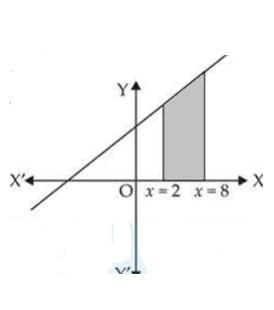
G i v e n     t h e     c u r v e s     y = 2 x ,     x = 0     a n d     x = 1 .                                                                             y = 2 x         ⇒ y 2 = 4 x ( P a r a b o l a ) Required  area=∫01(2x)dx                                                                   = 2 × 2 3 [ x 3 / 2 ] 0 1                                                                   = 4 3 [ ( 1 ) 3 / 2 − 0 ] = 4 3   s q .   u n i t s H e n c e ,     t h e     r e q u i r e d     a r e a = 4 3   s q .   u n i t s .

Q:  

Using integration, find the area of the region bounded by the line 2 y = 5 x + 7 , the x-axis, and the lines x = 2 and x = 8 .

Read more
A: 

This is a short answer type question as classified in NCERT Exemplar
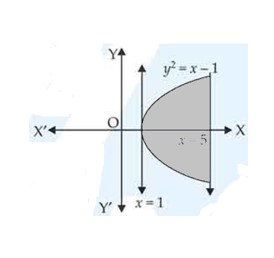
G i v e n     t h a t     2 y = 5 x + 7 ,     x − a x i s ,     x = 2     a n d     x = 8 L e t     u s     d r a w     t h e   g r a p h     o f     2 y = 5 x + 7         ⇒ y = 5 x + 7 2           x 1 − 1 y 6 1 Area  of  the  required  shaded  region=∫28(5x+72)dx                             = 1 2 [ 5 x 2 2 + 7 x ] 2 8                             = 1 2 [ 5 2 ( 6 4 − 4 ) + 7 ( 8 − 2 ) ]                               = 1 2 [ 5 2 × 6 0 + 7 × 6 ] = 1 2 [ 1 5 0 + 4 2 ] = 1 2 × 1 9 2 = 9 6   s q .   u n i t s H e n c e ,     t h e     r e q u i r e d     a r e a = 9 6   s q .   u n i t s .

Q:  

Draw a rough sketch of the curve   y = x − 1 in the interval [ 1 , 5 ] . Find the area under the curve and between the lines   x = 1 and x = 5 .

Read more
A: 

This is a short answer type question as classified in NCERT Exemplar
H e r e ,     w e     h a v e     y = x − 1 ⇒                                                     y 2 = x − 1 ( P a r a b o l a ) Area  of  the  required  region=∫15x−1dx                                                                   = 2 3 [ ( x − 1 ) 3 / 2 ] 1 5                                                                   = 2 3 [ ( 5 − 1 ) 3 / 2 − 0 ] = 2 3 × ( 4 ) 3 / 2                                                                     = 2 3 × 8 = 1 6 3   s q .   u n i t s H e n c e ,     t h e     r e q u i r e d     a r e a = 1 6 3   s q .   u n i t s .

Q:  

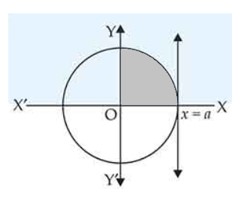
Determine the area under the curve y = a 2 − x 2 included between the lines x = 0  and .

Read more
A: 

This is a short answer type question as classified in NCERT Exemplar
H e r e ,     w e     h a v e     y = a 2 − x 2 ⇒                                                     y 2 = a 2 − x 2 ⇒                                 x 2 + y 2 = a 2 Area  of  the  shaded  region                                                                   = 2 [ ( 1 ) 3 / 2 − 0 ] − 3 2 [ ( 1 ) 2 − 0 ]                                                                   = [ x a a 2 − x 2 + a 2 2 s i n − 1 x a ] 0 a                                                                     = [ a a a 2 − a 2 + a 2 2 s i n − 1 a a − 0 − 0 ]                                                                     = a 2 2 s i n − 1 ( 1 ) = a 2 2 . π 2 = π a 2 4   s q .   u n i t s H e n c e ,     t h e     r e q u i r e d     a r e a = π a 2 4   s q .   u n i t s .

Q:  

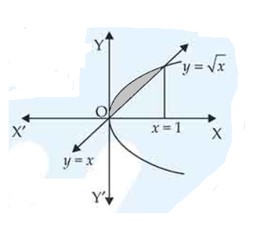
Find the area of the region bounded by   y = x and y = x .

Read more
A: 

This is a short answer type question as classified in NCERT Exemplar
W e     a r e     g i v e n     t h e     e q u a t i o n s     o f     c u r v e     y = x     a n d     l i n e     y = x . S o l v i n g     y = x     ⇒ y 2 = x     a n d     y = x ,     w e     g e t                                                                                     x 2 = x     ⇒ x 2 − x = 0 ⇒                                                     x ( x − 1 ) = 0         ∴ x = 0 , 1 Area  of  the  required  shaded  region=∫01xdx−∫01xdx                                                 = 2 3 [ x 3 / 2 ] 0 1 − 1 2 [ x 2 ] 0 1                                                   = 2 3 [ ( 1 ) 3 / 2 − 0 ] − 1 2 [ ( 1 ) 2 − 0 ]                                                   = 2 3 − 1 2 = 4 − 3 6 = 1 6   s q .   u n i t s H e n c e ,     t h e     r e q u i r e d     a r e a = 1 6   s q .   u n i t s .

Q:  

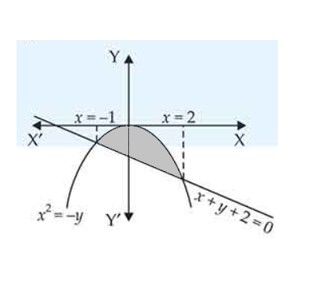
Find the area enclosed by the curve y = − x 2  and the straight line x + y + 2 = 0 .

Read more
A: 

This is a short answer type question as classified in NCERT Exemplar
W e     a r e     g i v e n     t h a t     y = − x 2     o r     x 2 = − y a n d     t h e     l i n e     x + y + 2 = 0 S o l v i n g     t h e     t w o     e q u a t i o n s ,     w e     g e t ∴                                               x − x 2 + 2 = 0 ⇒                                           x 2 − x − 2 = 0 ⇒                       x 2 − 2 x + x − 2 = 0 ⇒       x ( x − 2 ) + 1 ( x − 2 ) = 0 ⇒                             ( x − 2 ) ( x + 1 ) = 0           ∴ x = − 1 ,   x = 2 Area  of  the  required  shaded  region=|∫−12(−x−2)dx−∫−12−x2dx|                                                                   = | − [ x 2 2 + 2 x ] − 1 2 + 1 3 [ x 3 ] − 1 2 |                                                                   = | − [ ( 4 2 + 4 ) − ( 1 2 − 2 ) ] + 1 3 [ 8 + 1 ] |                                                                   = | − ( 6 + 3 2 ) + 1 3 ( 9 ) | = | − 1 5 2 + 3 |                                                                     = | − 1 5 + 6 2 | = | − 9 2 | = 9 2   s q .   u n i t s H e n c e ,     t h e     r e q u i r e d     a r e a = 9 2   s q .   u n i t s .

Q:  

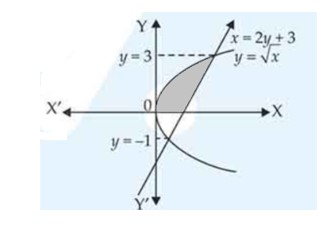
Find the area bounded by the curves y = x and x = 2 y + 3 in the first quadrant and the x-axis.

A: 

This is a short answer type question as classified in NCERT Exemplar
G i v e n     t h a t     y = x ,     x = 2 y + 3 ,     f i r s t     q u a d r a n t     a n d     x − a x i s . S o l v i n g     y = x     a n d     x = 2 y + 3 ,     w e     g e t                                                                                 y = 2 y + 3       ⇒ y 2 = 2 y + 3 ⇒                                 y 2 − 2 y − 3 = 0         ⇒ y 2 − 3 y + y − 3 = 0 ⇒ y ( y − 3 ) + 1 ( y − 3 ) = 0         ⇒ ( y + 1 ) ( y − 3 ) = 0 ∴                                                                                 y = − 1 , 3 A r e a     o f     t h e     s h a d e d     r e g i o n = ∫ 0 3 ( 2 y + 3 ) d y − ∫ 0 3 y 2 d y                                                 = [ 2 y 2 2 + 3 y ] 0 3 − 1 3 [ y 3 ] 0 3                                                   = [ ( 9 + 9 ) − ( 0 + 0 ) ] − 1 3 [ 2 7 − 0 ]                                                   = 1 8 − 9 = 9   s q .   u n i t s H e n c e ,     t h e     r e q u i r e d     a r e a = 9   s q .   u n i t s .

Maths NCERT Exemplar Solutions Class 12th Chapter Eight Logo

Applications of Integrals Long Answer Type Questions

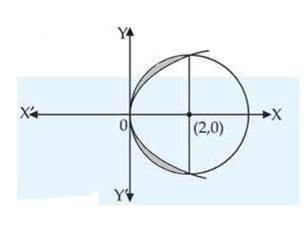
1. Find the area of the region bounded by the curves y 2 = 2 x and x 2 + y 2 = 4 x .

Sol.

E q u a t i o n s     o f     t h e     c u r v e     a r e     g i v e n     b y                                                             x 2 + y 2 = 4 x                                                                                                     … ( i ) a n d                                                                   y 2 = 2 x                                                                                                   … ( i i ) ⇒                                 x 2 − 4 x + y 2 = 0 ⇒ x 2 − 4 x + 4 − 4 + y 2 = 0                                           ( x − 2 ) 2 + y 2 = 4 C l e a r l y     i t     i s     t h e     e q u a t i o n     o f     a     c i r c l e     h a v i n g     i t s     c e n t r e ( 2 , 0 )     a n d     r a d i u s     2 . S o l v i n g     x 2 + y 2 = 4 x     a n d     y 2 = 2 x                                     x 2 + 2 x = 4 x ⇒       x 2 + 2 x − 4 x = 0 ⇒                             x 2 − 2 x = 0 ⇒                         x ( x − 2 ) = 0 ∴                                                             x = 0 , 2 Area     of     the     r equired     r e g i o n = 2 [ ∫ 0 2 4 − ( x − 2 ) 2 d x − ∫ 0 2 2 x d x ]       [ ∵     P a r a b o l a     a n d     c i r c l e     b o t h     a r e     s y m m e t r i c a l     a b o u t     x − a x i s ]                                                                   = 2 [ x − 2 2 4 − ( x − 2 ) 2 + 4 2 s i n − 1 x − 2 2 ] 0 2 − 2 . 2 . 2 3 [ x 3 / 2 ] 0 2                                                                   = 2 [ ( 0 + 0 ) − ( 0 + 2 s i n − 1 ( − 1 ) ) ] − 4 2 3 [ ( 2 ) 3 / 2 − 0 ]                                                                   = 2 × 2 . ( − π 2 ) − 4 2 3 . 2 2 = 2 π − 1 6 3 = 2 ( π − 8 3 )   s q .   u n i t s H e n c e ,     t h e     r e q u i r e d     a r e a = 2 ( π − 8 3 )   s q .   u n i t s .

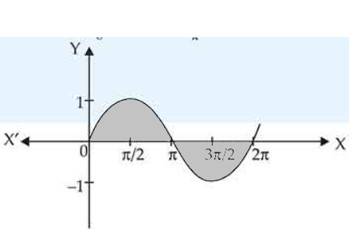
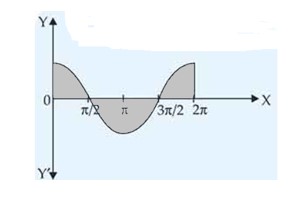
2. Find the area bounded by the curve y = s i n x between x = 0 and x = 2 π .

Sol. 

Required     area     = ∫ 0 π s i n x   d x + ∫ 0 2 π | s i n x |   d x                             = [ c o s x ] 0 π + | ( − c o s x ) | 0 2 π                             = − [ c o s π − c o s 0 ] + [ c o s 2 π − c o s π ]                             = − [ − 1 − 1 ] + [ 1 + 1 ] = 2 + 2 = 4   s q .   u n i t s H e n c e ,     t h e     r e q u i r e d     a r e a = 4   s q .   u n i t s .

Q&A Icon
Commonly asked questions
Q:  

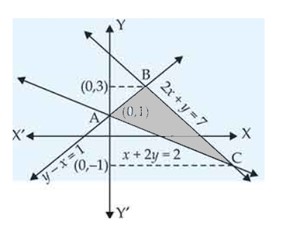
Compute the area bounded by the lines x + 2 y = 2 , y − x = 1 , and 2 x + y = 7 .

Read more
A: 

This is a long answer type question as classified in NCERT Exemplar
G i v e n     t h a t     x + 2 y = 2                                                                                                 … ( i )                                                         y − x = 1                                                                                                 … ( i i ) a n d                                     2 x + y = 7                                                                                             … ( i i i )           x 0 2 y 1 0                     x 0 − 1 y 1 0                     x 0 7 / 2 y 7 0 S o l v i n g     e q n ( i i )     a n d     ( i i i )     w e     g e t                                               y = 1 + x ∴         2 x + 1 + x = 7                                           3 x = 6         ⇒ x = 2 ∴                                           y = 1 + 2 = 3 C o o r d i n a t e s     o f     B = ( 2 , 3 ) S o l v i n g     e q n ( i )     a n d     ( i i i )     w e     g e t                           x + 2 y = 2 ∴                                           x = 2 − 2 y                             2 x + y = 7 2 ( 2 − 2 y ) + y = 7 ⇒       4 − 4 y + y = 7       ⇒ − 3 y = 3 ∴                                                 y = − 1     a n d     x = 4 ∴ C o o r d i n a t e s     o f     C = ( 4 , − 1 )     a n d     C o o r d i n a t e s     o f     A = ( 0 , 1 ) T a k i n g     t h e     l i m i t s     o n     y − a x i s ,     w e     g e t                             ∫ − 1 3 x B C d y − ∫ − 1 1 x A C d y − ∫ 1 3 x A B d y                         = ∫ − 1 3 7 − y 2 d y − ∫ − 1 1 ( 2 − 2 y ) d y − ∫ 1 3 ( y − 1 ) d y                         = 1 2 [ 7 y − y 2 2 ] − 1 3 − 2 [ y − y 2 2 ] − 1 1 − [ y 2 2 − y ] 1 3                         = 1 2 [ ( 2 1 − 9 2 ) − ( − 7 − 1 2 ) ] − 2 [ ( 1 − 1 2 ) − ( − 1 − 1 2 ) ] − [ ( 9 2 − 3 ) − ( 1 2 − 1 ) ]                         = 1 2 [ 3 3 2 + 1 5 2 ] − 2 [ 1 2 + 3 2 ] − [ 3 2 + 1 2 ]                         = 1 2 × 2 4 − 2 × 2 − 2 = 1 2 − 4 − 2 = 6   s q .   u n i t s H e n c e ,     t h e     r e q u i r e d     a r e a = 6   s q .   u n i t s .

Q:  

Find the area of the region bounded by the curves y 2 = 2 x and x 2 + y 2 = 4 x .

A: 

This is a long answer type question as classified in NCERT Exemplar
E q u a t i o n s     o f     t h e     c u r v e     a r e     g i v e n     b y                                                             x 2 + y 2 = 4 x                                                                                                     … ( i ) a n d                                                                   y 2 = 2 x                                                                                                   … ( i i ) ⇒                                 x 2 − 4 x + y 2 = 0 ⇒ x 2 − 4 x + 4 − 4 + y 2 = 0                                           ( x − 2 ) 2 + y 2 = 4 C l e a r l y     i t     i s     t h e     e q u a t i o n     o f     a     c i r c l e     h a v i n g     i t s     c e n t r e ( 2 , 0 )     a n d     r a d i u s     2 . S o l v i n g     x 2 + y 2 = 4 x     a n d     y 2 = 2 x                                     x 2 + 2 x = 4 x ⇒       x 2 + 2 x − 4 x = 0 ⇒                             x 2 − 2 x = 0 ⇒                         x ( x − 2 ) = 0 ∴                                                             x = 0 , 2 Area  of  the  required  region=2[∫024−(x−2)2dx−∫022xdx]       [ ?     P a r a b o l a     a n d     c i r c l e     b o t h     a r e     s y m m e t r i c a l     a b o u t     x − a x i s ]                                                                   = 2 [ x − 2 2 4 − ( x − 2 ) 2 + 4 2 s i n − 1 x − 2 2 ] 0 2 − 2 . 2 . 2 3 [ x 3 / 2 ] 0 2                                                                   = 2 [ ( 0 + 0 ) − ( 0 + 2 s i n − 1 ( − 1 ) ) ] −

Q:  

Find the area bounded by the curve y = s i n x between x = 0 and x = 2 π

A: 

This is a long answer type question as classified in NCERT Exemplar
Required  area  =∫0πsinx dx+∫02π|sinx| dx                             = [ c o s x ] 0 π + | ( − c o s x ) | 0 2 π                             = − [ c o s π − c o s 0 ] + [ c o s 2 π − c o s π ]                             = − [ − 1 − 1 ] + [ 1 + 1 ] = 2 + 2 = 4   s q .   u n i t s H e n c e ,     t h e     r e q u i r e d     a r e a = 4   s q .   u n i t s .

Q:  

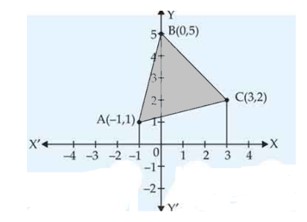
Find the area of the region bounded by the triangle whose vertices are ( − 1 , 1 ) , ( 0 , 5 ) , and ( 3 , 2 ) , using integration.

Read more
A: 

This is a long answer type question as classified in NCERT Exemplar
T h e     c o o r d i n a t e s     o f     t h e     v e r t i c e s     o f     Δ A B C     a r e     g i v e n     b y     A ( − 1 , 1 ) , B ( 0 , 5 )     C ( 3 , 2 ) . E q u a t i o n     o f     A B     i s     y − 1 = 5 − 1 0 + 1 ( x + 1 ) ⇒                                                                             y − 1 = 4 x + 4         ⇒ y = 4 x + 4 + 1 ⇒                                                                                             y = 4 x + 5                                                                                                                     … ( i ) E q u a t i o n     o f     B C     i s     y − 5 = 2 − 5 3 − 0 ( x − 0 ) ⇒                                                                             y − 5 = − x ⇒                                                                                           y = 5 − x                                                                                                                               … ( i i ) E q u a t i o n     o f     C A     i s     y − 1 = 2 − 1 3 + 1 ( x + 1 ) ⇒                                                                             y − 1 = 1 4 x + 1 4           ⇒ y = 1 4 x + 1 4 + 1 ⇒                                                                                           y = 1 4 x + 5 4 = 1 4 ( 5 + x )                                                                           … ( i i i ) Area  of  ΔABC=∫−10(4x+5) dx+∫03(5−x) dx−∫−1314(5+x) dx                             = 4 2 [ x 2 ] − 1 0 + 5 [ x ] − 1 0 + 5 [ x ] 0 3 − 1 2 [ x 2 ] 0 3 − 1 4 [ 5 x + x 2 2 ] − 1 3                             = 2 ( 0 − 1 ) + 5 ( 0 + 1 ) + 5 ( 3 − 0 ) − 1 2 ( 9 − 0 ) − 1 4 [ ( 1 5 + 9 2 ) − ( − 5 + 1 2 ) ]                             = − 2 + 5 + 1 5 − 9 2 − 1 4 ( 3 9 2 + 9 2 )                             = 1 8 − 9 2 − 1 4 × 4 8 2 = 1 8 − 9 2 − 6 = 1 2 − 9 2 = 1 5 2   s q .   u n i t s H e n c e ,     t h e     r e q u i r e d     a r e a = 1 5 2   s q .   u n i t s .

Q:  

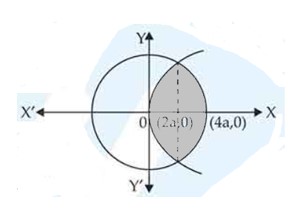
Draw a rough sketch of the region { (x,y):y2≤6ax and x2+y2≤16a2 } . Also, find the area of the region sketched using the method of integration.

Read more
A: 

This is a long answer type question as classified in NCERT Exemplar
W e     a r e     g i v e n     t h a t     { ( x , y ) : y 2 ≤ 6 a x     a n d     x 2 + y 2 ≤ 1 6 a 2 } E q u a t i o n     o f     P a r a b o l a     i s                                   y 2 = 6 a x                                                                                                   … ( i ) a n d     e q u a t i o n     o f     c i r c l e     i s                 x 2 + y 2 = 1 6 a 2                                                                                           … ( i i ) S o l v i n g     e q n . ( i )     a n d     ( i i )     w e     g e t                                                                         x 2 + 6 a x = 1 6 a 2 ⇒                                   x 2 + 6 a x − 1 6 a 2 = 0 ⇒           x 2 + 8 a x − 2 a x − 1 6 a 2 = 0 ⇒       x ( x + 8 a ) − 2 a ( x + 8 a ) = 0 ⇒                                   ( x + 8 a ) ( x − 2 a ) = 0 ∴     x = 2 a     a n d     x = − 8 a . ( Rejected  as  it  out  of  region ) Area  of  the  required  shaded  region=2[∫02a6axdx+∫2a4a16a2−x2]                                                                 = 2 [ 6 a ∫ 0 2 a x d x + ∫ 2 a 4 a ( 4 a ) 2 − x 2 ]                                                                   = 2 6 a . 2 3 [ x 3 / 2 ] 0 2 a + 2 [ x 2 ( 4 a ) 2 − x 2 + 1 6 a 2 2 s i n − 1 x 4 a ] 2 a 4 a                                                                   = 4 6 3 a [ ( 2 a ) 3 / 2 − 0 ] + [ x ( 4 a ) 2 − x 2 + 1 6 a 2 s i n − 1 x 4 a ] 2 a 4 a                                                                   = 4 6 3 a . 2 2 . a 3 / 2 + [ 0 + 1 6 a 2 s i n − 1 ( 4 a 4 a ) − 2 a 1 6 a 2 − 4 a 2 − 1 6 a 2 s i n − 1 2 a 4 a ]                                                                   = 8 1 2 3 a 2 + [ 1 6 a 2 s i n − 1 ( 1 ) − 2 a 1 2 a 2 − 1 6 a 2 s i n − 1 1 2 ]                                                                   = 1 6 3 3 a 2 + [ 1 6 a 2 . π 2 − 2 a . 2 3 a − 1 6 a 2 . π 6 ]                                                                   = 1 6 3 3 a 2 + 8 π a 2 − 4 3 a 2 − 8 3 π a 2                                                                   = ( 1 6 3 3 − 4 3 ) a 2 + 1 6 3 π a 2 = 4 3 3 a 2 + 1 6 3 π a 2                                                                   = 4 3 ( 3 + 4 π ) a 2   s q .   u n i t s H e n c e ,     t h e     r e q u i r e d     a r e a = 4 3 ( 3 + 4 π ) a 2   s q .   u n i t s .

Q:  

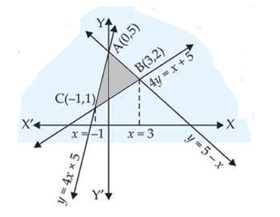
Find the area bounded by the lines y = 4 x + 5 , y = 5 − x , and 4 y = x + 5 .

Read more
A: 

This is a long answer type question as classified in NCERT Exemplar

G i v e n     t h a t     y = 4 x + 5                                                                                                                 … ( i )                                                   y = 5 − x                                                                                                                   … ( i i ) a n d                             4 y = x + 5                                                                                                                   … ( i i i )           x 0 − 5 / 4 y 5 0                     x 0 5 y 5 0                     x 0 − 5 y 5 / 4 0 S o l v i n g     e q n ( i )     a n d     ( i i )     w e     g e t           4 x + 5 = 5 − x ∴                         x = 0     a n d     y = 5 C o o r d i n a t e s     o f     A = ( 0 , 5 ) S o l v i n g     e q n ( i i )     a n d     ( i i i )     w e     g e t                           y = 5 − x ∴                 4 y = x + 5                       5 y = 1 0 ∴                       y = 2     a n d     x = 3 ∴ C o o r d i n a t e s     o f     B = ( 3 , 2 )     S o l v i n g     e q n ( i )     a n d     ( i i i )     w e     g e t                           y = 4 x + 5     a n d     4 y = x + 5 ⇒ 4 ( 4 x + 5 ) = x + 5 ⇒         1 6 x + 2 0 = x + 5             ⇒ 1 5 x = − 1 5 ∴                                             x = − 1     a n d     y = 1 ∴ C o o r d i n a t e s     o f     C = ( − 1 , 1 ) ∴ A r e a     o f     r e q u i r e d     r e g i o n s           = ∫ − 1 0 y A C d x + ∫ 0 3 y A B d x − ∫ − 1 3 y C B d x           = ∫ − 1 0 ( 4 x + 5 ) d x + ∫ 0 3 ( 5 − x ) d x − ∫ − 1 3 ( x + 5 4 ) d x           = [ 4 x 2 2 + 5 x ] − 1 0 + [ 5 x − x 2 2 ] 0 3 − 1 4 [ x 2 2 + 5 x ] − 1 3           = [ ( 0 + 0 ) − ( 2 − 5 ) ] + [ ( 1 5 − 9 2 ) − ( 0 − 0 ) ] − 1 4 [ ( 9 2 + 1 5 ) − ( 1 2 − 5 ) ]           = 3 + 2 1 2 − 1 4 [ 3 9 2 + 9 2 ] = 3 + 2 1 2 − 1 4 × 2 4           = 3 + 2 1 2 − 6 = 2 1 2   s q .   u n i t s H e n c e ,     t h e     r e q u i r e d     a r e a = 2 1 2   s q .   u n i t s .

Q:  

Find the area bounded by the curve y = 2 c o s x and the x-axis from x = 0 to x = 2 π .

Read more
A: 

This is a long answer type question as classified in NCERT Exemplar

G i v e n     e q u a t i o n     o f     t h e     c u r v e     i s     y = 2 c o s x ∴ A r e a     o f     s h a d e d     r e g i o n           = ∫ 0 2 π 2 c o s x   d x = ∫ 0 π 2 2 c o s x   d x + ∫ π 2 3 π 2 | 2 c o s x |   d x + ∫ 3 π 2 2 π 2 c o s x   d x           = 2 [ s i n x ] 0 π 2 + | [ s i n x ] π 2 3 π 2 | + 2 [ s i n x ] 3 π 2 2 π           = 2 [ s i n π 2 − s i n 0 ] + | 2 ( s i n 3 π 2 − s i n π 2 ) | + 2 [ s i n 2 π − s i n 3 π 2 ]           = 2 ( 1 ) + | 2 ( − 1 − 1 ) | + 2 ( 0 + 1 ) = 2 + 4 + 2 = 8   s q .   u n i t s H e n c e ,     t h e     r e q u i r e d     a r e a = 8   s q .   u n i t s .


Q:  

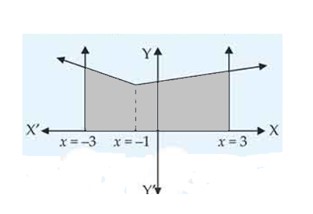
Draw a rough sketch of the given curve y = 1 + ? x + 1 ? , x = − 3 , x = 3 , y = 0  and find the area of the region bounded by them using integration.

Read more
A: 

This is a long answer type question as classified in NCERT Exemplar

G i v e n     e q u a t i o n s     a r e     y = 1 + | x + 1 | ,     x = − 3     a n d     x = 3 ,     y = 0 T a k i n g     y = 1 + | x + 1 | ⇒                           y = 1 + x + 1 ⇒                           y = x + 2     a n d     y = 1 − x − 1         ⇒ y = − x O n     s o l v i n g     w e     g e t     x = − 1 ∴ A r e a     o f     r e q u i r e d     r e g i o n s           = ∫ − 3 − 1 − x   d x + ∫ − 1 3 ( x + 2 )   d x           = − [ x 2 2 ] − 3 − 1 + [ x 2 2 + 2 x ] − 1 3 = − [ 1 2 − 9 2 ] + [ ( 9 2 + 6 ) − ( 1 2 − 2 ) ]           = − ( − 4 ) + [ 2 1 2 + 3 2 ] = 4 + 1 2 = 1 6   s q .   u n i t s H e n c e ,     t h e     r e q u i r e d     a r e a = 1 6   s q .   u n i t s .

Maths NCERT Exemplar Solutions Class 12th Chapter Eight Logo

Applications of Integrals Objective Type Questions


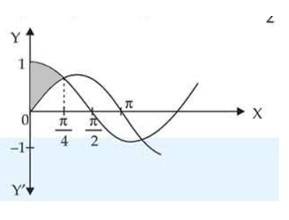
1. The area of the region bounded by the y-axis, y = c o s x  and y = s i n x , 0 ≤ x ≤ π 2 is:

(A) 2 sq. units

(B) 2 +1sq. units

(C) 2 − 1  sq. units

(D) 2 2 − 1 sq. units

Sol.

G i v e n     t h a t     y − a x i s ,     y = c o s x ,     y = s i n x ,     0 ≤ x ≤ π 2 Required     a r e a = ∫ 0 π 4 c o s x   d x − ∫ 0 π 4 s i n x   d x                                                                   = [ s i n x ] 0 π 4 − [ − c o s x ] 0 π 4                                                                   = [ s i n π 4 − s i n 0 ] + [ c o s π 4 − c o s 0 ]                                                                   = [ 1 2 − 0 + 1 2 − 1 ] = 2 2 − 1 = ( 2 − 1 )   s q .   u n i t s H e n c e ,     t h e     c o r r e c t     o p t i o n     i s     ( c ) .

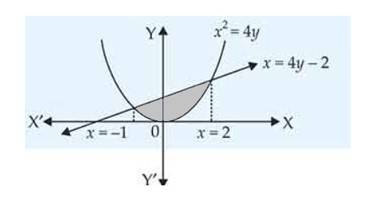
2. The area of the region bounded by the curve x 2 = 4 y  and the straight line x = 4 y − 2 is:

(A) 3 8 sq. units

(B) 5 8 sq. units

(C) 7 8 sq. units

(D) 9 8 sq. units

Sol.

G i v e n     t h a t :     T h e     e q u a t i o n     o f     p a r a b o l a     i s     x 2 = 4 y                                               … ( i ) a n d     e q u a t i o n     o f     s t r a i g h t     l i n e     x = 4 y − 2                                                                                     … ( i i ) S o l v i n g     e q n ( i )     a n d     ( i i )     w e     g e t                       y = x 2 4                     ⇒ x = 4 ( x 2 4 ) − 2 ⇒               x = x 2 − 2     ⇒ x 2 − x − 2 = 0 ⇒   x 2 − 2 x + x − 2 = 0         ⇒ x ( x − 2 ) + 1 ( x − 2 ) = 0 ⇒         ( x − 2 ) ( x + 1 ) = 0         ∴ x = − 1 ,     x = 2 Required     a r e a = ∫ − 1 2 x + 2 4   d x − ∫ − 1 2 x 2 4   d x                                                                   = 1 4 [ x 2 2 + 2 x ] − 1 2 − 1 4 . 1 3 [ x 3 ] − 1 2                                                                   = 1 4 [ ( 4 2 + 2 ) − ( 1 2 − 2 ) ] − 1 1 2 [ 8 + 1 ]                                                                   = 1 4 [ 6 + 3 2 ] − 1 1 2 [ 9 ] = 1 4 × 1 5 2 − 3 4 = 1 5 8 − 3 4 = 9 8   s q .   u n i t s H e n c e ,     t h e     c o r r e c t     o p t i o n     i s     ( d ) .
Q&A Icon
Commonly asked questions
Q:  

The area of the region bounded by the y-axis, y = c o s x  and y = s i n x , 0 ≤ x ≤ π 2  is:

(A) 2 sq. units

(B) 2 +1sq. units

(C) 2 − 1  sq. units

(D) 2 2 − 1 sq. units

Read more
A: 

This is an Objective Type Questions as classified in NCERT Exemplar
G i v e n     t h a t     y − a x i s ,     y = c o s x ,     y = s i n x ,     0 ≤ x ≤ π 2 Required  area=∫0π4cosx dx−∫0π4sinx dx                                                                   = [ s i n x ] 0 π 4 − [ − c o s x ] 0 π 4                                                                   = [ s i n π 4 − s i n 0 ] + [ c o s π 4 − c o s 0 ]                                                                   = [ 1 2 − 0 + 1 2 − 1 ] = 2 2 − 1 = ( 2 − 1 )   s q .   u n i t s H e n c e ,     t h e     c o r r e c t     o p t i o n     i s     ( c ) .

Q:  

The area of the region bounded by the curve x 2 = 4 y  and the straight line x = 4 y − 2 is:

(A) 3 8 sq. units

(B) 5 8 sq. units

(C) 7 8 sq. units

(D) 9 8 sq. units

Read more
A: 

This is an Objective Type Questions as classified in NCERT Exemplar
G i v e n     t h a t :     T h e     e q u a t i o n     o f     p a r a b o l a     i s     x 2 = 4 y                                               … ( i ) a n d     e q u a t i o n     o f     s t r a i g h t     l i n e     x = 4 y − 2                                                                                     … ( i i ) S o l v i n g     e q n ( i )     a n d     ( i i )     w e     g e t                       y = x 2 4                     ⇒ x = 4 ( x 2 4 ) − 2 ⇒               x = x 2 − 2     ⇒ x 2 − x − 2 = 0 ⇒   x 2 − 2 x + x − 2 = 0         ⇒ x ( x − 2 ) + 1 ( x − 2 ) = 0 ⇒         ( x − 2 ) ( x + 1 ) = 0         ∴ x = − 1 ,     x = 2 Required  area=∫−12x+24 dx−∫−12x24 dx                                                                   = 1 4 [ x 2 2 + 2 x ] − 1 2 − 1 4 . 1 3 [ x 3 ] − 1 2                                                                   = 1 4 [ ( 4 2 + 2 ) − ( 1 2 − 2 ) ] − 1 1 2 [ 8 + 1 ]                                                                   = 1 4 [ 6 + 3 2 ] − 1 1 2 [ 9 ] = 1 4 × 1 5 2 − 3 4 = 1 5 8 − 3 4 = 9 8   s q .   u n i t s H e n c e ,     t h e     c o r r e c t     o p t i o n     i s     ( d ) .

Q:  

The area of the region bounded by the curve y = 1 6 − x 2  and the x-axis is:

(A) 8 sq. units

(B) 2 0 π sq. units

(C) 1 6 π sq. units

(D) 2 5 6 π sq. units

Read more
A: 

This is an Objective Type Questions as classified in NCERT Exemplar
H e r e , e q u a t i o n     o f     c u r v e     i s     y = 1 6 − x 2 Required  area=2[∫0416−x2 dx]                                                                   = 2 [ x 2 1 6 − x 2 + 1 6 2 s i n − 1 x 4 ] 0 4                                                                   = 2 [ ( 0 + 8 s i n − 1 4 4 ) − ( 0 + 0 ) ]                                                                   = 2 [ 8 s i n − 1 ( 1 ) ] = 1 6 . π 2 = 8 π   s q .   u n i t s H e n c e ,     t h e     c o r r e c t     o p t i o n     i s     ( a ) .

Q:  

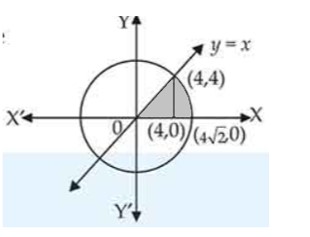
Area of the region in the first quadrant enclosed by the x-axis, the line y = x and the circle x 2 + y 2 = 3 2 is:

(A) 1 6 π sq. units

(B) 4 π sq. units

(C) 3 2 π sq. units

(D) 24 sq. units

Read more
A: 

This is an Objective Type Questions as classified in NCERT Exemplar


G i v e n     e q u a t i o n     o f     c i r c l e     i s     x 2 + y 2 = 3 2       ⇒ x 2 + y 2 = ( 4 2 ) 2 a n d     t h e     l i n e     i s     y = x     a n d     t h e   x − a x i s . S o l v i n g     t h e     t w o     e q u a t i o n s     w e     h a v e           x 2 + x 2 = 3 2       ⇒ 2 x 2 = 3 2 ⇒                     x 2 = 1 6                         ∴ x = ± 4 Required  area=∫04x dx+∫442(42)2−x2 dx                                                                   = 1 2 [ x 2 ] 0 4 + [ x 2 ( 4 2 ) 2 − x 2 + 3 2 2 s i n − 1 x 4 2 ] 4 4 2                                                                   = 1 2 [ 1 6 − 0 ] + [ 0 + 1 6 s i n − 1 ( 4 2 4 2 ) − 2 3 2 − 1 6 − 1 6 s i n − 1 x 4 2 ]                                                                   = 8 + [ 1 6 s i n − 1 ( 1 ) − 8 − 1 6 s i n − 1 1 2 ]                                                                     = 8 + 1 6 . π 2 − 8 − 1 6 . π 4 = 8 π − 4 π = 4 π   s q .   u n i t s H e n c e ,     t h e     c o r r e c t     o p t i o n     i s     ( b ) .

Q:  

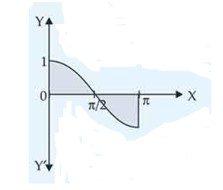
The area of the region bounded by the curve y = cosx between x = 0 and x = π is:

(A) 2 sq. units

(B) 4 sq. units

(C) 3 sq. units

(D) 1 sq. unit

Read more
A: 

This is an Objective Type Questions as classified in NCERT Exemplar
G i v e n     t h a t :     y = c o s x ,     x = 0 ,     x = π Required  area=∫0π2cosx dx+|∫π2πcosx dx|dx                                                                   = [ s i n x ] 0 π 2 + | [ s i n x ] π 2 π |                                                                   = [ s i n π 2 − s i n 0 ] + | [ s i n π − s i n π 2 ] |                                                                     = ( 1 − 0 ) + | 0 − 1 | = 1 + 1 = 2   s q .   u n i t s H e n c e ,     t h e     c o r r e c t     o p t i o n     i s     ( a ) .

Q:  

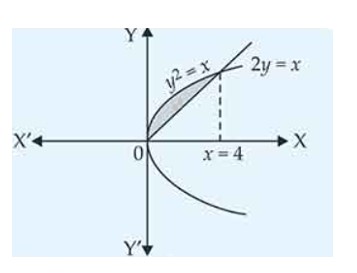
The area of the region bounded by the parabola y 2 = x and the straight line 2 y = x is:

(A) 4 3  sq. units

(B) 1 sq. unit

(C) 2 3  sq. units

(D) 1 3  sq. units

Read more
A: 

This is an Objective Type Questions as classified in NCERT Exemplar
G i v e n     e q u a t i o n     o f     p a r a b o l a     i s     y 2 = x                                                         … ( i ) a n d     e q u a t i o n     o f     s t r a i g h t     l i n e     i s     2 y = x                                                   … ( i i ) S o l v i n g     e q n . ( i )     a n d     ( i i )     w e     g e t           ( x 2 ) 2 = x         ⇒ x 2 4 = x         ⇒ x 2 = 4 x ⇒ x ( x − 4 ) = 0                         ∴ x = 0 , 4 Required  area=∫04x dx−∫04x2 dx                                                                   = 2 3 [ x 3 / 2 ] 0 4 − 1 2 . 1 2 [ x 2 ] 0 4                                                                   = 2 3 [ ( 4 ) 3 / 2 − 0 ] − 1 4 [ ( 4 ) 2 − 0 ]                                                                     = 2 3 × 8 − 1 4 × 1 6 = 1 6 3 − 4 = 4 3   s q .   u n i t s H e n c e ,     t h e     c o r r e c t     o p t i o n     i s     ( a ) .

Q:  

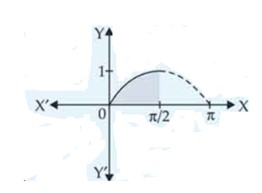
The area of the region bounded by the curve y = s i n x between the ordinates x = 0 , x = π 2 , and the x-axis is:

(A) 2 sq. units

(B) 4 sq. units

(C) 3 sq. units

(D) 1 sq. unit

Read more
A: 

This is an Objective Type Questions as classified in NCERT Exemplar
G i v e n     e q u a t i o n     o f     c u r v e     i s     y = s i n x     b e t w e e n     x = 0     a n d     x = π 2 Area  of  required  region=∫0π2sinx dx                                                                   = [ − c o s x ] 0 π 2 = − [ c o s π 2 − c o s 0 ] = − [ 0 − 1 ] = 1   s q .   u n i t s H e n c e ,     t h e     c o r r e c t     o p t i o n     i s     ( d ) .

Q:  

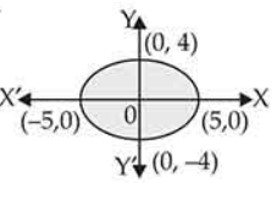
The area of the region bounded by the ellipse x 2 2 5 + y 2 1 6 = 1 is:

(A) 2 0 π sq. units

(B) 2 0 π 2 sq. units

(C) 1 6 π 2 sq. units

(D) 2 5 π sq. units

Read more
A: 

This is an Objective Type Questions as classified in NCERT Exemplar
G i v e n     e q u a t i o n     o f     e l l i p s e     i s     x 2 2 5 + y 2 1 6 = 1 ⇒     y 2 1 6 = 1 − x 2 2 5             ⇒ y 2 = 1 6 2 5 ( 2 5 − x 2 ) ∴                 y = 4 5 2 5 − x 2 ∴   Since  the  ellipse  is  symmetrical  about  the  axes. ∴Required  area=4∫054525−x2 dx=4×45∫05(5)2−x2 dx                                   = 1 6 5 [ x 2 ( 5 ) 2 − x 2 + 2 5 2 s i n − 1 x 5 ] 0 5                                   = 1 6 5 [ 0 + 2 5 2 s i n − 1 ( 5 5 ) − 0 − 0 ] = 1 6 5 [ 2 5 2 . s i n − 1 ( 1 ) ]                                   = 1 6 5 [ 2 5 2 . π 2 ] = 2 0 π   s q .   u n i t s H e n c e ,     t h e     c o r r e c t     o p t i o n     i s     ( a ) .

Q:  

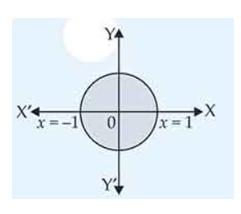
The area of the region bounded by the circle x 2 + y 2 = 1 is:

(A) 2 π sq. units

(B) π sq. units

(C) 3 π sq. units

(D) 4 π sq. units

Read more
A: 

This is an Objective Type Questions as classified in NCERT Exemplar

G i v e n     e q u a t i o n     o f     c i r c l e     i s     x 2 + y 2 = 1 ⇒                                   y = 1 − x 2 ∴   Since  the  circle  is  symmetrical  about  the  axes. ∴Required  area=4×∫011−x2 dx                                   = 4 [ x 2 1 − x 2 + 1 2 s i n − 1 x ] 0 1                                   = 4 [ 0 + 1 2 s i n − 1 ( 1 ) − 0 − 0 ] = 4 × 1 2 × π 2 = π   s q .   u n i t s H e n c e ,     t h e     c o r r e c t     o p t i o n     i s     ( b ) .

Q:  

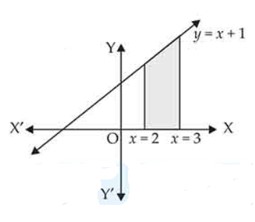
The area of the region bounded by the curve y=x+1 and the lines x=2 and x=3 is:

(A) 72  sq. units

(B) 92  sq. units

(C) 112  sq. units

(D) 132  sq. units

Read more
A: 

This is an Objective Type Questions as classified in NCERT Exemplar

G i v e n     e q u a t i o n     o f     l i n e s     a r e     y = x + 1 ,     x = 2     a n d     x = 3 ∴Required  area=∫23(x+1) dx                                   = [ x 2 2 + x ] 2 3 = ( 9 2 + 3 ) − ( 4 2 + 2 )                                   = 1 5 2 − 4 = 7 4   s q .   u n i t s H e n c e ,     t h e     c o r r e c t     o p t i o n     i s     ( a ) .

Q:  

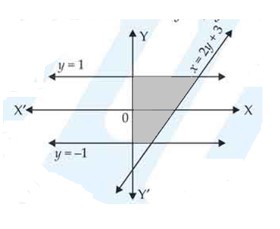
The area of the region bounded by the curve x = 2y + 3 and the y lines. y = 1 and y = –1 is

(A) 4 sq units

(B) 3 2 sq units

(C) 6 sq units

(D) 8 sq unit

Read more
A: 

This is an Objective Type Questions as classified in NCERT Exemplar

G i v e n     e q u a t i o n     o f     l i n e s     a r e     x = 2 y + 3 ,     y = 1     a n d     y = − 1 ∴Required  area=∫−11(2y+3) dy                                   = 2 . 1 2 [ y 2 ] − 1 1 + 3 [ y ] − 1 1 = ( 1 − 1 ) + 3 ( 1 + 1 ) = 6   s q .   u n i t s H e n c e ,     t h e     c o r r e c t     o p t i o n     i s     ( c ) .

qna

Maths NCERT Exemplar Solutions Class 12th Chapter Eight Exam

Student Forum

chatAnything you would want to ask experts?
Write here...