

Class 12th
Get insights from 12k questions on Class 12th, answered by students, alumni, and experts. You may also ask and answer any question you like about Class 12th
Follow Ask QuestionQuestions
Discussions
Active Users
Followers
New answer posted
a year agoContributor-Level 10
This is a short answer type question as classified in NCERT Exemplar
Rubber is a natural polymer. It is also known as an elastomer due to its elastic properties. It is manufactured from rubber latex.
New answer posted
a year ago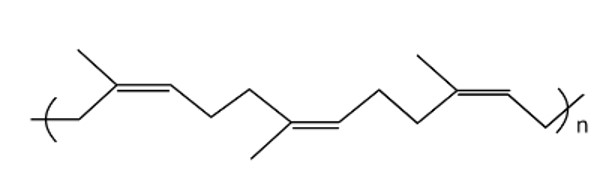
Contributor-Level 10
This is a short answer type question as classified in NCERT Exemplar
The cis-polyisoprene molecule is made up of several chains that are held together by weak van there Waals interactions and has a coiled structure. Thus, it can be stretched like a spring and exhibits elastic properties.
New answer posted
a year ago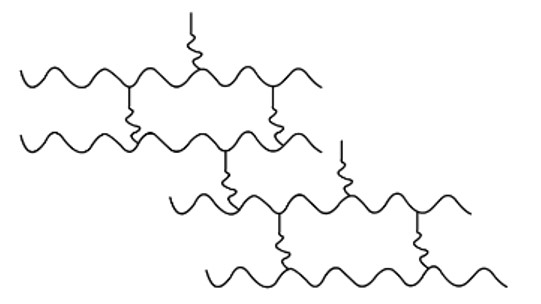
Contributor-Level 10
This is a short answer type question as classified in NCERT Exemplar
The polymer shown above is cross-linked or network polymer. They are formed from bi or tri-functional monomers that contain strong covalent bond between polymer chains.
New answer posted
a year agoContributor-Level 10
This is a short answer type question as classified in NCERT Exemplar
This is a type of chain-growth polymerization. The molecules of the same monomer or different monomer are added together to form this type of polymer.
New answer posted
a year agoContributor-Level 10
This is a short answer type question as classified in NCERT Exemplar
Addition polymers formed by the polymerization from two different monomers are co-polymers. The above-given polymer is a co-polymer. For example Buna-N, Buna-S.
New answer posted
a year agoContributor-Level 10
This is a short answer type question as classified in NCERT Exemplar
Addition polymers formed by the polymerization of a single monomeric species are known as homopolymers. The above-given polymer is a homopolymer.
New answer posted
a year agoContributor-Level 10
This is a short answer type question as classified in NCERT Exemplar
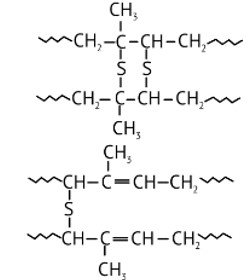
While manufacturing tyre rubber, 5 % sulfur is used as a crosslinking agent. A natural linear polymer of 2-methyl-1, 3-butadiene becomes hard on treatment with sulfur and forms vulcanised rubber. The structure of the product formed is,
New answer posted
a year agoContributor-Level 10
This is a multiple choice answer as classified in NCERT Exemplar
Option (A) and (D)
Explanation: Vulcanisation is a process used to improve the physical properties of natural rubber. This method involves heating a mixture of raw rubber, sulphur, and an appropriate additive to temperatures ranging from 373 K to 415 K. Sulphur forms cross links at the reactive sites of double bonds during vulcanisation, stiffening the rubber.
New answer posted
a year agoContributor-Level 10
This is a multiple choice answer as classified in NCERT Exemplar
Option (A), (B) and (D)
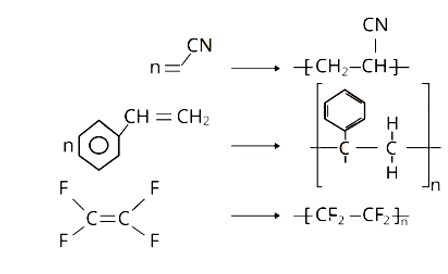
Explanation: Polyacrylonitrile is formed by the addition polymerisation of acrylonitrile in the presence of a peroxide catalyst. Polyacrylonitrile is used as a wool substitute in the manufacture of commercial fibers such as orlon or acrilan.
Polystyrene has the monomer unit styrene.
Teflon is made by heating tetrafluoroethene at high pressures with a free radical or persulphate catalyst.
New answer posted
a year agoContributor-Level 10
This is a multiple choice answer as classified in NCERT Exemplar
Option (A) and (D)
Explanation: Polyamides: These polymers with amide linkages are important examples of synthetic fibers and are known as nylons.
Polyesters: These are the polycondensation products of dicarboxylic acids and diols.
Dacron or terylene is the most well-known example of a polyester.
Taking an Exam? Selecting a College?
Get authentic answers from experts, students and alumni that you won't find anywhere else
Sign Up on ShikshaOn Shiksha, get access to
- 67k Colleges
- 1.2k Exams
- 718k Reviews
- 1850k Answers