Class 12th

Get insights from 12k questions on Class 12th, answered by students, alumni, and experts. You may also ask and answer any question you like about Class 12th

Follow Ask Question
12k

Questions

0

Discussions

25

Active Users

0

Followers

New answer posted

a year ago

0 Follower 5 Views

A
alok kumar singh

Contributor-Level 10

This is a Long Answer Type Questions as classified in NCERT Exemplar

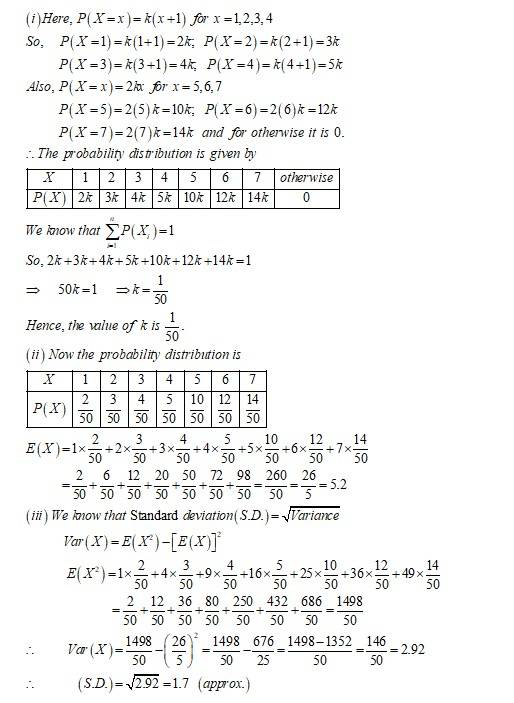
Sol:
New answer posted

a year ago

0 Follower 6 Views

A
alok kumar singh

Contributor-Level 10

This is a Long Answer Type Questions as classified in NCERT Exemplar
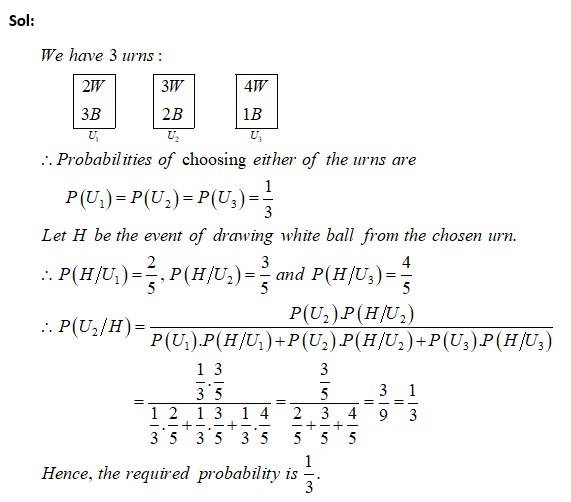
Sol:

Let  E1:the  event  that  the  item  is  manufactured  on  machine  A         E2:the  event  that  the  item  is  manufactured  on  machine  B         E3:the  event  that  the  item  is  manufactured  on  machine  CLet  H  be  the  event  that  the  selected  item  is  defective.  Using Bayes'  Theorm∴     P(E1)=50100,  P(E2)=30100  and  P(E3)=20100 P(H/E1)=2100,  P(H/E2)=2100  and  P(H/E3)=3100∴      P(E1/H)=P(E1).P(H/E1)P(E1).P(H/E1)+P(E2).P(H/E2)+P(E3).P(H/E3)                               =50100*210050100*2100+30100*2100+20100*3100=100100+60+60=100220=1022=511Hence,  the  required  probability  is  511.

New answer posted

a year ago

0 Follower 22 Views

A
alok kumar singh

Contributor-Level 10

This is a Long Answer Type Questions as classified in NCERT Exemplar

Sol:

Let  E1:the  event  that  a  person  has  TB         E2:the  event  that  a  person  does  not  have  TBLet  H  be  the  event  that  the  person  is  diagnosed  to  have  TB.  Bayes'  Theorm∴     P(E1)=11000=0.001,  P(E2)=1−11000=9991000=0.999 P(H/E1)=0.99,  P(H/E2)=0.001∴      P(E1/H)=P(E1).P(H/E1)P(E1).P(H/E1)+P(E2).P(H/E2)                               =0.001*0.990.001*0.99+0.999*0.001=0.990.99+0.999                               =0.9900.990+0.999=9901989=110221Hence,  the  required  probability  is  110221.

New answer posted

a year ago

0 Follower 5 Views

A
alok kumar singh

Contributor-Level 10

This is a Long Answer Type Questions as classified in NCERT Exemplar

New answer posted

a year ago

0 Follower 8 Views

A
alok kumar singh

Contributor-Level 10

This is a Long Answer Type Questions as classified in NCERT Exemplar

Sol:

Let    E1  be  the  event  of  selecting  BagI           E2  be  the  event  of  selecting  BagIIand  E3  be  the  event  that  black  ball  is  selected∴       P(E1)=26=13  and  P(E2)=1−13=23  P(E3/E1)=37  and  P(E3/E2)=47∴         P(E3)=P(E1).P(E3/E1)+P(E2).P(E3/E2)                         =13.37+23.47=3+821=1121Hence,  the  required  probability  is  1121.

New answer posted

a year ago

0 Follower 7 Views

A
alok kumar singh

Contributor-Level 10

This is a Long Answer Type Questions as classified in NCERT Exemplar

Sol:

Let      E1:The  event  that  the  letter  comes  from  TATANAGARand     E2:The  event  that  the  letter  comes  from  CALCUTTAAlso,  E3:The  event  that  on  the  letter,  two    letters  TA  are  visible.∴P(E1)=12,  P(E2)=12  and  P(E3E1)=28  and  P(E3E2)=17[?  For  TATA  NAGAR,  the  two consecutive   letters  visible  are  TA,AT,TA,AN,NA,AG,GA,AR]∴  P(E3/E1)=28and  [For  CALCUTTA,  the  two consecutive   letters  visible  are  CA,AL,LC,CU,UT,TT  and  TA]So,  P(E3/E2)=17Now  using  Bayes'  Therorm,  we  have∴P(E1/E3)=P(E1).P(E3/E1)P(E1).P(E3/E1)+P(E2).P(E3/E2)                  =12.2812.28+12.17=1818+114=187+456=711Hence,  the  required  probability  is  711.

New answer posted

a year ago

0 Follower 29 Views

A
alok kumar singh

Contributor-Level 10

This is a Long Answer Type Questions as classified in NCERT Exemplar

Sol:

Given  that  A1:A2:A3=4:4:2∴  P(A1)=410,  P(A2)=410  and  P(A3)=210  whereA1,A2  and  A3  are  the  three  types  of  seeds.Let  E  be  the  events  that  a  seed    and  E¯  be  the  events  that  a  seed  does  not  ∴  P(EA1)=45100,  P(EA2)=60100  and  P(EA3)=35100and  P(E¯A1)=55100,  P(E¯A2)=40100  and  P(E¯A3)=65100(i)  P(E)=P(A1).P(EA1)+P(A2).P(EA2)+P(A3).P(EA3)                     =410.45100+410.60100+210.35100                     =1801000+2401000+701000=4901000=0.49(ii)  P(E¯/A3)=1−P(E/A3)=1−35100=65100=0.65(iii)  ,  Bayes'  Theorem,  we  get         P(A2/E¯)=P(A2).P(E¯/A2)P(A1).P(E¯/A1)+P(A2).P(E¯/A2)+P(A3).P(E¯/A3)                              =410.40100410.55100+410.40100+210.65100=16010002201000+1601000+1301000                              =160220+160+130=160510=1651=0.314Hence,  the  required  probability  is  1651  or  0.314

New answer posted

a year ago

0 Follower 2 Views

A
alok kumar singh

Contributor-Level 10

This is a Long Answer Type Questions as classified in NCERT Exemplar

Sol:

  Referring to Exercise  Q.41,  we  will  use  here,  Bayes'  Theorem(i)  P(E2/F)=P(E2).P(F/E2)P(E1).P(F/E1)+P(E2).P(F/E2)+P(E3).P(F/E3)                             =26.1316.0+26.13+36.1=218218+36=218*1811=211(ii)  P(E3/F)=P(E3).P(F/E3)P(E1).P(F/E1)+P(E2).P(F/E2)+P(E3).P(F/E3)                              =36.116.0+26.13+36.1=36218+36=36*1811=911Hence,  the  required  probabilities  are  211  and  911

New answer posted

a year ago

0 Follower 4 Views

A
alok kumar singh

Contributor-Level 10

This is a Long Answer Type Questions as classified in NCERT Exemplar

Sol:

Given  that:       ???   Bag I   =3  red  balls  and  no  white  ball          Bag II=2  red  balls  and  1  white  ball         Bag III=no  red  ball  and  3  white  ballsLet  E1,  E2  and  E3  be  the  events  of    Bag II,  and  Bag III  respectively  and  a  ball  isdrawn  from  it.∴P(E1)=16,  P(E2)=26  and  P(E3)=36(i)  Let  E  be  the  event  that  red  ball  is  selected∴P(E)=P(E1).P(E/E1)+P(E2).P(E/E2)+P(E3).P(E/E3)                  =16.33+26.23+36.0=318+418=718(ii)  Let  F  be  the  event  that  white  ball  is  selected∴P(F)=1−P(E)                                [P(E)+P(F)=1]                  =1−718=1118Hence,  the  required  probabilities  are  718  and  1118.

New question posted

a year ago

0 Follower 6 Views

Get authentic answers from experts, students and alumni that you won't find anywhere else

Sign Up on Shiksha

On Shiksha, get access to

  • 67k Colleges
  • 1.2k Exams
  • 718k Reviews
  • 1850k Answers

Share Your College Life Experience

×
×

This website uses Cookies and related technologies for the site to function correctly and securely, improve & personalise your browsing experience, analyse traffic, and support our marketing efforts and serve the Core Purpose. By continuing to browse the site, you agree to Privacy Policy and Cookie Policy.