Electric Charge and Field
Get insights from 23 questions on Electric Charge and Field, answered by students, alumni, and experts. You may also ask and answer any question you like about Electric Charge and Field
- 23
Questions
- 0
Discussions
- 0
Active Users
- 0
Followers
Have a question about Electric Charge and Field? Ask our experts
Keep it short & simple. Type complete word. Avoid abusive language.
An electron is moving with speed of 1 m/s at distance of 1 m from a large sheet of charge with density sC/m2. Find maximum value ofs such that electron hit the sheet after 1 sec.
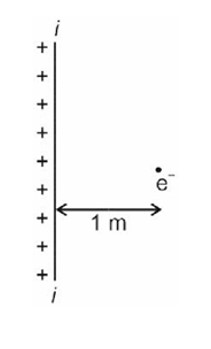
(mass of electron 9 × 10–31 kg, permittivity of free space e0 = 9 × 10–12C2/Nm2)
An electron is moving with speed of 1 m/s at distance of 1 m from a large sheet of charge with density sC/m2. Find maximum value ofs such that electron hit the sheet after 1 sec.
(mass of electron 9 × 10–31 kg, permittivity of free space e0 = 9 × 10–12C2/Nm2)
For maximum value of s, initially, electron must move away from plate.
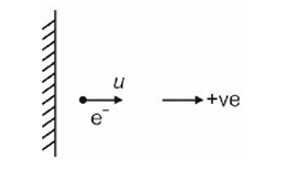
ut + at2 = s
t = 1u = 1m/s s = –1 m
1 × 1 – a × 12 = – 1
-> a = 4m/s2
 Upvote

The electric field in a region is given by The ratio of flux of reported field through the rectangular surface of are 0.2m2 (parallel to y – z plane) to the of the surface of are 0.3m2 (parallel to x – z plane) is a : b, where a = ……………
[Here are the unit vectors along x, y and z – axes respectively]
What is the weightage of Electric Charges and Fields in CBSE Board exam?
What is the weightage of Electric Charges and Fields in CBSE Board exam?
Class 12 physics chapter 1 Electric Charges and Fields is an important chapter for the CBSE Board exam. In unit 1 of the CBSE Board exam of class 12 Physics, there are questions from three chapters including - Electric Charges and Fields, Electrostatics, and Electrostatic Potential and Capacitance.
Upvote Two point charge Q each are placed at a distance d apart. A third point charge q is placed at a distance x from mid-point on the perpendicular bisector. The value of x at which charge q will experience the maximum Coulomb’s force is:
Two point charge Q each are placed at a distance d apart. A third point charge q is placed at a distance x from mid-point on the perpendicular bisector. The value of x at which charge q will experience the maximum Coulomb’s force is:
According to question, we can write
For maxima of force
Upvote A charge q of mass m enters a region of electric field E = -E₀ĵ with a velocity v₀î + v₀ĵ at origin. Find the x coordinate where the charge hits the x axis again. (Neglect effect of gravity)
A charge q of mass m enters a region of electric field E = -E₀ĵ with a velocity v₀î + v₀ĵ at origin. Find the x coordinate where the charge hits the x axis again. (Neglect effect of gravity)
In y axis u? = v? a? = -E? q / m
s? = 0, u? t + (1/2)a? t² = 0 ⇒ t = 2u? /a? = 2v? m/E? q
x coordinate at that time = v? × t = (2v? m/0) × v? = (2v? ²m)/E? q
Upvote A short dipole of dipole moment P is placed along x – axis at a distance d from a long wire having uniform linear charge density +λ (wire is along y – axis) as shown. Find minimum work required to align this dipole along y axis (so that dipole moment P is along +y direction)
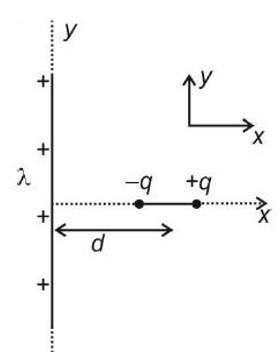
A short dipole of dipole moment P is placed along x – axis at a distance d from a long wire having uniform linear charge density +λ (wire is along y – axis) as shown. Find minimum work required to align this dipole along y axis (so that dipole moment P is along +y direction)
W = Uf - Ui
= 0 - (-P (λ/2πε? d)
= Pλ/2πε? d
Upvote Charge Q? and Q? are at point A and B of a right angle triangle OAB (see figure). The resultant electric field at point O is perpendicular to the hypotenuse, then Q?/Q? is proportional to:
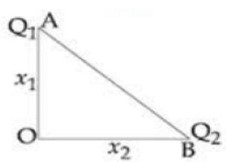
Charge Q? and Q? are at point A and B of a right angle triangle OAB (see figure). The resultant electric field at point O is perpendicular to the hypotenuse, then Q?/Q? is proportional to:
Net field along AB at O must be zero.
E? cosα = E? sinα
(kQ? /x? ²) (x? /AB) = (kQ? /x? ²) (x? /AB)
Q? /Q? = x? ³/x? ³
Upvote