
Electric Current
Get insights from 17 questions on Electric Current, answered by students, alumni, and experts. You may also ask and answer any question you like about Electric Current
- 17
Questions
- 0
Discussions
- 0
Active Users
- 0
Followers
Have a question about Electric Current? Ask our experts
Keep it short & simple. Type complete word. Avoid abusive language.
A wire of length 'l' and resistance is divided into 10 equal parts. The first 5 parts are connected in series while the next 5 parts are connected in parallel. The two combinations are again connected in series. The resistance of this final combination is:
A wire of length 'l' and resistance is divided into 10 equal parts. The first 5 parts are connected in series while the next 5 parts are connected in parallel. The two combinations are again connected in series. The resistance of this final combination is:

Divided into 10 parts
 Upvote

A thin spherical shell is charged by some source. The potential difference between the two points and (in V) shown in the figure is:
(Take SI units)
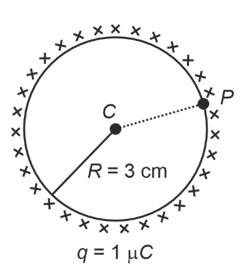
A thin spherical shell is charged by some source. The potential difference between the two points and (in V) shown in the figure is:
(Take SI units)
For uniformly charged spherical shell,
Upvote A uniform heating wire of resistance 36 is connected across a potential difference of 240V. The wire is then cut into half and a potential difference of 240 V is applied across each half separately. The ratio of power dissipation in first case to the total power dissipation in the second case would be 1 : x, where x is________.
A uniform heating wire of resistance 36 is connected across a potential difference of 240V. The wire is then cut into half and a potential difference of 240 V is applied across each half separately. The ratio of power dissipation in first case to the total power dissipation in the second case would be 1 : x, where x is________.
In first condition R1 = 36
In second condition R2 = 18
So
x = 4
Upvote 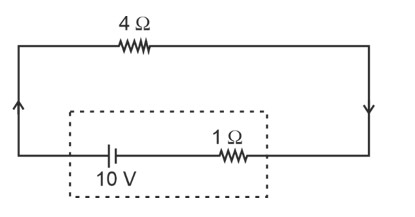
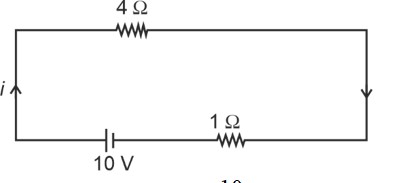
A current of 5A is passing through a non-linear magnesium wire of cross – section 0.04m2. At every point the direction of current density is at an angle of 60° ;with unit vector of area of cross-section. The magnitude of electric field at every point of the conductor is: (Resistivity of magnesium <!-- [if gte mso 9]><xml>
A current of 5A is passing through a non-linear magnesium wire of cross – section 0.04m2. At every point the direction of current density is at an angle of 60° ;with unit vector of area of cross-section. The magnitude of electric field at every point of the conductor is: (Resistivity of magnesium <!-- [if gte mso 9]><xml>
For the circuit shown below, calculate the value of I2
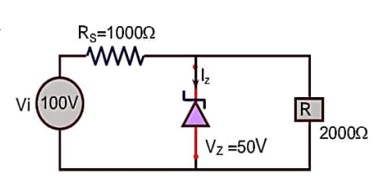
For the circuit shown below, calculate the value of I2
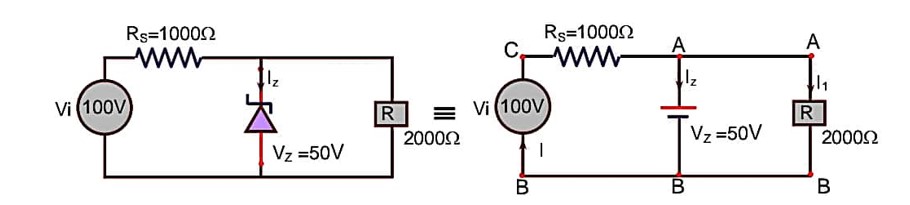
The value of current in the <!-- [if gte mso 9]><xml>
The value of current in the <!-- [if gte mso 9]><xml>
Method-I : Using Kirchhoff’s Law for loop we can write
Using Kirchhoff’s Law for loop
we can write
->-5l + 11l1 = 90 .(ii)
Adding equation (1) with twice the equation (2), we hav
Upvote A student determined Young’s Modulus of elasticity using the formula Y = <!-- [if gte mso 9]><xml>
Physical Quantity
Least count of the Equipment used for measurement
Observed value
Mass (M)
1 g
2 kg
Length of bar (L)
1 mm
1 m
Breadth of bar (b)
0.1 mm
4 cm
Thickness of bar (d)
0.01 mm
0.4 cm
Depression <!-- [if gte mso 9]><xml>
0.01 mm
5 mm
Then the fractional error in the measurement of Y is:
A student determined Young’s Modulus of elasticity using the formula Y = <!-- [if gte mso 9]><xml>
|
Physical Quantity |
Least count of the Equipment used for measurement |
Observed value |
|
Mass (M) |
1 g |
2 kg |
|
Length of bar (L) |
1 mm |
1 m
|
|
Breadth of bar (b) |
0.1 mm |
4 cm |
|
Thickness of bar (d) |
0.01 mm |
0.4 cm |
|
Depression <!-- [if gte mso 9]><xml> |
0.01 mm |
5 mm |
Then the fractional error in the measurement of Y is:
For significant error in Y
= 0.0155
Upvote A square loop of side 20 cm and resistance <!-- [if gte mso 9]><xml>
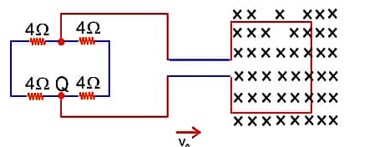
A square loop of side 20 cm and resistance <!-- [if gte mso 9]><xml>
Related Tags
2 Followers
0 Followers
0 Followers
0 Followers
0 Followers
0 Followers
A block of mass m slides on the wooden wedge, which in turn slides backward on the horizontal surface. The acceleration of the block with respect to the wedge is: Given m = 8 kg, M = 16kg. Assume all the surfaces shown in the figure to be frictionless.
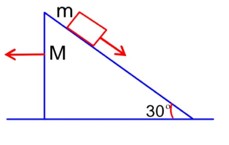
A block of mass m slides on the wooden wedge, which in turn slides backward on the horizontal surface. The acceleration of the block with respect to the wedge is: Given m = 8 kg, M = 16kg. Assume all the surfaces shown in the figure to be frictionless.
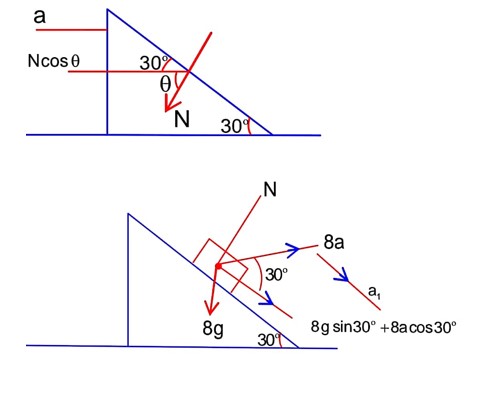
Suppose acceleration of wedge is a and acceleration of block w. r.t. wedge is a1 then N cos60° = Ma = 16 a -> N = 32 a
For block w.r.t. wedge
N + 8a sin 30° = 8g cos 30°
N = 8g cos 30° - 8a sin 30°
->32a = 8g cos 30° - 8a sin 30°
->a =
Now for 8 kg,
Upvote