
Electrostatic Potential and Capacitance
Get insights from 125 questions on Electrostatic Potential and Capacitance, answered by students, alumni, and experts. You may also ask and answer any question you like about Electrostatic Potential and Capacitance
- 125
Questions
- 0
Discussions
- 0
Active Users
- 0
Followers
Have a question about Electrostatic Potential and Capacitance? Ask our experts
Keep it short & simple. Type complete word. Avoid abusive language.
A batsman hits back a back a ball of mass 0.4 kg straight in the direction of the bowler without changing its initial speed of 15ms-1. The impulse imparted to the ball is__________Ns.
A batsman hits back a back a ball of mass 0.4 kg straight in the direction of the bowler without changing its initial speed of 15ms-1. The impulse imparted to the ball is__________Ns.
Impulse = change in momentum
=
= 2 × 15 × 0.4
= 12 N sec
 Upvote

If Electric field intensity of a uniform plane electro magnetic wave is given as <!-- [if gte mso 9]><xml>
Then, magnetic intensity ‘H’ of this wave in Am-1 will be:
[Given : Speed of light in vacuum c = 3 × 10⁸ ms-1, Permeability of vacuum <!-- [if gte mso 9]><xml>
If Electric field intensity of a uniform plane electro magnetic wave is given as <!-- [if gte mso 9]><xml>
Then, magnetic intensity ‘H’ of this wave in Am-1 will be:
[Given : Speed of light in vacuum c = 3 × 10⁸ ms-1, Permeability of vacuum <!-- [if gte mso 9]><xml>
A parallel plate capacitor with plate area A and plate separation d = 2m has a capacitance of The new capacitance of the system if half of the space between them is filled with a dielectric material of dielectric constant K = 3 (as shown in figure) will be:
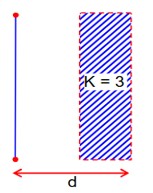
A parallel plate capacitor with plate area A and plate separation d = 2m has a capacitance of The new capacitance of the system if half of the space between them is filled with a dielectric material of dielectric constant K = 3 (as shown in figure) will be:
The change on capacitor of capacitance in the figure given below is:
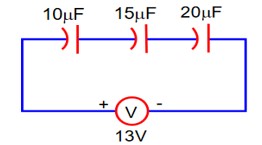
The change on capacitor of capacitance in the figure given below is:
A person is standing in an elevator. In which situation, he experiences weight loss?
A person is standing in an elevator. In which situation, he experiences weight loss?
F.B.D of person w.r.t. elevator
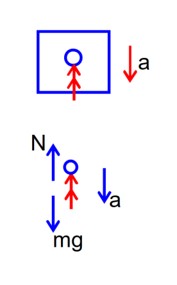
mg – N = ma
N = mg – ma
N decreases so, person experiences weight loss.
Upvote A composite parallel plate capacitor is made up to two different dielectric materials with different thickness (t1 and t2) as shown in figure. The two different dielectric materials are separated by a conducting foil F. The voltage of the conducing foil is ___________V.
A composite parallel plate capacitor is made up to two different dielectric materials with different thickness (t1 and t2) as shown in figure. The two different dielectric materials are separated by a conducting foil F. The voltage of the conducing foil is ___________V.
Capacitance of each capacitor
Equivalent capacitance
Upvote 27 similar drops of mercury are maintained at 10V each. All these spherical drops combine into a single big drop. The potential energy of the bigger drop is……… times that of a smaller drop.
27 similar drops of mercury are maintained at 10V each. All these spherical drops combine into a single big drop. The potential energy of the bigger drop is……… times that of a smaller drop.
With the help of conservation of volume, we can write
With the help of conservation of charge, we can write
Q = 27 q. (2)
Potential energy of single drop = U1 =
Potential energy of bigger drop =
Upvote The total charge on the system of capacitors connected in parallel is:
(Assume a battery of 20V is connected to the combination)
The total charge on the system of capacitors connected in parallel is:
(Assume a battery of 20V is connected to the combination)
= 1 + 2 + 4 + 3
Q = Ceq v
= (10 x 20)
Q = 200
Upvote Given below are two statements.
Statement I : Electric potential is constant within and at the surface of each conductor.
Statement II : Electric field just outside a charged conductor is perpendicular to the surface of the conductor at every point.
In the light of the above statements, choose the most appropriate answer from the options given below.
Given below are two statements.
Statement I : Electric potential is constant within and at the surface of each conductor.
Statement II : Electric field just outside a charged conductor is perpendicular to the surface of the conductor at every point.
In the light of the above statements, choose the most appropriate answer from the options given below.
‘A’ at static equilibrium, E (inside conductor) = 0
Upvote