

English
Get insights from 1.8k questions on English, answered by students, alumni, and experts. You may also ask and answer any question you like about English
Follow Ask QuestionQuestions
Discussions
Active Users
Followers
New answer posted
a year agoContributor-Level 10
Let us denote, the dozens of Bananas bought by A4's wife by a1, a2 by A3's wife, a3 by A2's wife and a4 by A1's wife. We prepare the table given below Bananas bought:
A1 = a4 A1's wife = a4
A2 = 2a3 A2's wife = a3
A3 = 3a2 A3's wife = a2
A4 = 4a1 A4's wife = a1
Where (a1, a2, a3, a4) is a rearrangement of (2, 3, 4, 5). Now, (a4 + 2a3 + 3a2 + 4a1) + (a4 + a3 + a2 + a1) = 44 4a1 + 3a2 + 2a3 + a4 = 44 – (2 + 3 + 4 + 5) = 30 …. (1) (Sum a1 + a2 +
New answer posted
a year ago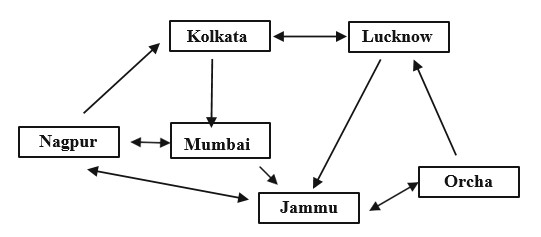
Contributor-Level 10
Following are the possible ways from city Mumbai to city Lucknow.
I. Mumbai – Nagpur – Kolkata –Lucknow
II. Mumbai – Jammu – Orcha – Lucknow
III. Mumbai – Nagpur – Jammu – Orcha – Lucknow
The least possible number of cities is two.
New answer posted
a year agoContributor-Level 10
A person can start and return the same city while passing through every city.
So, According to the given data option d is correct
New answer posted
a year agoContributor-Level 10
The following are the possible ways:
I. Kolkata – Mumbai – Nagpur
II. Kolkata – Lucknow – Jammu – Nagpur – Mumbai
There are two possible ways.
New answer posted
a year agoContributor-Level 10
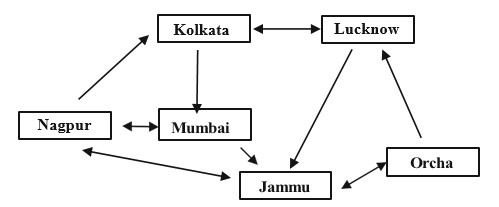
The following are the possible ways.
I. Nagpur – Kolkata – Lucknow
II. Nagpur – Kolkata – Mumbai – Jammu – Orcha – Lucknow
III. Nagpur – Mumbai – Jammu – Orcha – Lucknow
IV. Nagpur – Jammu – Orcha – Lucknow
There are four possible ways.
New answer posted
a year agoContributor-Level 10
Since Task T1 does not have either the first or last Task on Tuesday Task T1 must have the first or last Task on Monday. So, option (a) or option (b) is true but neither one must be true.
On Tuesday since Task T3 is first Task T7 must be second but Task T2 cannot follow Task T7. So Task T2 must have been done on Monday, hence (c) is eliminated. Since Task T4 has to be done on Tuesday Task T6 must have been done on Monday.
New answer posted
a year agoContributor-Level 10
Since Task T1, T4 and T5 has to be done on Monday. Therefore Task T2, T3, T6, T7 are to be done on Tuesday. Task T3 will be the first Task.
Task T7 must be the second Task according to the condition.
Task T6 must be the third Task and Task T2 will be the last Task according to the condition.
Taking an Exam? Selecting a College?
Get authentic answers from experts, students and alumni that you won't find anywhere else
Sign Up on ShikshaOn Shiksha, get access to
- 67k Colleges
- 1.2k Exams
- 719k Reviews
- 1850k Answers