Kirchhoffs Law
Get insights from 5 questions on Kirchhoffs Law, answered by students, alumni, and experts. You may also ask and answer any question you like about Kirchhoffs Law
- 5
Questions
- 0
Discussions
- 0
Active Users
- 0
Followers
Have a question about Kirchhoffs Law? Ask our experts
Keep it short & simple. Type complete word. Avoid abusive language.
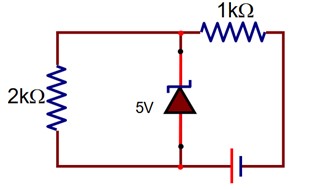
In connection with the circuit drawn below, the value of current flowing through 2 resistor is________ × 10-4A.
Potential difference across 2k
Where can I get the Current Electricity Class 12 important questions?
If you want the Current Electricity Class 12 important questions, then check the Class 12 Physics previous year question paper pdf. Also, focusing on the Class 12 Physics past 5 years of exam questions to identify the current electricity class 12 important questions. Well, we have framed all the imp
Why should I practice NCERT Solutions for Class 12 Physics Chapter 3?
Class 12 Physics Chapter 3 Current Electricity is important for the board exam. The weightage of the chapter is 8-10%. When you practice the Current Electricity class 12 NCERT solutions, you get an overview of your preparation. If you are lacking in any concept, then it helps to build the conceptual
What are the important topics covered in Class 12 Physics Chapter 3 solutions?
The topics focused on while preparing the Current Electricity NCERT solutions are:
Ohm's law
Drift velocity
Resistivity vs temperature
Combination of cells
Kirchhoff's rules and
Wheatstone bridge
In the circuit, given in the figure currents in different branches and value of one resistor are shown. Then potential at point B with respect to the point A is:
Let us assume the potential at A = V_A = 0.
Now at junction C, according to KCL
i? + i? = i?
1 A + i? = 2 A
i? = 2 A
Now analyse potential along ACDB
V_A + 1 + i? (2) - 2 = V_B
0 + 1 + 2 (1) - 2 = V_B
V_B = 3 - 2
V_B = 1amp.