
Maths Statistics
Get insights from 55 questions on Maths Statistics, answered by students, alumni, and experts. You may also ask and answer any question you like about Maths Statistics
- 55
Questions
- 0
Discussions
- 0
Active Users
- 3
Followers
Have a question about Maths Statistics? Ask our experts
Keep it short & simple. Type complete word. Avoid abusive language.
If the variance of the following frequency distribution :
Class : 10 – 20 20 – 30 30 – 40
Frequency : 2 x 2
is 50, then x is equal to:
<!-- [if !supportLineBreakNewLine]-->
<!--[endif]-->
If the variance of the following frequency distribution :
Class : 10 – 20 20 – 30 30 – 40
Frequency : 2 x 2
is 50, then x is equal to:
<!-- [if !supportLineBreakNewLine]-->
<!--[endif]-->
x? = Σf? x? / Σf? = (10 + 15x + 50) / (4+x)
= (60+15x)/ (4+x) = 15
σ² = 50 = Σf? x? ²/Σf? - (x? )²
50 = (50+225x+1250)/ (4+x) - (15)²
50 = (1300+225x)/ (4+x) - 225
⇒ 275 (4+x) = 1300 + 225x
⇒ 50x = 200 ⇒ x = 4
 Upvote

The mean and variance of 8 observations are 10 and 13.5, respectively. If 6 of these observations are 5,7,10,12,14,15, then the absolute difference of the remaining two observations is:
<!-- [if !supportLineBreakNewLine]-->
<!--[endif]-->
The mean and variance of 8 observations are 10 and 13.5, respectively. If 6 of these observations are 5,7,10,12,14,15, then the absolute difference of the remaining two observations is:
<!-- [if !supportLineBreakNewLine]-->
<!--[endif]-->
x? = 10
⇒ x? = (63 + a + b)/8 = 10
⇒ a + b = 17
Since, variance is independent of origin.
So, we subtract 10 from each observation.
So, σ² = 13.5 = (79 + (a-10)² + (b-10)²)/8
⇒ a² + b² - 20 (a+b) = -171
⇒ a² + b² = 169
From (1) and (2) ; a = 12 and b = 5
Upvote Let xᵢ (1 ≤ i ≤ 10) be ten observations of a random variable x. If Σ(from i=1 to 10)(xᵢ – p) = 3 and Σ(from i=1 to 10)(xᵢ – p)² = 9 where 0 ≠ p ∈ R, then the standard deviation of these observations is:
Let xᵢ (1 ≤ i ≤ 10) be ten observations of a random variable x. If Σ(from i=1 to 10)(xᵢ – p) = 3 and Σ(from i=1 to 10)(xᵢ – p)² = 9 where 0 ≠ p ∈ R, then the standard deviation of these observations is:
S.D. = √ (∑? ¹? (x? -p)²/10) - (∑? ¹? (x? -p)/10)²
√9/10 - (3/10)² = √9/10 - 9/100
Upvote For the frequency distribution:
Variate (x): x₁, x₂, x₃.x₁₅
Frequency (f): f₁, f₂, f₃ . f₁₅
Where 0 < x₁ < x₂ < x₃ < … < x₁₅ = 10 and
Σ(i=1 to 15) fᵢ > 0, the standard deviation cannot be:
For the frequency distribution:
Variate (x): x₁, x₂, x₃.x₁₅
Frequency (f): f₁, f₂, f₃ . f₁₅
Where 0 < x₁ < x₂ < x₃ < … < x₁₅ = 10 and
Σ(i=1 to 15) fᵢ > 0, the standard deviation cannot be:
∴ σ² ≤ 1/4 (M - m)²
Where M and m are upper and lower bounds of values of any random variable.
∴ σ² < 1/4 (10 - 0)²
⇒ 0 < σ < 5
∴ σ ≠ 6
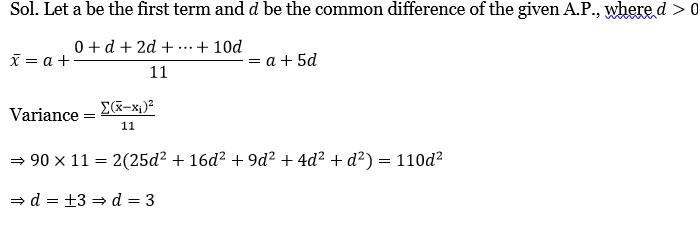
Upvote If the variance of the terms in an increasing A.P. b?,b?,b?,.,b? is 90, then the common difference of this A.P. is
If the variance of the terms in an increasing A.P. b?,b?,b?,.,b? is 90, then the common difference of this A.P. is
Let X={x∈N: 1≤x≤17} and Y={ax+b: x∈X and a,b∈R, a>0}. If mean and variance of elements of Y are 17 and 216 respectively then a+b is equal to
<!-- [if !supportLineBreakNewLine]-->
<!--[endif]-->
Let X={x∈N: 1≤x≤17} and Y={ax+b: x∈X and a,b∈R, a>0}. If mean and variance of elements of Y are 17 and 216 respectively then a+b is equal to
<!-- [if !supportLineBreakNewLine]-->
<!--[endif]-->
σ²=variance
µ=mean
σ² = Σ (x? -µ)²/n
µ=17
⇒ Σ (ax+b)/17 = 17
⇒ 9a+b=17
σ²=216
⇒ Σ (ax+b-17)²/17 = 216
⇒ Σa² (x-9)²/17 = 216
⇒ a² (81-18×9+3×35) = 216
⇒ a² (24) = 216 ⇒ a²=9 ⇒ a=3 (a>0)
⇒ From (1), b=-10
So, a+b=-7
Upvote Consider the following frequency distribution:
| Class: | 10-20 | 20-30 | 30-40 | 40-50 | 50-60 |
|---|---|---|---|---|---|
| Frequency: | α | 110 | 54 | 30 | β |
If the sum of all frequencies is 584 and median is 45, then |α - β| is equal to…….
Consider the following frequency distribution:
| Class: | 10-20 | 20-30 | 30-40 | 40-50 | 50-60 |
|---|---|---|---|---|---|
| Frequency: | α | 110 | 54 | 30 | β |
If the sum of all frequencies is 584 and median is 45, then |α - β| is equal to…….
α+110+54+30+β=584 ⇒ α+β=390.
Median=45. L=40, N=584, C=α+110+54=α+164, f=30, h=10.
45 = 40 + [ (292- (α+164)/30]×10 = 40 + (128-α)/3.
5 = (128-α)/3 ⇒ 15=128-α ⇒ α=113.
β = 390-113=277.
|α-β|=164.
Upvote